
What happened here
 1 / 3
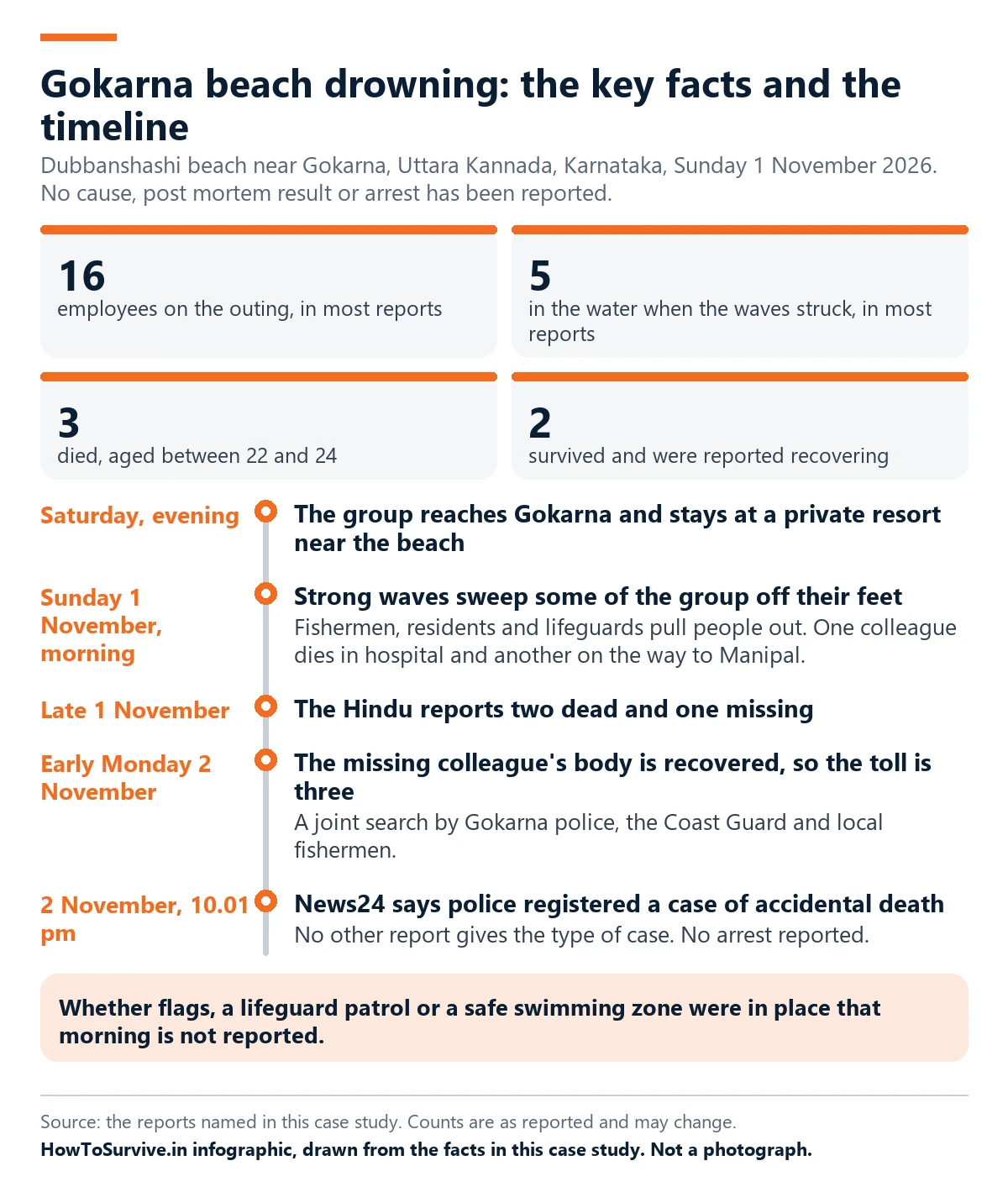
On the morning of Sunday, 1 November 2026, a group from a Bengaluru technology company, 16 employees on a weekend outing and staying at a private resort, went into the sea at Dubbanshashi beach near Gokarna in Uttara Kannada, Karnataka. Strong waves swept five of them (six in one report) off their feet. Fishermen, residents and lifeguards brought people ashore. One colleague died in hospital, another died on the way to a hospital in Manipal, and a third went missing and was found dead early on 2 November after a joint search by police, the Coast Guard and fishermen. Two colleagues survived and were reported to be recovering. The Hindu first reported two dead and one missing and then updated the toll to three; Daily Jagran, UNI and NewsX also say three. Gokarna police registered a case. Whether warning flags or lifeguards covered that stretch, and what caused the waves to be so dangerous, is not reported.
Quick answers
What happened at Gokarna beach on 1 November 2026?
A group of 16 employees of a Bengaluru technology company on a weekend outing went into the sea at Dubbanshashi beach near Gokarna on the morning of 1 November. Strong waves swept five of them off their feet and three died; two colleagues survived.
How many people died at Gokarna: two or three?
Three, as of 3 November 2026. The Hindu first reported two dead and one missing on the night of 1 November, then updated to three after the missing colleague's body was recovered early on 2 November. Reports published earlier or copied from the first report still show two.
Was there a lifeguard or a warning flag on the beach?
Two reports (Asianet Newsable, Mahanayaka) say the lifeguards who helped in the rescue were the resort's. No report says whether a public patrol covered the stretch or whether red flags or warning boards were in place.
Was it a rip current?
Not reported. Reports say only strong waves; police have not given a cause beyond that.
Has anyone been arrested?
We found no report of an arrest when we checked on 3 November. Gokarna police have registered a case and are investigating.
Is it safe to swim at Gokarna beaches?
Only in a lifeguard-patrolled area with the flags allowing it. The beaches are on the open Arabian Sea, and the sea can be dangerous even on a clear morning.
What should you do if someone is drowning in the sea?
Do not swim out to them. Call for the lifeguard, throw anything that floats, and call 112. If they are not breathing once out, start CPR and ask for an ambulance on 108.
How do you escape a rip current?
Stay calm, float, raise an arm to signal, and swim sideways parallel to the shore until you are out of the current, then angle back to the beach.
What happened
On the morning of Sunday, 1 November 2026, a group of employees from a Bengaluru technology company went into the sea at Dubbanshashi beach, near Gokarna in Uttara Kannada district, Karnataka. Strong waves swept some of them off their feet. Three of the group died. They were three young colleagues aged between 22 and 24, according to the reports we opened. Checked on 3 November 2026 against reports published up to that morning, and rechecked in the afternoon: no post-mortem result, cause or arrest has been reported.
The team had 16 members from an office in Bellandur. They had reached Gokarna on Saturday evening for a weekend outing and were staying at a private resort close to the beach. Most reports say five of them were in the water when the waves struck. Local fishermen, residents and lifeguards pulled people out. One colleague died in hospital after being brought ashore, and another died on the way to a hospital in Manipal. A third colleague went missing, and the body was recovered early on Monday, 2 November, after a joint search by Gokarna police, the Coast Guard and local fishermen (The Hindu). Two colleagues survived and were taken to the Gokarna Primary Health Centre, where they were reported to be recovering. We have not named the dead or the company.
Two dead or three? How the figures changed
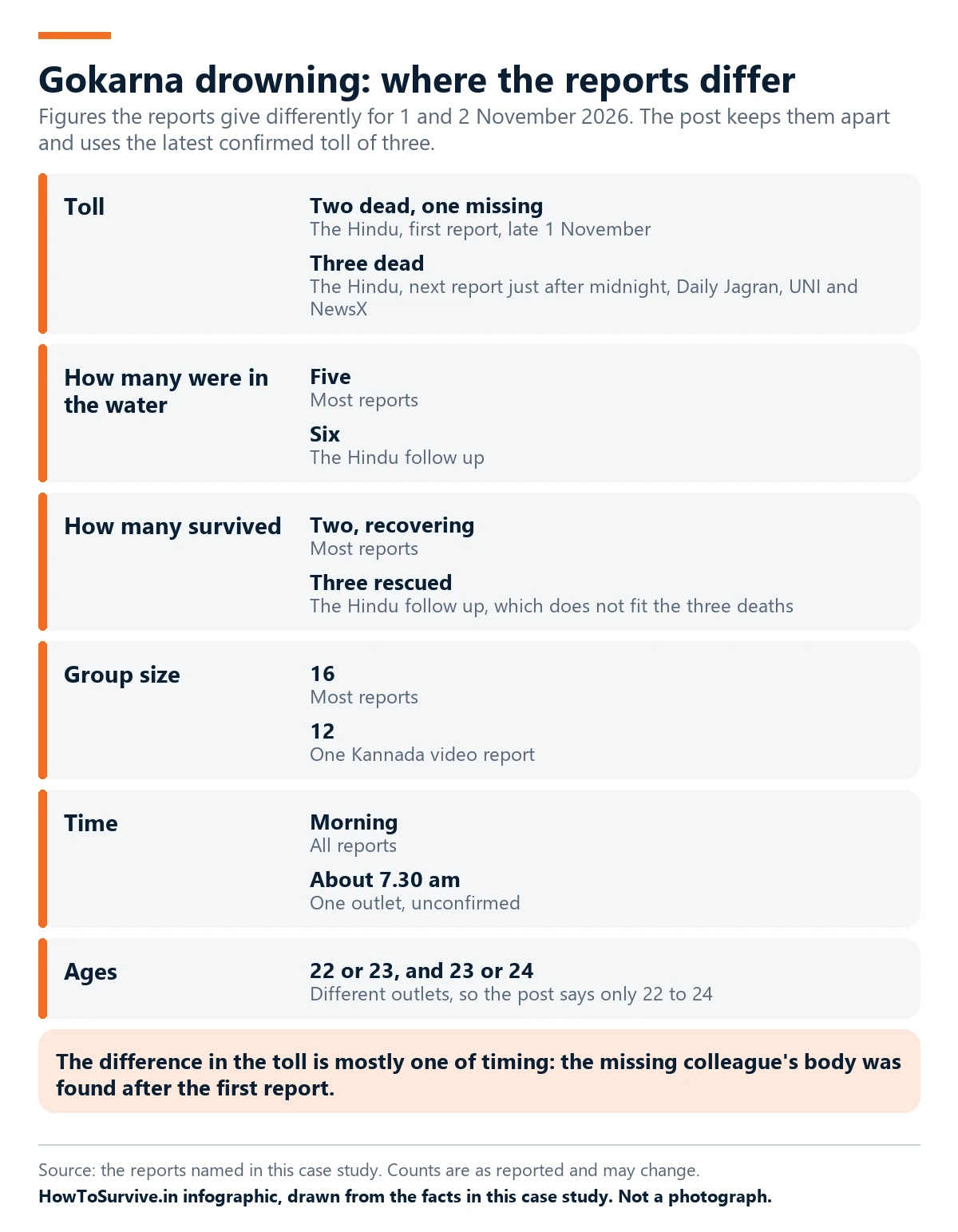
You may see different numbers online. The Hindu’s first report, published late on 1 November, said two had died and one was missing. Its next report, published just after midnight, said the toll had risen to three because the missing colleague’s body had been found. The Daily Jagran, UNI, NewsX and other outlets published after that and say three dead. So the difference is mostly one of timing, and we use three dead as the latest confirmed figure. Some early videos and posts still carry the older count.
Other details do not match across reports, and we have kept them apart rather than choose one:
- How many were in the water: five in most reports; six in The Hindu’s follow-up.
- How many survived: two in most reports. Asianet Newsable, News24 and Mahanayaka say rescuers brought four of the five swept away to the shore and one stayed missing; two of the four later died, which leaves two survivors and fits the three deaths. The Hindu’s follow-up, which names three people rescued, still does not fit, so we keep to the two reported as recovering.
- Who went to which hospital: reports differ on whether one person died on the spot or in a Gokarna hospital. Both agree that one more died on the way to Manipal.
- Time: “morning” in all reports; one outlet says about 7.30 am. We treat the exact time as unconfirmed.
- Group size: 16 in most reports; one Kannada video report says 12.
- Ages and hometowns are given differently by different outlets (22 or 23, 23 or 24), so we say only 22 to 24.
What police and officials have said
- Gokarna police visited the site and registered a case. An investigation into the circumstances is under way (Daily Jagran; fact.net.in; The Hindu). News24 (10.01 pm, 2 November) says Gokarna police registered a case of accidental death. No other report we opened gives the type of case or the sections, and no arrest has been reported.
- Police cautioned tourists against entering a rough sea and asked resort and homestay owners to take care of visitors’ safety on the coast.
- The bodies were taken to the Karwar Medical College mortuary (Daily Jagran; fact.net.in).
What is not known
- Whether red flags, warning boards or a marked safe swimming zone were in place on that stretch that morning. No report we opened says.
- Who was on lifeguard duty at that time and how far from the group. Asianet Newsable and Mahanayaka say the lifeguards who helped in the rescue were the resort’s. No report says whether a public patrol also covered the stretch or whether flags were up.
- Whether a rip current, a drop-off or a high-swell day was behind the waves. Reports say only “strong waves”.
- How many in the group could swim, and what briefing the team or the resort gave before they went into the sea.
- What the post-mortem and the police inquiry will find.
Sea-beach safety lessons
None of the points below is a finding about this resort, this beach or these colleagues. They are the general rules that lifeguards teach, and they apply to every group outing on the Indian coast.
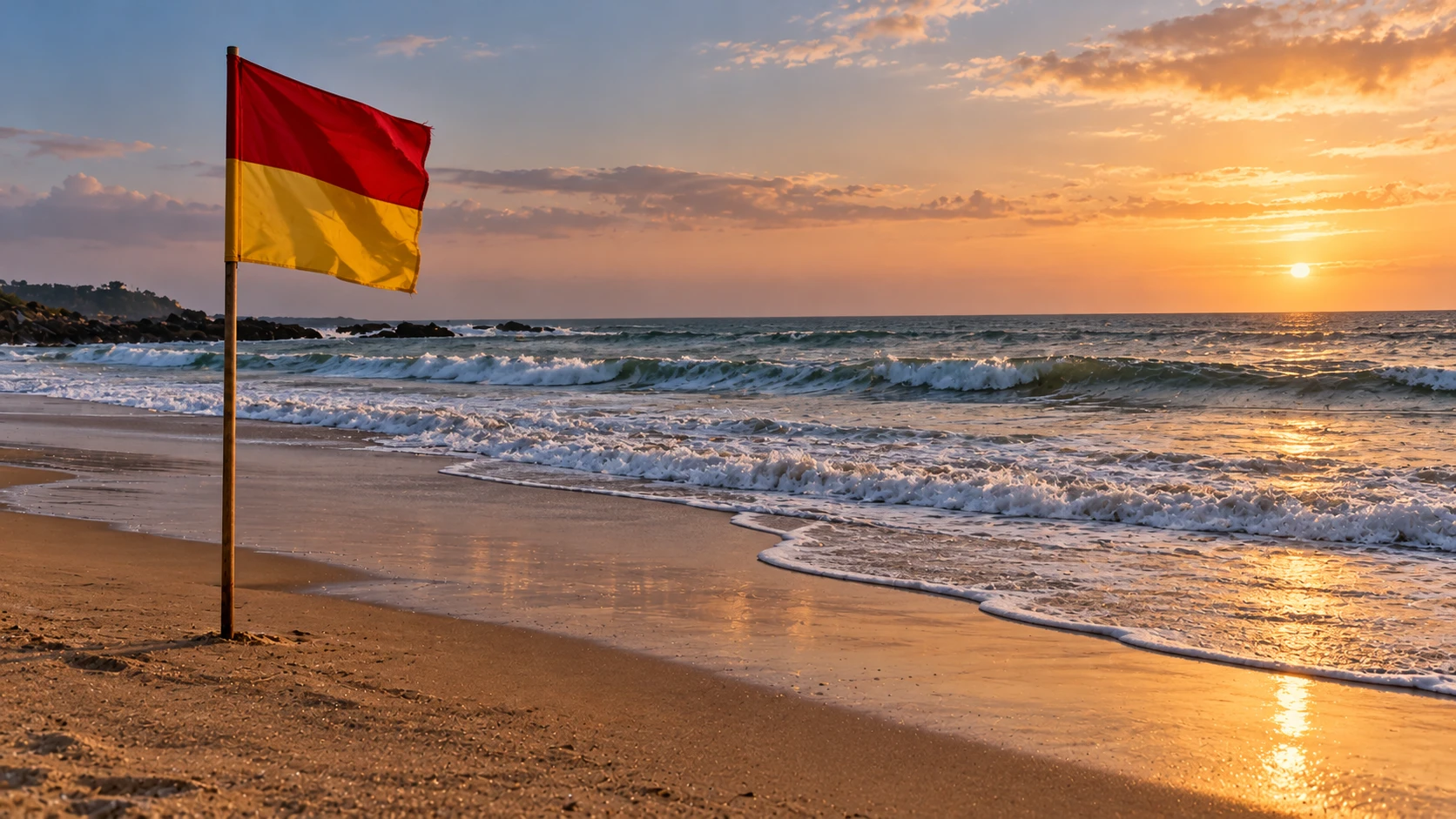
- Swim only where a lifeguard is on duty and the flags allow it. A red flag means stay out. Red and yellow flags mark the patrolled swimming area. If you see no flag and no lifeguard, assume the sea is not safe for swimming, however calm it looks from the sand.
- Beaches in Uttara Kannada are open sea. The bottom can drop away within a few steps, and waves arrive in sets, so a calm minute can be followed by a large wave. Stay in water no deeper than your knees, and keep your back away from the waves.
- Know a rip current. It is a narrow stream of water running away from the shore, often a darker, calmer-looking gap between breaking waves. Do not swim against it. Float, raise an arm to call for help, and swim sideways, parallel to the shore, until you are out of the stream. A short explainer is in the video panel.
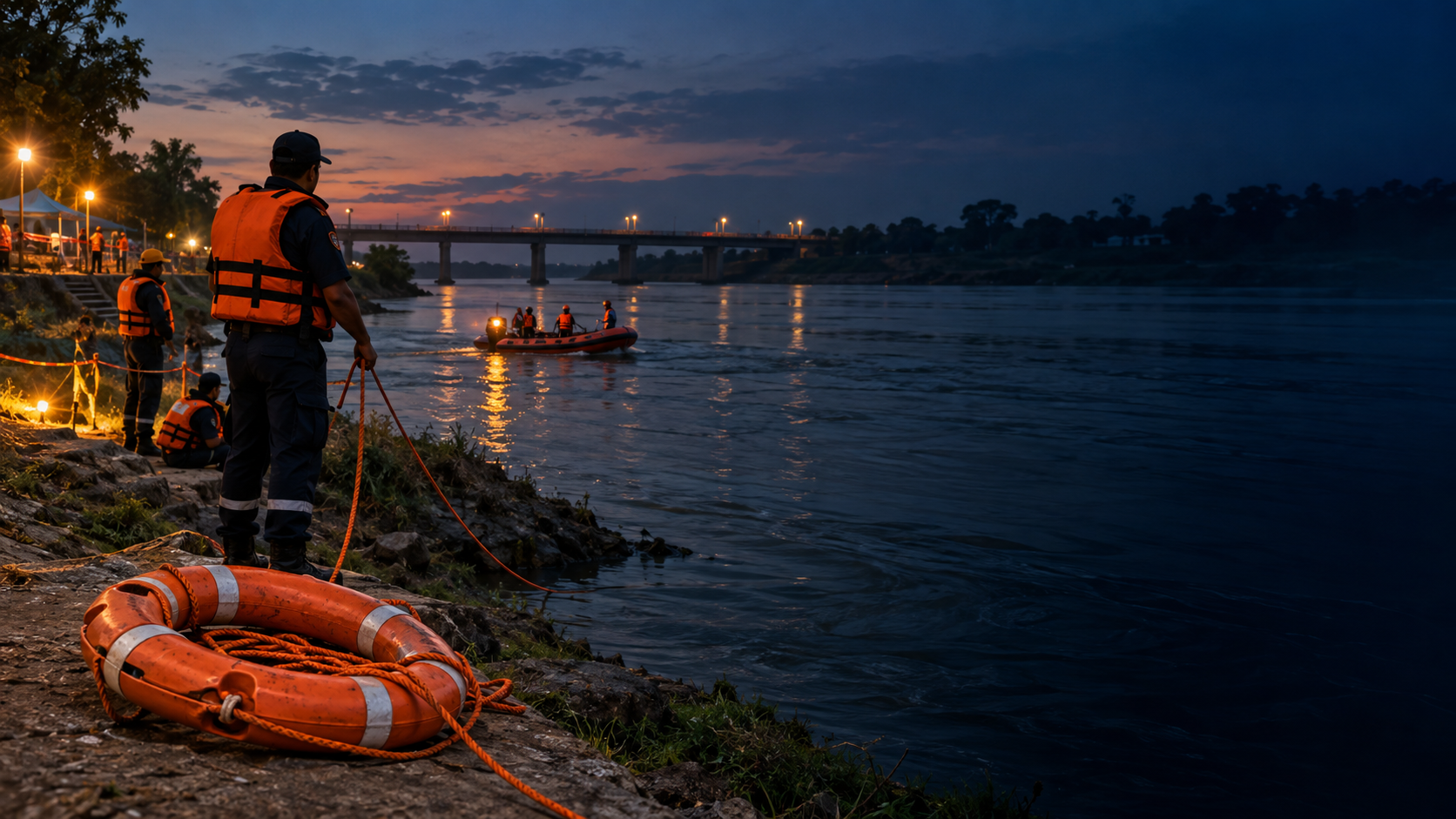
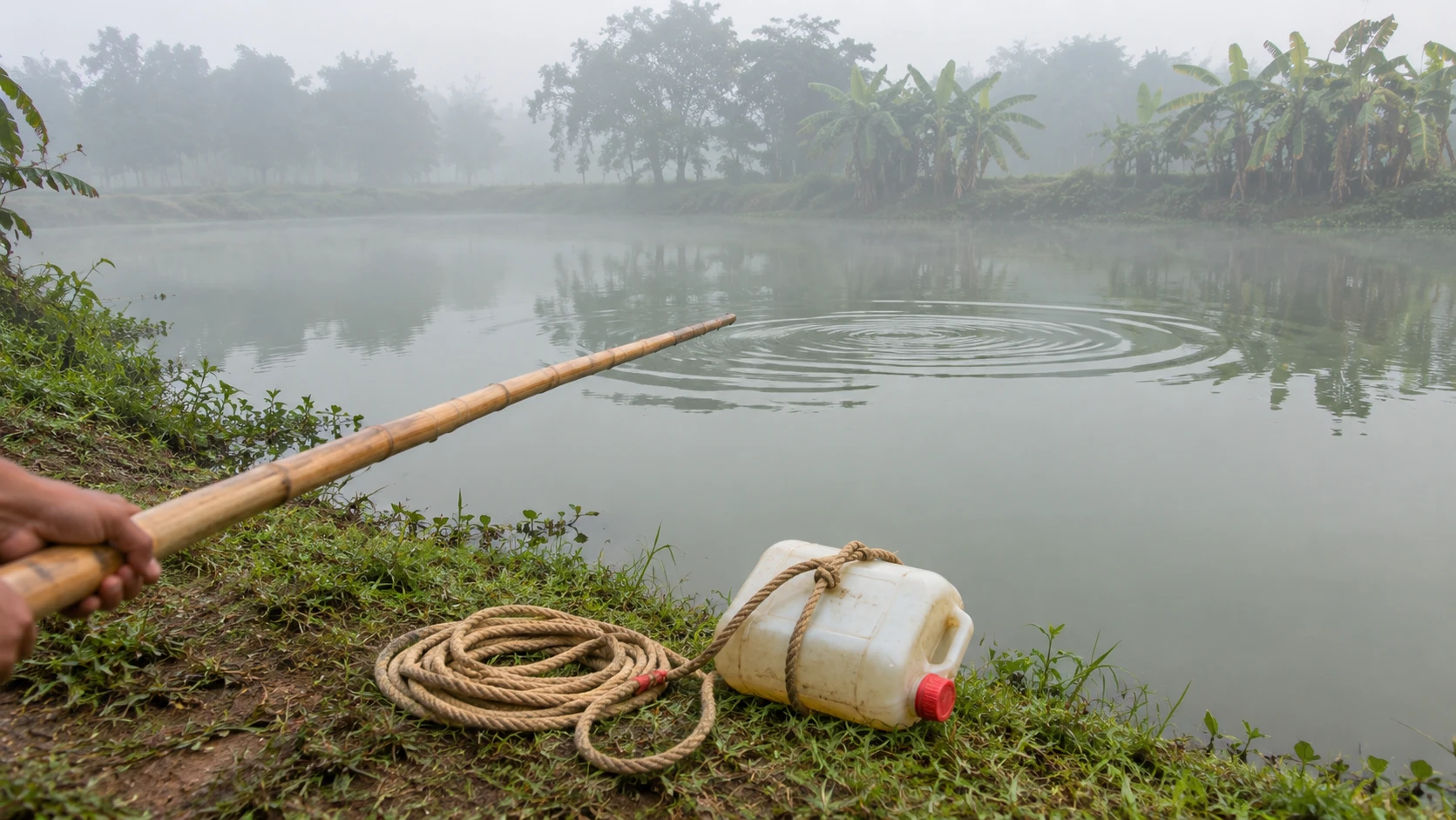
- If a friend is in trouble, do not swim out to them. Shout for the lifeguard or local fishermen, throw anything that floats (a cooler box, a bottle, a lifebuoy) and call 112. Our guide, “How to Save a Drowning Person Without Risking Your Own Life”, is linked under related reading. Rescuers drowning after the first victim is a repeated pattern, as in the Sai River immersion drowning near Lucknow.
- Do not go in after a long journey, a late night or alcohol. Tiredness and drink slow your reactions and judgement. Non-swimmers and weak swimmers should stay on the sand.
- Do not pose for photos or reels at the waterline. See our guide on reels and selfies near waves and water.
For employers, team leaders and resorts
- Brief the group before anyone enters the water. Ask who cannot swim, point out the flags and the lifeguard post, and agree a rule: only in the patrolled zone, only in groups of two or more, never alone and never at dawn or after dark.
- Name one sober person as the watcher who stays on the sand with a phone and a float, and does a head count every few minutes.
- Ask the resort what its beach arrangement is: is there a lifeguard, are there flags, who is called in an emergency, how far is the nearest hospital with an emergency department. If there is no safe swimming area, choose a pool for the activity.
- Keep emergency numbers in the group chat: 112 for emergencies and 108 for an ambulance. Our guide to emergency numbers in India has the full list.
- Know basic first aid. After a rescue, a person who is not breathing needs CPR at once. See basic first aid, including CPR.
For another recent beach case where visitors were swept away, see the Himchhari beach tragedy at Cox’s Bazar.
More on Tadadi (Gokarna area): see our Tadadi (Gokarna area) fire and emergency safety guide for fire brigade numbers, every fire station and the local risks to know.
- The group of 16 reaches Gokarna and checks in at a private resort near Dubbanshashi beach
- Some of the group enter the sea; strong waves sweep five (six in one report) off their feet
- Fishermen, residents and lifeguards bring people ashore; two survivors are taken to Gokarna Primary Health Centre; one colleague dies in hospital and another dies on the way to a hospital in Manipal
- The Hindu reports two dead and one missing
- The missing colleague's body is recovered after a joint search by Gokarna police, the Coast Guard and local fishermen
- Gokarna police register a case; bodies taken to Karwar Medical College mortuary; police caution tourists and ask resort and homestay owners to take care
- The Hindu updates the toll to three
- No report found on the cause, the flag or lifeguard arrangement, the sections of the case, or any arrest
- Recheck: no post-mortem result, cause or arrest reported; two reports say resort lifeguards joined the rescue; one report calls the police case accidental death
Why consequences escalated
- Three employees of a Bengaluru technology company died after strong waves swept a group off their feet at Dubbanshashi beach near Gokarna on 1 November 2026; two colleagues survived.
- The toll rose from two dead and one missing to three dead when the missing colleague's body was recovered on 2 November; the latest confirmed figure is three.
- Gokarna police registered a case and are investigating; no cause beyond strong waves has been reported.
- Reports do not say whether flags, warning boards or a patrolled swimming zone were in place; two say the lifeguards who helped were the resort's.
- No finding of fault against any person or the resort has been made, and none is stated here.
Failures and risk multipliers
- No finding of fault has been made, and none is stated here.
- A group went into open surf on a morning when no report says a flag or lifeguard zone was in place; that is a question for the inquiry, not a conclusion.
- Reports of five people in the water do not say how many could swim.
- In open-sea drownings, other people often enter the water to help and are put at risk; the safer step is to call lifeguards and throw a float.
- Figures in early posts and videos (two dead, one missing) were overtaken by the later count of three dead.
Actions that reduce risk
- Swim only where a lifeguard is on duty and the flags allow it; treat a beach with no flag and no lifeguard as unsafe for swimming.
- Stay no deeper than your knees in open surf, and keep your back away from the waves.
- If caught in a rip current, do not swim against it: float, raise an arm and swim sideways, parallel to the shore.
- If someone is drowning, shout for the lifeguard, throw a float and call 112; do not swim out to them.
- Team leaders and employers should brief the group, ask who cannot swim, set swimming rules and name a sober person to watch from the sand.
- Resorts should state clearly what lifeguard and flag arrangement exists and where the safe zone is.

Leave a comment