
⏱️ Golden Hour – How to Act in the First 5 Minutes of Any Emergency
What needs attention
- The article topic must be linked to the actual occupancy and hazard
- Prevention and early warning provide more safety margin than last-second intervention
- Equipment is effective only when correctly selected, accessible and maintained
- People need short practised actions and a clear decision to stop and escape
- Children, visitors and people needing assistance require explicit planning
- Records, drills and inspections matter only when defects are corrected
Controls that reduce risk
- Complete a task- and site-specific hazard assessment
- Verify applicable Indian, state and local requirements
- Use competent inspection for installed systems and specialist hazards
- Keep alarms, exits, signs and emergency access usable
- Train intended users and practise evacuation
- Record defects with an owner and completion date
- Review the plan after changes, incidents or near misses
Understand and apply the guidance
🔴 Truth Drop
In India, one life is lost every 2 minutes to emergencies — fire, accidents, cardiac arrest, or trauma.
Yet, over 60% of these deaths are preventable if help arrives or action starts in the Golden Hour — the first 60 minutes after an injury or medical crisis.
The first 5 minutes are the most critical.
Your actions — not the ambulance — decide survival.
“The clock starts when tragedy strikes. The question is: will you freeze, or act?”
📖 What is the Golden Hour?
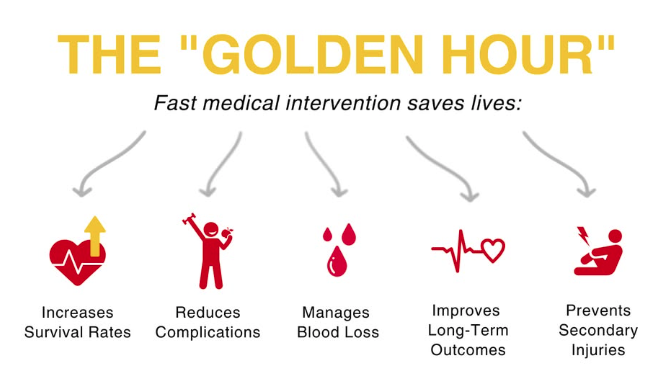
The Golden Hour is the brief period after an accident, injury, or health emergency when prompt, simple help can prevent death or permanent disability.
During this time, the human body still fights — but it needs support: oxygen, blood flow, or simply space to breathe.
Every second you wait, survival chances fall by 7–10%.
🧩 Common Golden Hour Emergencies
| Category | Common Scenarios | First 5-Minute Priority |
|---|---|---|
| Road Accident | Collision, fall, bleeding | Stop bleeding, ensure airway, call 108 |
| Fire / Burn | Flames, explosion | Extinguish, cool burns, remove tight clothing |
| Heart Attack / Cardiac Arrest | Chest pain, unconsciousness | CPR, AED (if available), call 108 |
| Stroke | Facial droop, speech slur | FAST test, keep head elevated, don’t give food |
| Electrocution | Electric shock | Turn off source, check breathing, no water use |
| Drowning / Asphyxia | Near water, suffocation | CPR + recovery position, clear airway |
| Poisoning / Gas Leak | Chemical / smoke | Move to fresh air, call emergency help |
⚙️ The 5-Minute Life Chain
1️⃣ Check Safety (10 seconds)
– Don’t rush blindly.
– Ensure no live wires, fire, or gas.
– Approach only when safe.
2️⃣ Check Response (10 seconds)
– Tap the shoulder: “Are you okay?”
– No response → shout for help.
3️⃣ Call for Help (30 seconds)
– Dial 108 (ambulance) or 112 (emergency).
– Share exact location, injury type, number of victims.
– Assign someone to guide responders.
4️⃣ Airway, Breathing, Circulation (ABC)
- A: Open airway (tilt head, lift chin)
- B: Look, listen, feel for breathing (10 sec)
- C: If no pulse → Start CPR immediately.
5️⃣ Control Bleeding
– Apply firm pressure with cloth.
– Elevate the wound above heart level.
6️⃣ Stabilize the Victim
– Don’t move unnecessarily (possible spine injury).
– Keep them warm and calm.
7️⃣ Keep Communication Active
– Update emergency operator every minute if situation changes.
❤️ CPR (Cardio Pulmonary Resuscitation) – The 3-Step Guide
- Position: Lay person flat on back.
- Compress: Place palms center of chest → push hard and fast (100–120/min).
- Rescue Breaths: If trained, 2 breaths after every 30 compressions.
👉 Continue till medical help or movement seen.
(Remember: It’s better to do imperfect CPR than do nothing.)
📦 What to Keep in Every Car / Workplace / Home
- ✅ First Aid Kit (bandage, antiseptic, gloves, scissors)
- ✅ Fire extinguisher / LSB (Life Safety Blanket)
- ✅ Emergency numbers (108 / 101 / 112 / nearest hospital)
- ✅ Water bottle / glucose / torchlight / small towel
- ✅ Reflective triangle / whistle / power bank
🧠 Golden Hour Myths vs Facts
| Myth | Truth |
|---|---|
| “Wait for ambulance — don’t touch.” | ❌ Wrong. Basic help before arrival saves lives. |
| “Water can help burn wounds.” | ✅ True — cool with clean water for 10 min. |
| “CPR can break ribs.” | ✅ Sometimes — but it saves a heart. |
| “Covering fire victim tightly helps.” | ❌ No — use light cotton cloth, not blanket or wool. |
| “Only doctors can save lives.” | ❌ Anyone trained in basics can save a life. |
🧭 Remember: The “Survival Pyramid”
1️⃣ You (Bystander) — Immediate action saves life.
2️⃣ Emergency System (108/112) — Response within 15 min.
3️⃣ Hospital — Stabilization and recovery.
If step 1 fails — step 3 never happens.
📢 Systemic Lessons
India must:
- Train at least 1 crore citizens in CPR and first aid under national missions.
- Equip all schools, malls, and offices with AEDs (defibrillators).
- Strengthen 108 emergency network and digital tracking (via Bharat101).
- Launch a national “Golden Hour Awareness Week.”
📣 Call to Action
🚨 Don’t wait to be a hero — just be human.
👉 Learn CPR, save one life — you’ll live twice.
The difference between death and survival is often your reaction time.
📎 References
- NDMA “Emergency Medical Response Guidelines,” 2024
- AIIMS Trauma Care Division “Golden Hour Survival Data,” 2025
- WHO “Prehospital Emergency Care in Low & Middle-Income Nations,” 2023
- VFF India “Public Emergency Response Study,” 2024
🔚 Closing Line
Time doesn’t stop during emergencies — but you can stop the loss of life.
This is why we built HowToSurvive.in — to teach every citizen to act in the first five minutes, not regret in the last.
Common unsafe practices
- Relying on equipment without a hazard assessment
- Blocking or compromising escape routes
- Delaying the alarm or emergency call
- Attempting a response beyond training or safe conditions
- Re-entering before authorised clearance
- Treating a checklist as a substitute for competent inspection