
🏃♂️ Escape Planning for Families – Practical Tips
What needs attention
- The article topic must be linked to the actual occupancy and hazard
- Prevention and early warning provide more safety margin than last-second intervention
- Equipment is effective only when correctly selected, accessible and maintained
- People need short practised actions and a clear decision to stop and escape
- Children, visitors and people needing assistance require explicit planning
- Records, drills and inspections matter only when defects are corrected
Controls that reduce risk
- Complete a task- and site-specific hazard assessment
- Verify applicable Indian, state and local requirements
- Use competent inspection for installed systems and specialist hazards
- Keep alarms, exits, signs and emergency access usable
- Train intended users and practise evacuation
- Record defects with an owner and completion date
- Review the plan after changes, incidents or near misses
Understand and apply the guidance
🔴 Truth Drop
In 90% of home fire or disaster deaths, victims were trapped inside because they didn’t know how to escape — not because there wasn’t a way.
(Source: NDMA Home Safety Survey, 2024)
“When disaster strikes, panic kills faster than flames.”
Every family — in a house, apartment, or village home — needs an escape plan that’s simple, practiced, and clear to everyone, including children and elders.
📖 Why an Escape Plan Saves Lives
During fire, earthquake, flood, or toxic gas leaks — visibility drops, panic rises, and decisions freeze.
A well-rehearsed escape plan gives direction in chaos.
It turns panic into motion — and fear into focus.
Goal:
- Evacuate every family member in under 2 minutes.
- Reach a safe point outside the building.
- Account for everyone.
🧩 Step-by-Step Family Escape Plan
1️⃣ Know Your Exits
- Identify two escape routes from every room.
- Ensure doors and windows open freely, not jammed or blocked.
- If living in a high-rise, know your stairway location (never elevator).
💡 Tip: In dark or smoky conditions, stay low and crawl toward the exit — air near the floor is clearer.
2️⃣ Assign Roles
Every second counts — assign who helps whom.
| Role | Responsibility |
|---|---|
| Parent / Adult 1 | Grabs emergency kit, leads evacuation |
| Adult 2 | Helps children / elders |
| Older Child | Assists younger sibling |
| Family Head | Counts all members at assembly point |
🚫 Never go back inside once out — even for valuables or pets.
3️⃣ Create a Safe Assembly Point
- Choose a visible, open area (e.g., front gate, nearby landmark).
- It must be away from buildings, wires, and vehicles.
- Mark this place clearly and teach every family member to go there automatically.
4️⃣ Keep Exits Clear
- No furniture, storage boxes, or decorations blocking main routes.
- Don’t lock safety grills or balcony gates from the outside.
- Keep keys near doors or windows (not inside drawers).
A locked gate during fire is not safety — it’s a trap.
5️⃣ Nighttime Preparedness
- Keep a torch, charged phone, and whistle near your bed.
- Pre-decide who will carry infants, elders, or disabled members.
- Install smoke alarms in bedrooms, corridors, and kitchens.
(Half of home fire deaths happen between midnight and 6 a.m.)
6️⃣ Plan for Special Situations
| Scenario | Key Tip |
|---|---|
| Fire | Evacuate downward, stay low, never use lift |
| Earthquake | Wait for tremor to stop → exit using stairs |
| Flood | Move upward, shut power, carry ID & water |
| Gas Leak | No switches, no flames, open doors, exit quickly |
| Building Collapse Risk | Move to open ground or park, avoid walls |
🧠 Practice Makes Survival
Conduct escape drills every 3 months at home — make it fun but serious.
Checklist for each drill:
✅ Time the full evacuation (target < 2 minutes)
✅ Check if all exits worked
✅ Verify every member reached assembly point
✅ Discuss what went right / wrong
“What you rehearse in calm, you’ll remember in chaos.”
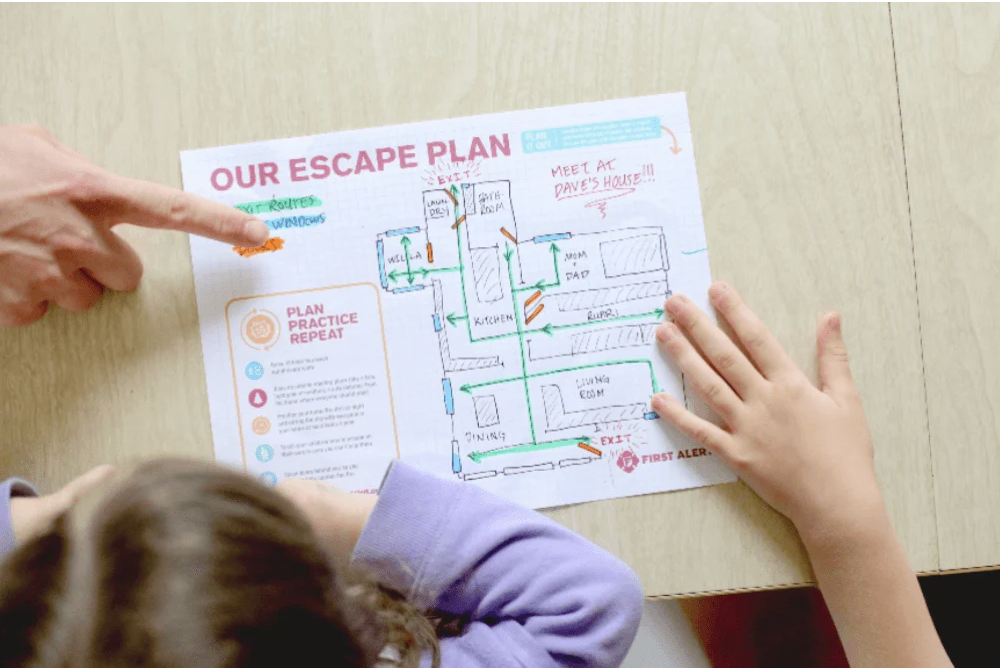
🧭 Family Escape Map
Create a simple floor plan on paper:
- Mark exits, stairs, and safe point.
- Color-code main (red) and alternate (green) routes.
- Paste it in kitchen and hallway at child’s eye level.
(Use glow tape on routes for night visibility.)
⚙️ Prepare Building-Wide Safety
If you live in an apartment or society:
✅ Attend or demand fire & evacuation drills.
✅ Ensure staircases and exits are not locked or cluttered.
✅ Check emergency lights and exit signs monthly.
✅ Keep emergency numbers visible in lobby and elevators.
🧩 Common Mistakes to Avoid
❌ Using lifts during fires or earthquakes.
❌ Locking balcony grills from outside.
❌ No alternate exit known.
❌ Ignoring alarms thinking it’s a “drill.”
❌ Returning inside for valuables or pets.
📢 Systemic Lessons
India must:
- Make escape planning education mandatory in schools & residential buildings.
- Enforce bi-annual evacuation drills in all apartments and societies.
- Promote smoke alarm installation through subsidies.
- Ensure NDMA safety posters are displayed in all public housing projects.
📣 Call to Action
🚨 Safety begins at home — literally.
👉 Sit with your family tonight, draw your escape map, and practice it.
One plan, once prepared, can save every life you love.
📎 References
- NDMA “Residential Building Fire Safety Guidelines,” 2024
- NDRF “Community Evacuation Practices,” 2023
- Indian Fire Services Data Portal 2024
- WHO “Family Disaster Preparedness Recommendations,” 2023
🔚 Closing Line
The safest family is not the luckiest — it’s the one that’s prepared.
This is why we built HowToSurvive.in — to make every household a place of awareness, readiness, and life protection.
Common unsafe practices
- Relying on equipment without a hazard assessment
- Blocking or compromising escape routes
- Delaying the alarm or emergency call
- Attempting a response beyond training or safe conditions
- Re-entering before authorised clearance
- Treating a checklist as a substitute for competent inspection