
🏛️ State Disaster Management Authorities (SDMAs) – Status Check (2019–2025)
What needs attention
- The article topic must be linked to the actual occupancy and hazard
- Prevention and early warning provide more safety margin than last-second intervention
- Equipment is effective only when correctly selected, accessible and maintained
- People need short practised actions and a clear decision to stop and escape
- Children, visitors and people needing assistance require explicit planning
- Records, drills and inspections matter only when defects are corrected
Controls that reduce risk
- Complete a task- and site-specific hazard assessment
- Verify applicable Indian, state and local requirements
- Use competent inspection for installed systems and specialist hazards
- Keep alarms, exits, signs and emergency access usable
- Train intended users and practise evacuation
- Record defects with an owner and completion date
- Review the plan after changes, incidents or near misses
Understand and apply the guidance
🔴 Truth Drop
Every Indian state has a Disaster Management Authority — but only 12 out of 28 function with full capacity and funding as per the NDMA Act, 2005.
(Source: NDMA Governance Review, 2025)
“We don’t need new laws; we need living systems that act before disaster, not after.”
📖 Why This Matters
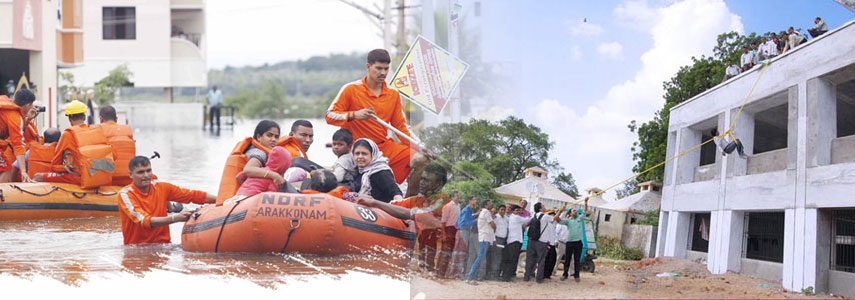
Each SDMA is responsible for local planning, early warning, coordination with NDRF, and post-disaster recovery.
Yet most are administrative shells — existing only on paper, lacking manpower, data systems, or budgets.
When governance sleeps, even small accidents become national tragedies.
📊 SDMA Functionality Overview (as of 2025)
| Category | States | % of Total | Key Observation |
|---|---|---|---|
| Fully Functional (Active Units, EOCs, Budget >₹100 Cr) | 12 | 43% | Eg. Gujarat, Odisha, Kerala, Tamil Nadu, Maharashtra |
| Partially Functional (Limited Ops or No Training Cell) | 10 | 36% | Eg. UP, MP, Haryana, Rajasthan, WB |
| Dormant (Inactive / No Dedicated Teams or Funds) | 6 | 21% | Eg. Bihar, Jharkhand, Tripura, Nagaland, Manipur, Sikkim |
(Sources: NDMA “State Preparedness Audit Report,” 2025; CAG Audit Review 2024)
📈 Key Insights:
- Only 7 states hold annual disaster drills at district level.
- 60% of SDMAs do not maintain updated Disaster Management Plans (DMPs).
- Average staff strength utilization: 52%.
- Funds released ≠ funds used — ₹3,200 crore unspent as of FY2024–25.
🧠 Case Study: Odisha – A Model of Preparedness
- System: Fully functional SDMA with 24×7 EOC, community volunteers (ODRAF).
- Results: Cyclone “Fani” (2019) – 1.2 million evacuated, minimal fatalities.
- Why It Works: Clear command structure, early alerts, and citizen participation.
- Lesson: A strong state system reduces disaster into disruption — not devastation.
⚙️ Common Weaknesses Across States
1️⃣ No real-time coordination between SDMAs, DDMAs, and local fire/health units.
2️⃣ Dependence on central relief, instead of proactive state-level mitigation.
3️⃣ Lack of GIS-based risk mapping and data analytics.
4️⃣ Insufficient manpower — many states operate with 10–15 officers only.
5️⃣ No public awareness outreach programs.
🧭 What an Effective SDMA Should Have
✅ Functional State Emergency Operations Center (SEOC) – 24×7 control room.
✅ District-level DDMAs with real-time communication channels.
✅ Trained personnel in fire, flood, chemical, and earthquake response.
✅ Regular mock drills for schools, industries, and civic bodies.
✅ Community volunteers trained under SDRF & NDMA programs.
💡 Model States to Learn From
🌊 Odisha: Early warning & zero-fatality cyclone management.
🔥 Gujarat: GIS-integrated disaster control system linked to fire, police, and health.
🏞️ Kerala: Post-flood recovery framework using local panchayat leadership.
🏗️ Tamil Nadu: Strong industrial risk audit programs.
🚁 Maharashtra: Smart City EOC integration for Mumbai & Pune.
🧩 Lagging States (NDMA Findings 2025)
| State | Problem Identified | Audit Remark |
|---|---|---|
| Bihar | No dedicated training center | “Reactive, not preventive” |
| Jharkhand | Poor coordination with district units | “No updated plan since 2018” |
| Uttar Pradesh | No GIS mapping | “Largest population, least readiness” |
| Rajasthan | Delayed fund utilization | “EOC inactive since 2022” |
| Nagaland | No SDRF training held | “Paper-only existence” |
📢 Systemic Lessons
India must:
- Enforce annual third-party SDMA audits under NDMA oversight.
- Mandate citizen representation in each SDMA advisory committee.
- Create national performance dashboard (publicly viewable).
- Shift from post-disaster relief to pre-disaster prevention planning.
- Link fund release to measurable readiness indicators.
📣 Call to Action
🚨 Check if your state SDMA has an active website, helpline, or plan — most don’t.
👉 Ask your district administration: “When was our last disaster drill?”
Awareness begins where governance ends — with us.
📎 References
- NDMA “State Preparedness Audit Report,” 2025
- CAG “State Disaster Fund Utilization Review,” 2024
- Ministry of Home Affairs “SDMA Progress Evaluation,” 2023
- NITI Aayog “Governance in Disaster Risk Reduction,” 2024
🔚 Closing Line
Disaster management isn’t about response — it’s about readiness.
This is why we built HowToSurvive.in — to turn every state from a victim of disaster into a model of prevention.
Common unsafe practices
- Relying on equipment without a hazard assessment
- Blocking or compromising escape routes
- Delaying the alarm or emergency call
- Attempting a response beyond training or safe conditions
- Re-entering before authorised clearance
- Treating a checklist as a substitute for competent inspection