
🔥 Do Sprinklers Make Fire Worse? – Myth vs Fact
What needs attention
- The article topic must be linked to the actual occupancy and hazard
- Prevention and early warning provide more safety margin than last-second intervention
- Equipment is effective only when correctly selected, accessible and maintained
- People need short practised actions and a clear decision to stop and escape
- Children, visitors and people needing assistance require explicit planning
- Records, drills and inspections matter only when defects are corrected
Controls that reduce risk
- Complete a task- and site-specific hazard assessment
- Verify applicable Indian, state and local requirements
- Use competent inspection for installed systems and specialist hazards
- Keep alarms, exits, signs and emergency access usable
- Train intended users and practise evacuation
- Record defects with an owner and completion date
- Review the plan after changes, incidents or near misses
Understand and apply the guidance
🔴 Truth Drop
In 95% of building fires where sprinklers were installed and functional, flames were controlled or fully extinguished before firefighters arrived.
(Source: NFPA, NDMA India Fire Data Review 2024)
⚠️ The Myth
“Sprinklers spread the fire.”
“Sprinklers will flood my property.”
“Only big buildings need sprinklers.”
These are dangerous misconceptions that continue to delay fire system installations across India — and cost lives.
✅ The Fact
Sprinklers don’t start all at once like in movies.
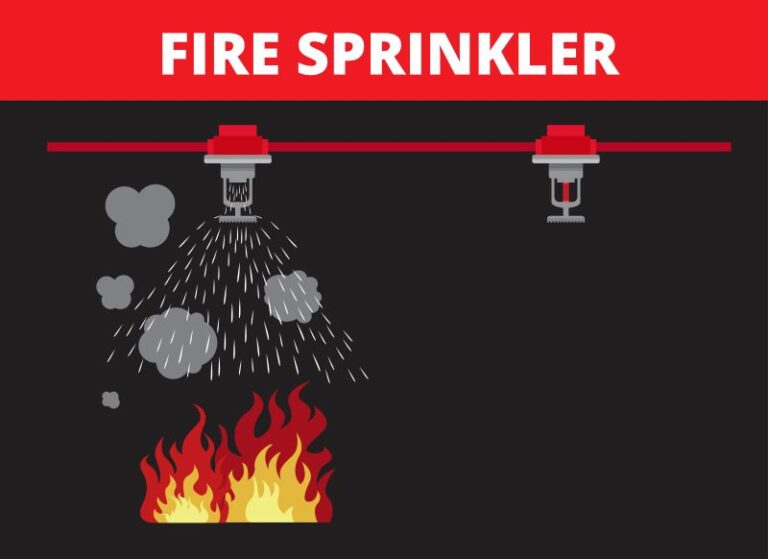
Only the nearest head to the heat activates — spraying water directly at the fire source, not the entire floor.
Each sprinkler head contains a glass bulb that bursts at around 68°C–74°C, releasing water only when the temperature crosses that threshold.
Far from “making fire worse,” sprinklers actually cool the area, suffocate flames, and reduce smoke spread — the top killer in building fires.
📊 Data Snapshot – Sprinklers vs Fire Fatalities
| Country | Fire Deaths (per 100,000 people) | % Buildings with Sprinklers | Fire Death Reduction |
| India | 0.72 | < 10% | — |
| Japan | 0.14 | 85% | 80% |
| USA | 0.18 | 90% | 88% |
| UK | 0.12 | 95% | 91% |
(Source: NFPA Global Fire Safety Report 2024, NDMA India 2025)
🧯 In India, more than 68% of fire fatalities occur in non-sprinkler-equipped buildings.
💥 Myth vs Fact Box
| Myth | Fact |
| “Sprinklers burst automatically during any fire.” | Only heat-activated sprinklers work — others stay sealed. |
| “Water causes more damage than fire.” | Fire damage costs are 5–10× higher than sprinkler-related water cleanup. |
| “I’ll just use extinguishers.” | Extinguishers work only in the first 30 seconds; sprinklers protect continuously. |
| “Installing sprinklers is too expensive.” | Retrofitting cost < 1% of total building expense — priceless compared to lives saved. |
🧠 Case Insight – Mumbai Mall Fire (2023)
A small electrical fire in a basement storage room triggered sprinklers within 20 seconds.
By the time fire services arrived, fire was completely suppressed — zero injuries, minimal damage.
Contrast that with non-sprinklered fires like Surat 2019 and Rajkot 2024 — where dozens died.
🧰 What You Can Do Today
🧯 Check if your home or workplace has sprinkler heads installed.
📞 Ask your society or builder for the latest fire system test report.
🚪 Never cover or paint sprinkler heads.
🏢 Support government policy for mandatory sprinklers in all new buildings above 3 floors.
🧑🏫 Share this article with your society management or school board.
📈 Visual Suggestion
Title: “Sprinklers Save Lives – Not Damage”
Visual: Side-by-side illustration — Fire without sprinklers (smoke, chaos) vs Fire with sprinkler activated (controlled zone)
Caption: “One drop of awareness can stop a sea of flames.”
📣 Call to Action
Ask your builder today:
“When was our sprinkler system last tested?”
Your question could prevent the next tragedy.
📎 References
- National Fire Protection Association (NFPA), 2024
- NDMA India – “Fire Safety & Prevention Data Review 2025”
- BIS 15105:2002 – Indian Standard for Automatic Sprinkler Installations
- MoHUA – Urban Fire Safety Manual, 2023
📌 Tags
#FireSafety #SprinklersSaveLives #HowToSurvive #VFFIndia #EveryLifeMatters #NDMA #BuildingSafety
🔚 Closing Line
Sprinklers don’t make fire worse — our ignorance does.
This is why we built HowToSurvive.in — to turn fear into understanding, and hesitation into protection.
Common unsafe practices
- Relying on equipment without a hazard assessment
- Blocking or compromising escape routes
- Delaying the alarm or emergency call
- Attempting a response beyond training or safe conditions
- Re-entering before authorised clearance
- Treating a checklist as a substitute for competent inspection