
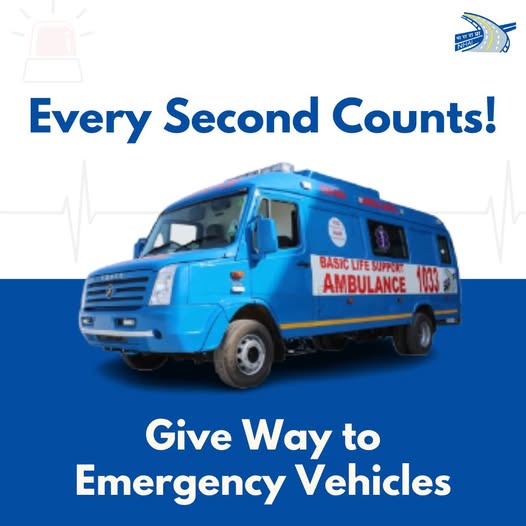
🚑 Ambulance Sirens – Why People Don’t Give Way?
What needs attention
- The article topic must be linked to the actual occupancy and hazard
- Prevention and early warning provide more safety margin than last-second intervention
- Equipment is effective only when correctly selected, accessible and maintained
- People need short practised actions and a clear decision to stop and escape
- Children, visitors and people needing assistance require explicit planning
- Records, drills and inspections matter only when defects are corrected
Controls that reduce risk
- Complete a task- and site-specific hazard assessment
- Verify applicable Indian, state and local requirements
- Use competent inspection for installed systems and specialist hazards
- Keep alarms, exits, signs and emergency access usable
- Train intended users and practise evacuation
- Record defects with an owner and completion date
- Review the plan after changes, incidents or near misses
Understand and apply the guidance
⚠️ The Myth
“Giving way won’t make a difference — someone else will move.”
Or worse — “Ambulances are always empty.”
These excuses, repeated across Indian roads, have created a silent epidemic of preventable deaths.
✅ The Fact
In emergency medicine, every minute matters.
Delays caused by traffic indifference or poor road discipline can reduce a critical patient’s survival chance by up to 50%.
“An ambulance delayed by two minutes is a life delayed forever.”
📊 Data Snapshot (India 2019–2025)
| Metric | 2019 | 2022 | 2025 |
|---|---|---|---|
| Avg. Ambulance Response Time (Urban) | 22 min | 19 min | 17 min |
| Deaths Linked to Delay (per year) | 28,000 | 26,400 | 25,100 |
| % Drivers Yielding to Ambulances | 34% | 39% | 43% |
| % Who Believe Ambulances “Fake Sirens” | 22% | 17% | 12% |
(Sources: MoRTH, NDMA, AIIMS Trauma Study, 2025)
📈 Only 4 in 10 drivers in India give way to ambulances immediately.
By comparison — Japan (98%), Singapore (94%), USA (91%), UK (89%).
🧠 Why People Don’t Give Way
1️⃣ Ignorance: Many don’t know the cost of a delay.
2️⃣ Distrust: Some think sirens are misused to skip traffic.
3️⃣ Road design: No emergency lanes or enforcement in cities.
4️⃣ Lack of empathy: No understanding that “someone’s family is inside.”
5️⃣ Systemic failure: No legal enforcement or digital tracking for ambulance movement.
🧩 Case Study – Delhi, 2024
- A cardiac patient died inside ambulance stuck at Ashram flyover for 18 minutes.
- Despite sirens, vehicles refused to yield.
- Family later said, “People stared, but no one moved.”
- FIR filed, but no law punishes delay.
Lesson: Awareness saves faster than law can punish.
⚙️ What Global Systems Do
| Country | Policy | Impact |
|---|---|---|
| Japan | Lane-splitting rule + training in driver education | Avg response 6 min |
| Singapore | Smart traffic signal system clears ambulance path | 4× faster movement |
| UK | Public awareness campaigns (“Blue Light Aware”) | 95% drivers respond |
| India | None standardized | 17–40 min response lag |
💡 Solutions India Needs
✅ Dedicated emergency lanes on major highways and city routes.
✅ Smart traffic lights linked to ambulance GPS.
✅ Public awareness campaigns like “Give Way = Save Life.”
✅ Fine enforcement: Blocking an ambulance = ₹10,000 penalty.
✅ Ambulance verification app to ensure trust and reduce fake siren misuse.
📢 Systemic Lessons
The siren isn’t noise — it’s a heartbeat.
The problem isn’t technology — it’s indifference.
Until awareness becomes instinct, India’s roads will remain corridors of delay.
📣 Call to Action
🚨 The next time you hear a siren:
- Move left immediately.
- Signal others to do the same.
- Never block junctions.
👉 Remember — you might be the reason someone reaches home alive.
📎 References
- Ministry of Road Transport & Highways “Emergency Response Review,” 2025
- NDMA “Urban Medical Transport Efficiency Report,” 2024
- AIIMS Trauma Centre “Ambulance Delay Mortality Study,” 2024
- WHO “Road User Behaviour Index,” 2023
🔚 Closing Line
A siren is not asking for space — it’s asking for time, and time means life.
This is why we built HowToSurvive.in — to make empathy the fastest moving vehicle on India’s roads.
Common unsafe practices
- Relying on equipment without a hazard assessment
- Blocking or compromising escape routes
- Delaying the alarm or emergency call
- Attempting a response beyond training or safe conditions
- Re-entering before authorised clearance
- Treating a checklist as a substitute for competent inspection