
🚒 State-wise Fire Service Deficiency – Latest NDMA Data (2019–2025)
What needs attention
- The article topic must be linked to the actual occupancy and hazard
- Prevention and early warning provide more safety margin than last-second intervention
- Equipment is effective only when correctly selected, accessible and maintained
- People need short practised actions and a clear decision to stop and escape
- Children, visitors and people needing assistance require explicit planning
- Records, drills and inspections matter only when defects are corrected
Controls that reduce risk
- Complete a task- and site-specific hazard assessment
- Verify applicable Indian, state and local requirements
- Use competent inspection for installed systems and specialist hazards
- Keep alarms, exits, signs and emergency access usable
- Train intended users and practise evacuation
- Record defects with an owner and completion date
- Review the plan after changes, incidents or near misses
Understand and apply the guidance
🔴 Truth Drop
India faces a 97% shortage in fire stations, vehicles, and manpower nationwide.
(Source: NDMA Fire Safety & Preparedness Report 2025)
“For every 3 lakh Indians, there’s just one trained firefighter — the world average is one for every 1,000.”
📖 Why This Matters
Fires are not rare incidents — they are daily emergencies.
From hospitals to industries, schools to homes, India witnesses over 1.6 lakh fire incidents each year, killing more than 12,000 people annually.
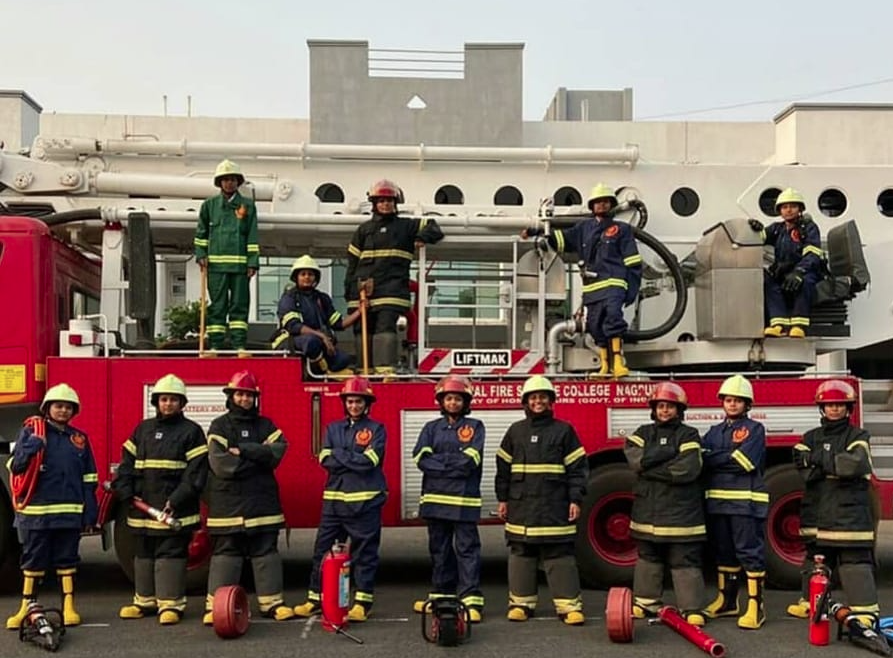
Yet, our frontline responders remain understaffed, under-equipped, and undervalued.
A country that talks about development must first protect the people building it.
📊 Fire Service Deficiency Data (NDMA, 2025)
| Parameter | Required | Available | Shortage (%) |
|---|---|---|---|
| Fire Stations | 8,559 | 3,104 | 63.7% |
| Firefighters | 5,50,000 | 16,700 | 96.9% |
| Fire Vehicles | 22,000 | 7,700 | 65.0% |
| Breathing Apparatus | 18,000 | 5,200 | 71.1% |
| Fire Officers | 12,000 | 2,850 | 76.2% |
(Sources: NDMA Fire Services Assessment Report, Ministry of Home Affairs, 2025)
📈 National Snapshot:
- 22 states have less than 20% of required manpower.
- Rural areas completely lack fire coverage in 70% of India’s geography.
- Average response time exceeds 25 minutes in most Tier-2 and Tier-3 cities.
🗺️ State-Wise Deficiency Highlights
| State | Firefighter Deficiency | Key Concern |
|---|---|---|
| Uttar Pradesh | 98% | No fire stations in 42 districts’ rural zones |
| Bihar | 99% | Fire engines over 25 years old |
| Madhya Pradesh | 95% | Only 4,200 firefighters for 8 crore population |
| Gujarat | 92% | 60% stations lack breathing sets |
| Maharashtra | 85% | Urban slum fires rising annually |
| Rajasthan | 97% | No training school functional since 2018 |
| Tamil Nadu | 76% | Better staffing, but rural coverage weak |
| Kerala | 68% | Moderate infrastructure, high urban response |
| Delhi NCR | 52% | Good capacity, poor enforcement & maintenance |
🧠 Case Study: Rajkot Game Zone Fire (2024)
- Incident: Indoor gaming facility caught fire due to short circuit.
- Result: 28 lives lost, mostly children.
- Finding: Delay in response — nearest fire tender took 35 minutes due to lack of manpower and access.
- Lesson: One missing fire station can mean dozens missing lives.
⚙️ NDMA Observations
1️⃣ No uniform Fire Services Act across all states.
2️⃣ Budget allocation <0.5% of total disaster management funds.
3️⃣ Outdated vehicles and communication systems.
4️⃣ No database for inspection, maintenance, or incident mapping.
5️⃣ Fire safety education missing from schools and training institutes.
💡 Global Comparison
| Country | Firefighters per 1 Lakh People | Fire Stations per 10 Lakh | Avg. Response Time | Fatality Rate (per 10k fires) |
|---|---|---|---|---|
| India | 3 | 2.5 | 25–40 min | 30+ |
| USA | 170 | 9 | 8–10 min | 4 |
| Japan | 140 | 8 | 6–8 min | 2 |
| Germany | 110 | 7 | 8–9 min | 3 |
| Australia | 100 | 6 | 10–12 min | 3 |
(Source: IFRC Global Fire Data Index, 2024)
📊 India’s firefighter density is 1/40th of developed nations.
🧭 The Way Forward
✅ Pass a National Fire Services Act for uniform standards & structure.
✅ Create District-level Fire & Life Safety Cells under SDMAs.
✅ Integrate digital fire station mapping with NDMA dashboards.
✅ Invest in firefighter training academies and youth volunteer programs.
✅ Allocate dedicated fire service budget (1% of total disaster funds).
✅ Mandate annual third-party audits for public and industrial establishments.
💬 Citizen Responsibility
- Report faulty hydrants or blocked exits to civic helplines.
- Support creation of volunteer response networks in each district.
- Don’t wait for tragedy — build awareness in schools, housing societies, and workplaces.
📣 Call to Action
🚨 India doesn’t lack bravery — it lacks infrastructure.
👉 Demand transparency in your city’s fire preparedness.
A single question to your municipality — “How many fire stations are active?” — can start change.
📎 References
- NDMA “Fire Services Infrastructure Report,” 2025
- Ministry of Home Affairs “Fire Safety Assessment,” 2024
- IFRC “Global Fire Preparedness Index,” 2024
- CAG “Audit on Fire Department Readiness,” 2023
🔚 Closing Line
Our firefighters fight flames — but the real fire is the system’s neglect.
This is why we built HowToSurvive.in — to ignite awareness before tragedy ignites our cities.
Common unsafe practices
- Relying on equipment without a hazard assessment
- Blocking or compromising escape routes
- Delaying the alarm or emergency call
- Attempting a response beyond training or safe conditions
- Re-entering before authorised clearance
- Treating a checklist as a substitute for competent inspection