
🚗 Youth & Road Accidents – Age-Wise Data & Insights
What needs attention
- The article topic must be linked to the actual occupancy and hazard
- Prevention and early warning provide more safety margin than last-second intervention
- Equipment is effective only when correctly selected, accessible and maintained
- People need short practised actions and a clear decision to stop and escape
- Children, visitors and people needing assistance require explicit planning
- Records, drills and inspections matter only when defects are corrected
Controls that reduce risk
- Complete a task- and site-specific hazard assessment
- Verify applicable Indian, state and local requirements
- Use competent inspection for installed systems and specialist hazards
- Keep alarms, exits, signs and emergency access usable
- Train intended users and practise evacuation
- Record defects with an owner and completion date
- Review the plan after changes, incidents or near misses
Understand and apply the guidance
🔴 Truth Drop
India’s roads are not just pathways of progress — they’ve become graveyards of youth.
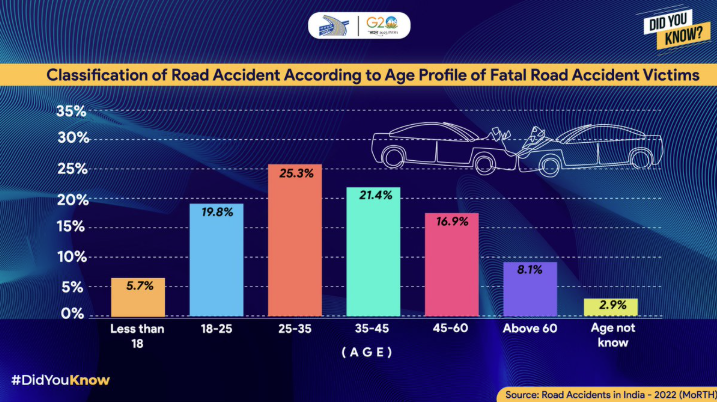
👉 Over 65% of all road accident deaths in India involve people aged 18–35 (MoRTH, NCRB 2024).
👉 That means every 3rd person dying on the road is in their most productive years — students, workers, dreamers.
The future of Bharat is being lost not to war, but to speed, ignorance, and inaction.
📖 Why This Matters
When a young person dies in a crash, we don’t just lose one life —
we lose decades of dreams, effort, and potential.
These aren’t reckless statistics. They are:
- A college student rushing to class.
- A delivery rider working overnight.
- A young couple on a weekend trip.
Each year, India buries more youth due to preventable road tragedies than any disease or disaster combined.
⚠️ Age-Wise Breakdown of Road Accident Deaths (MoRTH, NCRB 2024)
| Age Group | % of Total Deaths | Major Causes |
|---|---|---|
| 0–17 yrs | 6% | Negligence, poor supervision, unsafe school transport |
| 18–25 yrs | 32% | Overspeeding, night driving, drunk driving |
| 26–35 yrs | 33% | Work pressure, fatigue, rash driving |
| 36–45 yrs | 14% | Commuting stress, road fatigue |
| 46+ yrs | 15% | Slower reaction, medical issues, poor road conditions |
👉 18–35 years = nearly 65% of all road accident deaths.
🧠 Why the Youth Are Most at Risk
- Overspeeding & Overconfidence
– Common in 18–25 age group; thrill often overtakes judgment. - Drunk or Late-Night Driving
– Party culture + poor enforcement = fatal mix. - Mobile Distraction
– Social media, GPS, calls during driving = delayed reactions. - Low Awareness of Risk
– Many young riders think “nothing will happen to me.” - Poor Helmet & Seatbelt Discipline
– Peer pressure or discomfort leads to non-usage. - Inexperience
– New drivers lack hazard perception and defensive driving skills.
📊 Data Box
- 1.6 lakh total road deaths (2024):
– 1 lakh+ in 18–35 age group. - 90% of youth victims are male.
- Two-wheelers = 45% of deaths, mostly under age 30.
- Drunk driving & overspeeding = 60% of youth crashes.
- India loses ₹90,000 crore annually in productivity due to young lives lost.
🛡 Survival Lessons for Youth
✅ Speed thrills, but kills: Stay below limits — always.
✅ Never drive under influence. One bad night can destroy multiple families.
✅ Helmet = Life. Wear ISI-marked helmets, not decorative ones.
✅ Buckle up. Rear-seat belts save lives too.
✅ Avoid distractions: Put your phone on silent mode while driving.
✅ Know your limits: Fatigue and long hours are invisible killers.
✅ If you see an accident: Call 108/112, assist, don’t record.
📢 Systemic Lessons
India must:
- Make defensive driving training mandatory before issuing licenses.
- Enforce zero tolerance for underage and drunk driving.
- Launch youth-focused road safety campaigns in colleges and workplaces.
- Reward safe riders & drivers with insurance incentives.
- Include road safety in school curriculum under National Education Policy.
📣 Call to Action
🚨 Young India deserves to live, not die on highways.
👉 Be the generation that drives change, not destruction.
Pledge today:
“I will wear a helmet, follow rules, and protect others on the road.”
Your awareness is not just survival — it’s national service.
🔚 Closing Line
India’s youth are its heartbeat — but that heartbeat is fading on the roads.
This is why we built HowToSurvive.in — to awaken responsibility, protect young lives, and ensure our future doesn’t die on the way home.
Common unsafe practices
- Relying on equipment without a hazard assessment
- Blocking or compromising escape routes
- Delaying the alarm or emergency call
- Attempting a response beyond training or safe conditions
- Re-entering before authorised clearance
- Treating a checklist as a substitute for competent inspection