
🛢️ Oil Depot Fires & Environmental Loss Data (India 2019 – 2025)
What needs attention
- The article topic must be linked to the actual occupancy and hazard
- Prevention and early warning provide more safety margin than last-second intervention
- Equipment is effective only when correctly selected, accessible and maintained
- People need short practised actions and a clear decision to stop and escape
- Children, visitors and people needing assistance require explicit planning
- Records, drills and inspections matter only when defects are corrected
Controls that reduce risk
- Complete a task- and site-specific hazard assessment
- Verify applicable Indian, state and local requirements
- Use competent inspection for installed systems and specialist hazards
- Keep alarms, exits, signs and emergency access usable
- Train intended users and practise evacuation
- Record defects with an owner and completion date
- Review the plan after changes, incidents or near misses
Understand and apply the guidance
🔴 Truth Drop
India’s petroleum storage and distribution network has grown 300 % in two decades — but fire safety hasn’t kept pace.
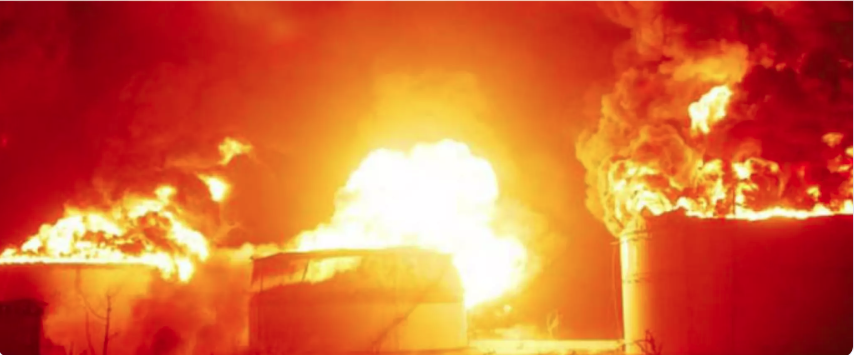
Between 2019 and 2025, at least 72 major oil-depot and refinery fires were reported, killing 190 people, injuring 620 +, and causing economic losses above ₹7,800 crore.
(Source: OISD, NDMA, MoPNG Incident Reports 2025)
👉 Most fires began with small leaks, static discharge, or overfilled tanks — turning minutes into infernos that burned for days.
📖 Why This Matters
Oil depots, terminals, and fuel stations are lifelines of our economy — but every accident poisons soil, air, and water for miles.
Just 100 litres of leaked petrol can contaminate 1 million litres of groundwater.
A single tank-farm explosion releases the carbon equivalent of an entire city’s daily emissions.
“These fires don’t just destroy property — they burn the environment we all breathe.”
📊 Oil & Fuel Storage Fire Data (2019 – 2025)
| Year | Major Fires | Deaths | Injured | Estimated Loss (₹ Cr) | Key Triggers |
|---|---|---|---|---|---|
| 2019 | 9 | 32 | 85 | 1,100 | Overflow, tank leak ignition |
| 2020 | 11 | 27 | 70 | 950 | Lightning strike, poor earthing |
| 2021 | 12 | 28 | 95 | 1,200 | Pipeline rupture + static discharge |
| 2022 | 13 | 30 | 100 | 1,350 | Diesel vapor ignition, open flame |
| 2023 | 14 | 36 | 140 | 1,650 | Manifold blast, boil-over event |
| 2024 | 9 | 25 | 90 | 1,050 | Fuel-truck leak, no emergency valve |
| 2025 (till Aug) | 4 | 12 | 40 | 500 | Tank vent fire, hot work without permit |
📈 Total: 72 fires | 190 deaths | 620 injuries | ₹7,800 crore loss
🧠 Where & Why They Happen
| Facility Type | % Share | Common Cause |
|---|---|---|
| Tank Farms (Depots / Terminals) | 45 | Vapor release + static spark |
| Refineries | 25 | Maintenance hot work errors |
| Fuel Transport Trucks / Loading Bays | 15 | Hose rupture / spillage |
| Retail Petrol Stations | 10 | Smoking / mobile use / fuel overflow |
| Ship / Port Storage | 5 | Lightning and poor earthing |
⚠️ Major Incidents (2019–2025)
1️⃣ Haldia Port (2021) — Crude tank fire; 4 dead, 45 injured; burned 30 hrs.
Leak from floating-roof seal ignited by static spark.
🔹 Lesson: Floating roof tanks must have bonding straps & foam rings.
2️⃣ Chennai Tondiarpet Depot (2022) — Petrol vapor ignition; no foam system working.
🔹 Lesson: Weekly foam pump test is non-negotiable.
3️⃣ Jaipur IOC Depot (legacy review) — Though 2009, still benchmark case: 11 killed, 200 crore loss, fuel leaked for 36 min before ignition.
🔹 Lesson: Automatic shut-off valves and gas detectors must be linked to control rooms nationwide.
🌍 Environmental Impact Snapshot
| Indicator | Average per Major Incident | 5-Year Estimate |
|---|---|---|
| CO₂ Equivalent Emission | 45,000 tons | 3.2 million tons |
| Contaminated Soil Area | 1.5 km² | >100 km² |
| Groundwater Impact | up to 3 km radius | ~40 districts affected |
| Livelihood Loss (Fishermen / Farmers) | ₹30–60 Cr per event | ₹1,200 Cr + |
⚙️ Technical Failures Behind the Blazes
- No pressure/vacuum relief valves on old tanks
- Earthing resistance > 10 ohms – ineffective lightning protection
- Non-functional foam monitors and hydrants
- Poor segregation between tank farms (<30 m instead of 60 m minimum)
- No gas-detection alarms in loading bays
- Manual valves instead of remote shutoffs → delayed isolation
🧩 Regulation & Compliance Reality
| Standard / Code | Owner | Status | Remarks |
|---|---|---|---|
| OISD Standards 105 / 118 | Oil Industry Safety Directorate | Mandatory | Implementation weak in private depots |
| Petroleum Rules 2002 | PESO | Active | Licensing renewals irregular |
| NDMA Guidelines on Oil & Gas Sector (2020) | NDMA | Issued | Not adopted by many states |
| Environmental Impact Assessment (EIA) 2022 | MoEFCC | Updated | Focus on project approval, not operation phase |
🛡 Safety & Survival Lessons
✅ Check for smell / vapor before entering tank areas; never start vehicles if leak detected.
✅ During fire alarm — evacuate upwind, minimum 100 m from tank farm.
✅ Do not spray water on fuel surface — use foam only.
✅ Know the wind direction flag and nearest muster point.
✅ Workers must wear anti-static shoes & flame-resistant coveralls.
✅ Community near depots should know the evacuation route and helpline (112 / 101).
📢 Systemic Lessons
India must:
- Digitally map all oil depots & tank farms with real-time gas and temperature sensors (linked to Bharat101).
- Mandate annual fire & environmental audit by third party.
- Install bund drain isolation valves to prevent leak runoff.
- Develop district-level hazard maps showing fuel storage zones.
- Upgrade fire stations with foam tenders & drones for thermal imaging.
- Create Environmental Restoration Fund financed by O&G companies for post-fire remediation.
📣 Call to Action
🚨 Every drop of fuel burned in a depot fire adds poison to our air and soil.
👉 Industries, officials, and citizens must treat oil-fire prevention as climate action.
Safety audits save not just workers — they save the planet we live on.
📎 References
- Oil Industry Safety Directorate (OISD) Accident Reports 2019–2025
- NDMA “Oil & Gas Sector Risk Mitigation Guidelines,” 2024
- PESO Petroleum Storage Inspection Summary 2025
- CPCB “Environmental Impact of Industrial Fires” Report 2024
- MoPNG Annual Safety Performance Bulletins
🔚 Closing Line
When oil burns, it’s not just fuel that is lost — it’s our future.
This is why we built HowToSurvive.in — to make every drop of awareness count before the next spark ignites another city.
Common unsafe practices
- Relying on equipment without a hazard assessment
- Blocking or compromising escape routes
- Delaying the alarm or emergency call
- Attempting a response beyond training or safe conditions
- Re-entering before authorised clearance
- Treating a checklist as a substitute for competent inspection