
🧯 Fire Extinguishers – Which Type Works Where?
What needs attention
- The article topic must be linked to the actual occupancy and hazard
- Prevention and early warning provide more safety margin than last-second intervention
- Equipment is effective only when correctly selected, accessible and maintained
- People need short practised actions and a clear decision to stop and escape
- Children, visitors and people needing assistance require explicit planning
- Records, drills and inspections matter only when defects are corrected
Controls that reduce risk
- Complete a task- and site-specific hazard assessment
- Verify applicable Indian, state and local requirements
- Use competent inspection for installed systems and specialist hazards
- Keep alarms, exits, signs and emergency access usable
- Train intended users and practise evacuation
- Record defects with an owner and completion date
- Review the plan after changes, incidents or near misses
Understand and apply the guidance
⚠️ The Myth
“All fire extinguishers are the same.”
Many people — even in offices and schools — grab any extinguisher during a fire, unaware that using the wrong one can make the fire explode or spread instantly.
“A wrong extinguisher is more dangerous than no extinguisher.”
✅ The Fact
Different fires need different extinguishing agents.
There are five main types of fires (A, B, C, D, K) — and each has a specific extinguisher designed for it.
Knowing which one to use is the difference between control and catastrophe.
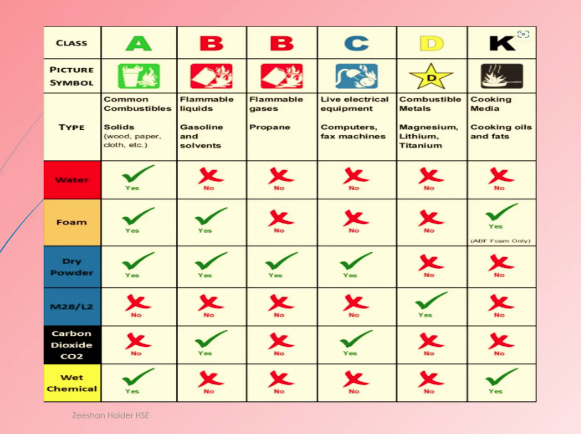
🔥 Fire Classification & Correct Extinguisher Use
| Fire Class | Type of Fire | Common Examples | Use This Extinguisher | Avoid |
|---|---|---|---|---|
| Class A | Ordinary combustibles | Wood, paper, cloth, trash | Water / Foam (A type) | Don’t use CO₂ (ineffective) |
| Class B | Flammable liquids | Petrol, diesel, paints, LPG | CO₂ / Dry Chemical Powder (BC) | Never use water – may spread fuel |
| Class C | Electrical fires | Short circuits, wiring, appliances | CO₂ / Dry Chemical Powder (ABC) | Don’t use water or foam – shock risk |
| Class D | Metal fires | Magnesium, sodium, lithium | Dry Powder (Special D type) | Never use water – explosive reaction |
| Class K (F) | Kitchen fires | Cooking oil, grease | Wet Chemical (K type) | Don’t use water – splashes burning oil |
(Sources: BIS IS 2190:2010, NFPA 10, NDMA Fire Safety Guidelines)
📊 India’s Extinguisher Reality (2025)
| Parameter | % Functional | % Incorrectly Installed | % Without Maintenance Tag |
|---|---|---|---|
| Commercial Buildings | 62% | 38% | 44% |
| Schools & Colleges | 58% | 42% | 47% |
| Hospitals | 64% | 35% | 40% |
| Residential Complexes | 22% | 61% | 72% |
(Source: NDMA Fire Safety Audit 2025)
📈 In short — most extinguishers in India are either wrong, expired, or unusable.
🧭 Simple Rule to Remember
A – Ashes (Wood, Paper) → Water / Foam
B – Barrel (Liquids) → CO₂ / DCP
C – Current (Electrical) → CO₂ / ABC Dry Powder
D – Dense Metals → Special Dry Powder
K – Kitchen → Wet Chemical (K type)
💡 If unsure, use ABC multipurpose extinguisher — safe for most scenarios.
⚙️ Quick Extinguisher Use Steps (PASS Rule)
P – Pull the pin
A – Aim at base of fire
S – Squeeze the handle
S – Sweep side to side
👉 Always keep your back toward the exit when fighting a fire.
📢 Systemic Lessons
Fire extinguishers save lives only when they’re chosen, placed, and maintained correctly.
A single label can mean the difference between safety and smoke.
📣 Call to Action
🚨 Check every extinguisher near you today:
👉 Is it within expiry (less than 5 years old)?
👉 Is it correct for the fire risk in that area?
👉 Does it have a valid inspection tag?
Awareness is your best protection — not panic.
📎 References
- Bureau of Indian Standards (IS 2190:2010)
- NDMA “Fire Extinguisher Installation & Maintenance Guidelines,” 2024
- NFPA 10 “Standard for Portable Fire Extinguishers,” 2024
- CAG “Audit on Building Fire Preparedness,” 2023
🔚 Closing Line
You don’t need to be a firefighter to stop a fire — just someone who knows which extinguisher to use.
This is why we built HowToSurvive.in — to make life-saving knowledge reach every home, office, and school.
Common unsafe practices
- Relying on equipment without a hazard assessment
- Blocking or compromising escape routes
- Delaying the alarm or emergency call
- Attempting a response beyond training or safe conditions
- Re-entering before authorised clearance
- Treating a checklist as a substitute for competent inspection