
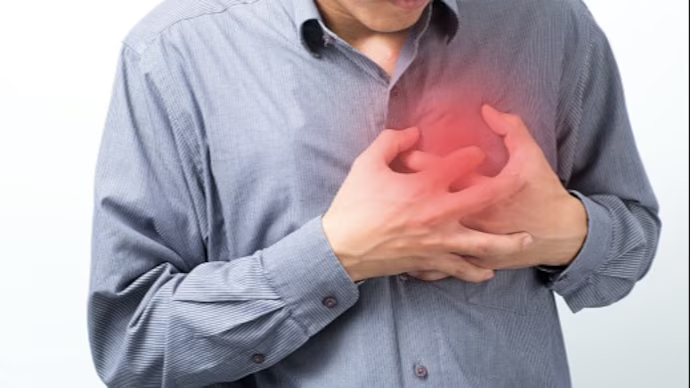
❤️ Heart Attack Survival Rates in Public Places – India vs World
What needs attention
- The article topic must be linked to the actual occupancy and hazard
- Prevention and early warning provide more safety margin than last-second intervention
- Equipment is effective only when correctly selected, accessible and maintained
- People need short practised actions and a clear decision to stop and escape
- Children, visitors and people needing assistance require explicit planning
- Records, drills and inspections matter only when defects are corrected
Controls that reduce risk
- Complete a task- and site-specific hazard assessment
- Verify applicable Indian, state and local requirements
- Use competent inspection for installed systems and specialist hazards
- Keep alarms, exits, signs and emergency access usable
- Train intended users and practise evacuation
- Record defects with an owner and completion date
- Review the plan after changes, incidents or near misses
Understand and apply the guidance
🔴 Truth Drop
🔴 In India, fewer than 5% of people who suffer a heart attack in public survive.
In contrast, countries like the US and Japan record 45–60% survival rates — thanks to faster response and bystander CPR.
(Source: WHO Global Health Observatory 2023, AIIMS Cardiac Care Report 2024)
📖 Why This Matters
Every minute after a cardiac arrest, survival chances drop by 10% without CPR.
Yet in India, most people freeze, crowd, or record videos instead of helping.
Hospitals are minutes away, but help is needed right there, right now — in the street, the metro, the mall, the office.
This is where public preparedness decides between life and loss.
💥 Myth vs Fact
| Myth | Fact |
|---|---|
| “Heart attacks happen only to old people.” | 1 in 4 heart attack victims in India are below 40 (IJSR 2024). |
| “Someone else will help.” | 90% of cardiac arrests happen in front of bystanders who don’t act. |
| “Ambulance will come in time.” | Average urban response = 18–25 minutes, rural = 45+ minutes — far beyond the Golden 10. |
📊 Data Snapshot: India vs World
| Country | Public Place Survival Rate | CPR Awareness in Population | Avg Ambulance Time | AED Availability in Public Spaces |
|---|---|---|---|---|
| 🇮🇳 India | <5% | 2–3% | 18–45 mins | Rare / None |
| 🇺🇸 USA | 55–60% | 70% | 8–10 mins | Widely available |
| 🇯🇵 Japan | 50%+ | 75% | 7–9 mins | Available at all train stations |
| 🇸🇪 Sweden | 70% | 80% | 6–8 mins | Public access in all schools/offices |
| 🇸🇬 Singapore | 65% | 72% | 9–11 mins | Mandated in all malls & airports |
👉 India’s survival rate is 10x lower than global benchmarks — not due to lack of technology, but due to lack of training and awareness.
🧰 What You Can Do Today
🫀 Learn CPR — it takes 5 minutes to learn, saves a lifetime of regret.
📞 Call 108 / 112 immediately — don’t wait to confirm.
⚡ Use AED (Defibrillator) if available — follow voice prompts.
🚶 Clear crowd, open airways, start compressions.
🏫 Ask your office/mall/society if they have AEDs or trained staff.
📲 Share this blog — one click could save someone’s tomorrow.
📈 Visual / Infographic Idea
Bar Graph Title: Public Survival Rate in Cardiac Arrest (2024)
- X-axis: India, USA, Japan, Sweden, Singapore
- Y-axis: % Survival (0–70%)
India bar drastically shorter (<5%) — highlighted in red, others in green/blue — to visually convey the gap.
📎 Reference / Source Links
- World Health Organization – Global Health Observatory, 2023
- AIIMS Cardiac Emergency Care Annual Report, 2024
- Indian Council of Medical Research (ICMR) Cardiac Arrest Study, 2023
- American Heart Association CPR Statistics, 2022
- Japan Resuscitation Council (JRC) Data, 2023
📣 Call to Action
🚨 Tag your workplace, school, or mall — ask:
“Do we have an AED and CPR-trained staff?”
If not, start the change.
Because awareness before ambulance saves lives.
🔚 Closing Line
A heart stops — not because of time, but because no one acted in time.
This is why we built HowToSurvive.in — to turn bystanders into lifesavers, and every citizen into a responder.
Common unsafe practices
- Relying on equipment without a hazard assessment
- Blocking or compromising escape routes
- Delaying the alarm or emergency call
- Attempting a response beyond training or safe conditions
- Re-entering before authorised clearance
- Treating a checklist as a substitute for competent inspection