
The guide
Temporary Worker Accommodation Fire Safety: A 12-Point Checklist Employers Cannot Treat as Temporary
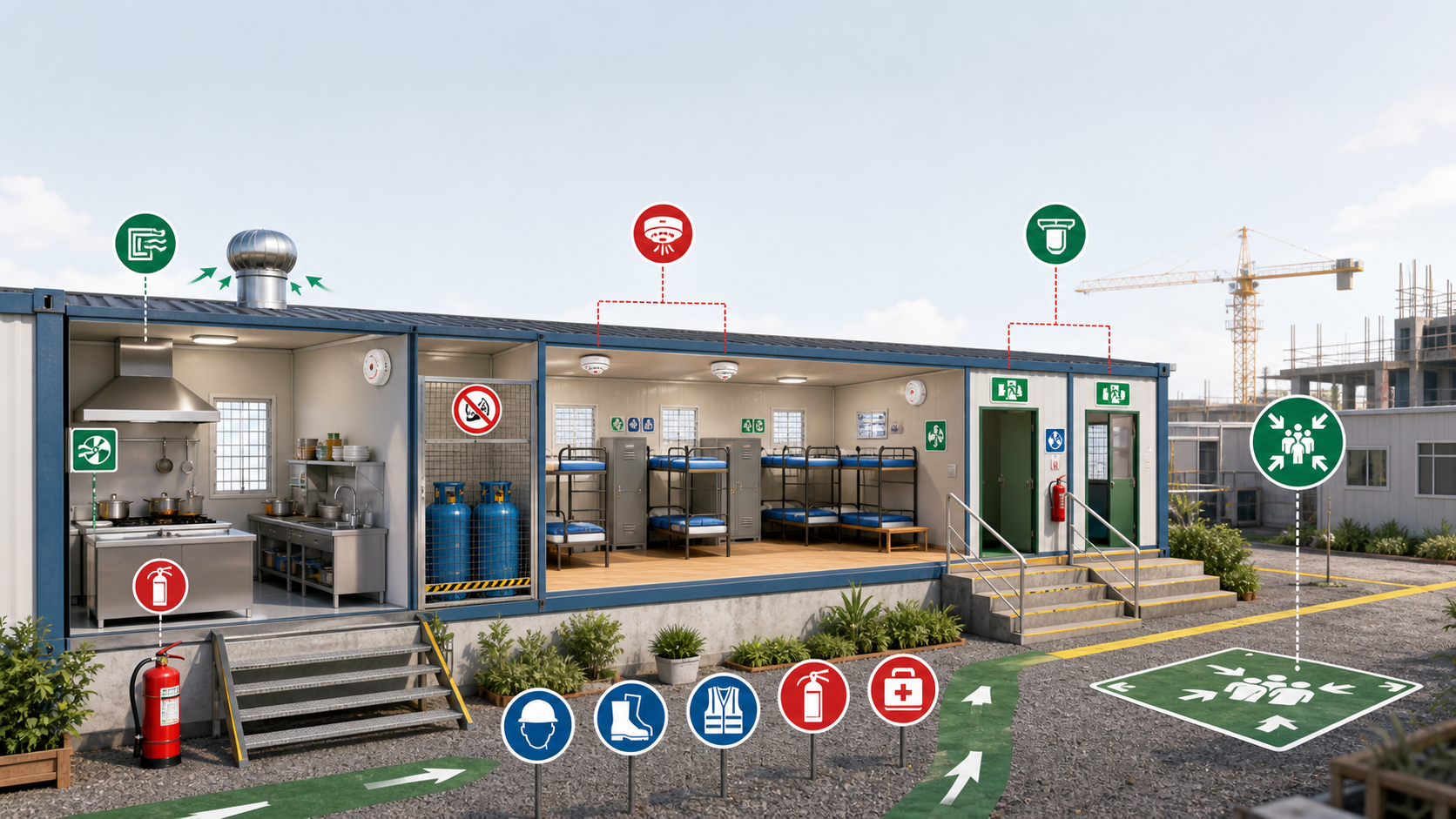
What needs attention
- The article topic must be linked to the actual occupancy and hazard
- Prevention and early warning provide more safety margin than last-second intervention
- Equipment is effective only when correctly selected, accessible and maintained
- People need short practised actions and a clear decision to stop and escape
- Children, visitors and people needing assistance require explicit planning
- Records, drills and inspections matter only when defects are corrected
Controls that reduce risk
- Complete a task- and site-specific hazard assessment
- Verify applicable Indian, state and local requirements
- Use competent inspection for installed systems and specialist hazards
- Keep alarms, exits, signs and emergency access usable
- Train intended users and practise evacuation
- Record defects with an owner and completion date
- Review the plan after changes, incidents or near misses
Understand and apply the guidance
Temporary Worker Accommodation Fire Safety: 12 Essential Checks for Employers
**HowToSurvive.in | Practical Fire and Life Safety**
Temporary accommodation can remain occupied for months or years. Its label may be temporary; its fire risk is continuous.
Employer-provided housing at construction and industrial sites often combines sleeping rooms, cooking, charging, electrical distribution, stored belongings and rotating work shifts. When these functions are crowded into lightweight structures, one ignition can affect many people before they understand what is happening.
This guide converts recognised fire-risk principles into a practical inspection checklist. Local building, labour, fire, electrical, LPG and licensing requirements always take priority.
## Why Accommodation Must Be Included in the Safety Management System
The International Labour Organization’s construction guidance says employer-provided accommodation should meet minimum standards and be inspected regularly, including fire alarms, emergency lighting, firefighting equipment and operational exit doors. It also emphasises that workers must receive safety information and training they understand.
A company should therefore treat accommodation as an occupied facility—not as an informal extension of the worksite.
## The 12-Point Checklist
### 1. Appoint one accountable competent person
Name who owns accommodation fire safety, inspections, defect closure, occupancy records and liaison with emergency services. Shared responsibility without named ownership often becomes no responsibility.
### 2. Know the real occupancy
Maintain an updated list by room, shift and language. A headcount cannot work if supervisors do not know who is sleeping, working, absent or visiting.
### 3. Separate cooking from sleeping
Provide a designated, ventilated cooking area away from beds, exits and combustible walls. Do not allow cooking or boiling water inside sleeping rooms.
### 4. Control LPG quantity and location
Keep cylinders upright and protected from impact. Avoid keeping standby or excess cylinders in living spaces. Assess applicable PESO licensing, storage and separation requirements for the actual aggregate quantity.
### 5. Inspect the complete LPG system
Check cylinder condition and markings, regulator fit, hose age/condition, connections, appliance stability and clearance from combustibles. Replace suspect equipment—do not improvise repairs.
### 6. Manage electrical demand
Prohibit makeshift wiring, overloaded extension boards and unapproved high-wattage appliances. Provide sufficient protected outlets and have distribution boards inspected by competent electrical personnel.
### 7. Provide early warning everyone recognises
Use suitable smoke/heat detection and an alarm audible throughout the accommodation. Test it routinely. Explain the alarm in every worker language and account for people sleeping during daytime shifts.
### 8. Maintain two escape directions where practicable
Avoid layouts where fire in one cooking area or corridor traps an entire row. Exits must remain unlocked, outwardly usable, illuminated and unobstructed.
### 9. Stop fire moving from unit to unit
Maintain spacing/firebreaks, limit combustible storage, remove waste frequently and use construction/lining systems appropriate to the occupancy. Do not bridge gaps with tarpaulins, stock or temporary extensions.
### 10. Install and maintain appropriate firefighting equipment
Select extinguishers for the assessed hazards, mount them visibly and train designated people in their safe use. An extinguisher is for an incipient fire with a clear escape route—not for fighting a growing cylinder fire.
### 11. Drill evacuation by shift and language
Practise alarm recognition, two escape paths, assembly, headcount and responder access. Repeat drills for new arrivals and night/day shifts. Use pictograms where literacy or language differs.
### 12. Pre-plan the emergency response
Give security and wardens a simple plan: raise alarm, call **112**, provide the exact gate, isolate utilities only when safe, evacuate, count people, keep roads clear and hand responders a site/cylinder plan.
## A Simple Inspection Test: FIRE
### **F — Fuel separated**
Are LPG, waste, charging and combustible storage controlled and separated from sleeping and exits?
### **I — Ignition controlled**
Are cooking, smoking, hot work, electrical loads and unauthorised appliances managed?
### **R — Routes and response ready**
Are alarms, exits, lighting, assembly, headcounts and responder access functional?
### **E — Everyone informed**
Does every worker understand the alarm and action in a language and format they can use?
## What Workers Should Be Told on Day One
– Where cooking is permitted.
– Where cylinders may and may not be kept.
– What the fire alarm sounds like.
– Two ways out and the assembly point.
– How to report damaged wiring, hoses, regulators or cylinders.
– Emergency numbers: **112**, **101** and LPG emergency helpline **1906**.
– Never return for belongings and never crowd around a cylinder fire.
## Common Audit Failures
– The occupancy list is weeks out of date.
– Exits are locked for security.
– Cooking migrates into bedrooms during rain or night shifts.
– Spare cylinders accumulate without anyone calculating total quantity.
– Alarm testing happens only before an external inspection.
– Fire extinguishers exist, but workers do not recognise the alarm or assembly point.
– Instructions are written only in a language many residents cannot read.
## The Systemic Lesson
Good accommodation safety is not one extinguisher beside one kitchen. It is a connected system of layout, fuel control, electrical safety, detection, escape, training, headcount and emergency access.
If one layer fails, the next must still protect life.
## What Employers Can Do This Week
1. Conduct a joint fire, electrical and LPG inspection.
2. Count every cylinder and map every cooking point.
3. Test alarms and emergency lighting during both work and sleep shifts.
4. Open and walk every escape route.
5. Run a multilingual headcount drill.
6. Give the fire service a clear site entrance and hazard plan.
## Closing Line
Temporary accommodation should never mean temporary responsibility. Every worker deserves to wake, escape and return home safely.
Common unsafe practices
- Relying on equipment without a hazard assessment
- Blocking or compromising escape routes
- Delaying the alarm or emergency call
- Attempting a response beyond training or safe conditions
- Re-entering before authorised clearance
- Treating a checklist as a substitute for competent inspection