The guide
Trapped Under a Heavy Object? What Bystanders Must Know About Crush Injuries
What needs attention
- The article topic must be linked to the actual occupancy and hazard
- Prevention and early warning provide more safety margin than last-second intervention
- Equipment is effective only when correctly selected, accessible and maintained
- People need short practised actions and a clear decision to stop and escape
- Children, visitors and people needing assistance require explicit planning
- Records, drills and inspections matter only when defects are corrected
Controls that reduce risk
- Complete a task- and site-specific hazard assessment
- Verify applicable Indian, state and local requirements
- Use competent inspection for installed systems and specialist hazards
- Keep alarms, exits, signs and emergency access usable
- Train intended users and practise evacuation
- Record defects with an owner and completion date
- Review the plan after changes, incidents or near misses
Understand and apply the guidance
Crush Injury First Aid: What to Do When Someone Is Trapped Under a Heavy Object
**HowToSurvive.in | Practical Emergency Awareness**
A stage component falls. A wall collapses. A vehicle rolls onto someone. A heavy machine traps a worker. People nearby immediately want to help—and that instinct matters.
But an uncontrolled rescue can injure the trapped person further, destabilise the load or create additional victims.
This guide explains how ordinary bystanders should respond during the critical minutes before trained rescuers arrive. It is general awareness, not a substitute for certified first-aid or rescue training.
## 🧠 What Is a Crush Injury?
A crush injury occurs when part of the body is compressed between heavy objects or beneath a heavy load. Damage may affect skin, muscles, nerves, blood vessels, bones and internal organs.
The danger is not always visible. A person may be conscious and have little external bleeding while serious injury is developing beneath the skin. Compression of the chest or abdomen can also interfere with breathing or injure internal organs.
Severe or prolonged compression can contribute to **crush syndrome**, a life-threatening systemic condition requiring urgent medical treatment. Bystanders should therefore treat significant entrapment as a medical emergency.
## 🚨 First Priority: Do Not Create a Second Victim
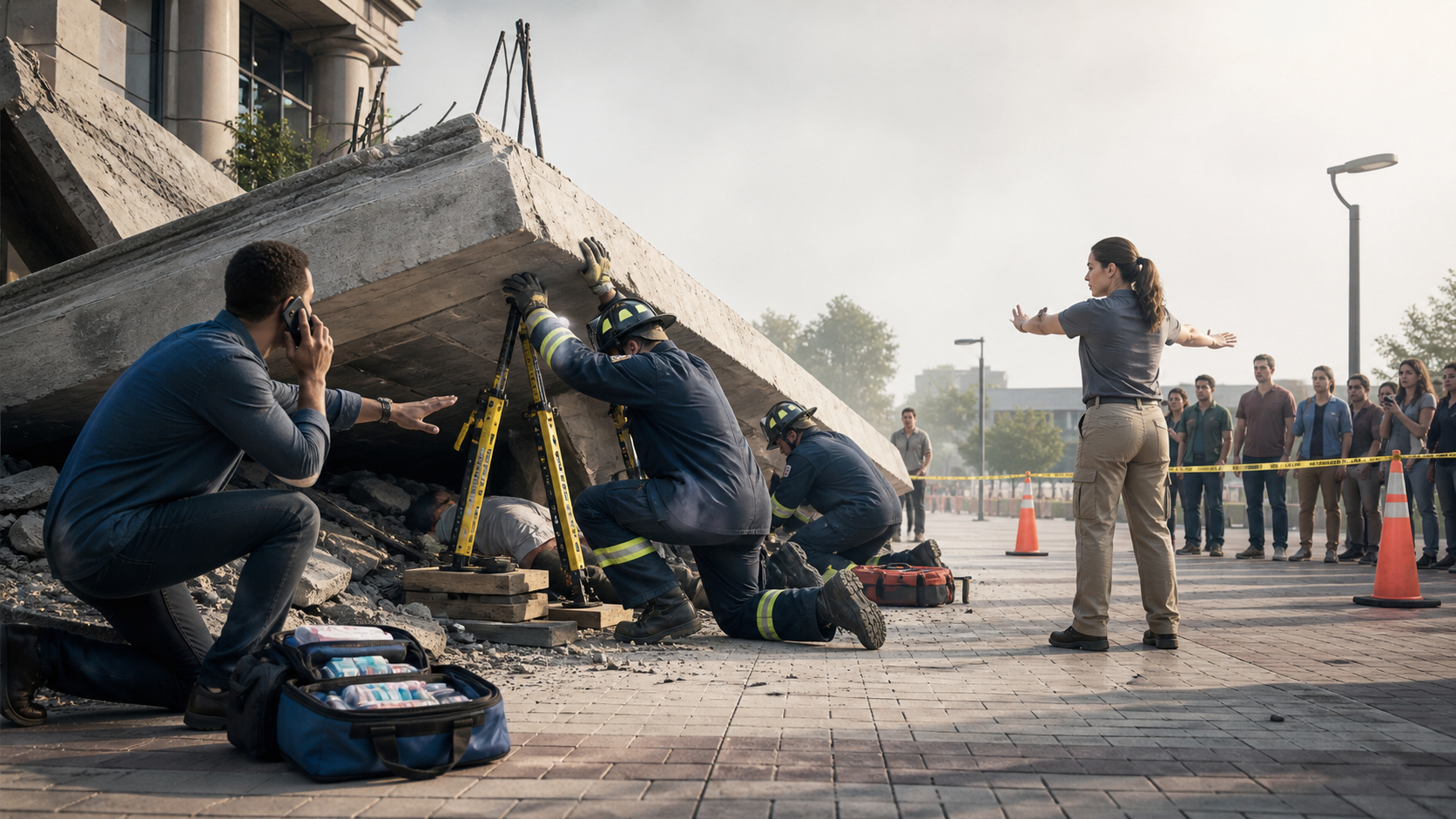
Before approaching, pause for a rapid scene check.
Look for:
– an object that may move or collapse again;
– suspended loads, damaged walls or unstable debris;
– live electrical wires;
– fire, smoke, fuel or chemical leakage;
– moving traffic or machinery;
– a crowd pushing towards the casualty;
– unsafe lifting attempts already underway.
If the scene is unsafe, stay back, warn others and wait for properly equipped rescuers. One trapped casualty must not become several.
## 📞 Step 1: Call for Professional Help
In India, call **112** and clearly state:
1. the exact location and nearest landmark;
2. what has collapsed or what is trapping the person;
3. how many people are trapped or injured;
4. whether the person is conscious and breathing;
5. whether fire, electricity, fuel, traffic or structural instability is present;
6. the best route for emergency vehicles.
Put the phone on speaker if safe. Follow the emergency operator’s instructions.
Ask one specific person to meet and guide responders. Avoid shouting “Someone call an ambulance,” because everyone may assume somebody else has done it.
## 🛑 Step 2: Stop Uncontrolled Lifting
A crowd may instinctively gather and lift. That can be dangerous when:
– the object is unstable;
– part of it remains attached to another structure;
– lifting one edge shifts weight onto the casualty;
– the load cannot be held securely;
– rescuers underneath could be trapped;
– the casualty’s body is supporting or blocking the object;
– the person has been compressed for a prolonged period and needs coordinated medical rescue.
Do not crawl under an unsupported load. Do not use improvised jacks, ropes or vehicles unless directed by trained responders. A successful lift must include safe stabilisation so the object cannot fall again.
## 🫁 Step 3: Check Responsiveness and Breathing—If Safely Accessible
Without entering the danger zone:
– speak loudly and ask the person to respond;
– observe whether they are breathing normally;
– ask where they feel pain and whether they can feel or move their fingers or toes;
– tell them help is coming;
– discourage unnecessary movement.
If the person is unresponsive and not breathing normally, tell the emergency operator immediately and follow CPR/AED instructions if the casualty can be reached safely and the necessary care can be provided without moving an unstable load.
## 🩸 Step 4: Control Accessible Severe Bleeding
If severe external bleeding is visible and accessible without putting yourself in danger:
– apply firm, direct pressure using clean cloth, gauze or dressing;
– maintain pressure;
– add more dressing on top if blood soaks through rather than repeatedly removing the first layer;
– follow emergency-dispatch instructions regarding additional bleeding-control measures.
Do not push directly on an embedded object. Do not remove an object stuck in a wound; it may be limiting bleeding.
## 🧍 Step 5: Keep the Casualty Still, Warm and Reassured
Major crush incidents may include fractures, spinal injury, internal bleeding or shock.
– Do not ask the person to stand or walk simply because they say they feel able.
– Avoid twisting or pulling a trapped limb.
– Keep them comfortably warm using a blanket or clothing when safe.
– Speak calmly and explain what rescuers are doing.
– Do not give food or drink; urgent procedures or anaesthesia may be required.
– Continue watching breathing and responsiveness until help arrives.
## ⚠️ When Should a Trapped Object Be Moved?
For an untrained bystander, the safest default is:
**Do not move a large or unstable object—call rescuers and stabilise the scene.**
An immediate life threat, such as spreading fire, may change the risk calculation. Even then, moving a heavy load without the equipment and personnel to control it can be fatal. Tell emergency services exactly what is happening and follow their real-time direction.
## ❌ Dangerous Myths
### “If there is no blood, the person is fine.”
False. Crush injuries may cause serious muscle, vessel, nerve, bone or internal-organ damage without dramatic external bleeding.
### “More people lifting always makes rescue safer.”
False. An uncoordinated lift can tilt the object, transfer the load or cause a second collapse.
### “Pull the person out as quickly as possible.”
Not always. Pulling can worsen spinal, pelvic or limb injuries and may be impossible without first stabilising the load.
### “Give water because the casualty is in shock.”
Do not give food or drink unless medical professionals instruct you to do so.
### “A conscious casualty does not need an ambulance.”
False. Consciousness does not rule out internal injury or crush syndrome.
## 🏗️ Prevention: Create Distance Before Collapse
Crush survival begins before the object falls.
### At festivals and public events
– Stay outside barriers around stages, idols, arches, lighting towers and moving installations.
– Do not stand in front of, beneath or beside a tall moving structure.
– Keep children physically beside you.
– Identify open escape space rather than allowing the crowd to surround you.
### At work
– Never work beneath a suspended load.
– Use lockout/tagout and proper machinery isolation.
– Use rated lifting equipment and load supports.
– Respect exclusion zones and banksman/signaller instructions.
– Report damaged welds, bolts, frames and lifting points immediately.
### At home
– Anchor tall cupboards and heavy furniture where appropriate.
– Keep children from climbing unsecured furniture.
– Use competent help and correct equipment when moving heavy appliances.
– Never rely on bricks, loose blocks or improvised supports beneath a raised vehicle or load.
## 🧰 A Simple Bystander Response Model: SAFE
### **S — Scan the scene**
Check for instability, electricity, fire, traffic and secondary collapse.
### **A — Alert emergency services**
Call 112, describe the entrapment and send someone to guide responders.
### **F — First aid without unsafe movement**
Check responsiveness and breathing, control accessible severe bleeding, keep the casualty still and warm.
### **E — Exclude the crowd**
Keep people out of the danger zone and preserve access for professional rescue teams.
## 👥 What Event Organisers and Workplaces Need
– A written plan for collapse and entrapment—not only fire evacuation.
– A competent person responsible for temporary-structure safety.
– Documented inspection of supports, fasteners and lifting points.
– Clearly marked fall zones and physical crowd barriers.
– Trained marshals who can stop movement immediately.
– Reliable communication between operators and ground teams.
– First-aid personnel and rapid ambulance access.
– A drill covering crowd isolation and responder access.
## 📢 The Systemic Lesson
The first human instinct after a collapse is to rush forward. Effective emergency response often begins with the opposite action: stop, identify what can move next, call the right help and prevent the crowd from creating another collapse.
Courage matters. Controlled courage saves more lives.
## 💡 What You Can Do Today
– Save **112** in your phone and teach family members when to use it.
– Take a recognised first-aid and CPR course.
– Never stand beneath suspended or visibly unstable objects.
– At public events, identify tall structures and remain outside their fall zones.
– Learn to give an exact location and concise incident report.
– Share the SAFE model: **Scan, Alert, First aid, Exclude.**
## 🔚 Closing Line
When something heavy falls, strength alone is not the answer. Scene safety, controlled rescue and correct first aid turn willing bystanders into effective lifesavers.
Common unsafe practices
- Relying on equipment without a hazard assessment
- Blocking or compromising escape routes
- Delaying the alarm or emergency call
- Attempting a response beyond training or safe conditions
- Re-entering before authorised clearance
- Treating a checklist as a substitute for competent inspection