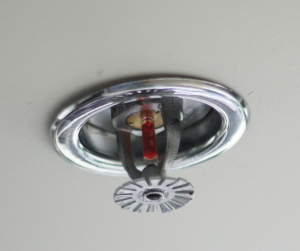
The familiar four labels are useful visually: a pendent sprinkler hangs below the pipe, a concealed pendent sits behind a heat-releasing cover plate, an upright sprinkler stands above the pipe and a sidewall sprinkler projects from a wall. Technically, pendent, upright and sidewall describe discharge orientation; 'concealed' describes how a pendent sprinkler is finished and installed. A safe choice also depends on occupancy hazard, storage, ceiling geometry, obstruction, design density, K-factor, temperature rating, response characteristic, corrosion exposure and whether the exact sprinkler is listed for that position and system.
TopicFire Safety · WorkplaceUpdated2026-08-31
01
The guide
4 Types of Fire Sprinkler Heads
Key risks
What needs attention
Pendent sprinklers direct water downward onto a deflector below the orifice
Upright sprinklers use a deflector above the orifice and are common where piping is exposed
Sidewall sprinklers produce a listed directional pattern from a wall and are not simply half of a pendent sprinkler
A concealed cover plate releases when heated before the sprinkler operates; it does not fall because room temperature drops
Only the sprinkler or sprinklers heated sufficiently by a fire normally operate; all heads do not automatically open together
An attractive concealed finish does not permit painting, caulking or substituting a cover plate
Obstructions and ceiling features can delay activation or block water even when the chosen orientation looks correct
Prevention checklist
Controls that reduce risk
Read the model and temperature marking from a safe position without touching the sprinkler
Compare every installed model with the approved sprinkler schedule and hydraulic drawings
Check ceiling pockets, beams, ducts, racks and new services for obstruction conflicts
Remove storage encroachment according to the approved clearance requirement
Flag painted, corroded, leaking, loaded, bent or mechanically damaged sprinklers for qualified replacement
Keep the correct listed spare sprinklers and wrench in the required cabinet
Require fire-protection review before any ceiling, partition, light, HVAC or storage change
Document model, orientation and location during inspection rather than recording only 'heads checked'
Practical guide
Understand and apply the guidance
Sprinkler systems are one of the best ways to keep your buildings safe from fire. Not all fire sprinkler systems are made equal. There are many different kinds of fire sprinkler systems and sprinkler heads that can be used with them. Depending on the area you want to protect, the type of sprinkler head you use may be different. Some of the most common types of sprinkler heads are:
Pendents:- This type of fire sprinkler head is the most common. A sprinkler head in the shape of a pendant hangs from pipes near the ceiling. Pendent sprinklers remain visible after installation. This type of sprinkler head has a convex, circular, gapped deflector plate that spreads water out in a conical pattern.
Concealed Pendents:– Places that need fire sprinklers but want them to look nice do not show the heads. This kind of sprinkler head is built into the ceiling and has a decorative cap on top. The decorative caps are made to fall off when the room temperature drops 20 degrees below the sprinkler’s activation temperature so that the water can flow freely.
Upright:- The sprinkler heads are straight up and point to the ceiling. This type of sprinkler head has deflectors that are bent down to spray water in a hemispherical pattern. Straight sprinkler heads work well in places where there are obstacles, open ceilings, or places that are hard to reach, like beams and ducts.
Sidewall:– Sprinkler heads on the side of a wall are called sidewall sprinkler heads. This type of sprinkler head has only half of a deflector and sprays water in a half circle. Sidewall sprinkler heads are put in small rooms, hallways, and other places where the fire sprinkler pipes go up the walls.
Which Fire Sprinkler Head is Right for You? Talk to a fire protection expert if you want to figure out which type of fire sprinkler head would work best for your situation. They can help you figure out which sprinkler head will protect your application the best.
Mistakes to avoid
Common unsafe practices
Calling concealed pendent a completely separate orientation instead of a listed pendent variant
Selecting a sprinkler by appearance, price or pipe direction alone
Painting a sprinkler or cover plate during renovation
Using a cover plate from another model, manufacturer or temperature rating
Installing a pendent sprinkler upright or an upright sprinkler pendent unless the exact listing permits it
Adding ducts, lights, signs, shelves or tall storage beneath sprinklers without design review
Hanging decorations, cables or objects from sprinkler frames or pipe
Replacing a damaged head without matching model, K-factor, response, temperature and listing
02
Watch & learn
Related Videos
Captions
Practical system training
Fire Sprinkler System Practical Explanation
Safety Management Study · Hindi · Verified
Hindi-first overview of sprinkler arrangements and system components
03
Facts & action
Evidence, Cases & Next Steps
3Fundamental orientation termsPendent, upright and sidewall
1Common covered architectural variant discussedConcealed pendent
1Sprinkler expected to operate firstThe individual unit heated to its operating condition
Evidence chart
Deflector below the orifice; downward protection patternPendent
Listed cover plate releases, then pendent sprinkler operatesConcealed pendent
Deflector above the orifice; commonly used with exposed pipingUpright
Listed directional pattern from a wall locationSidewall