
Safe immersion starts on shore: a practical plan for families and group organisers

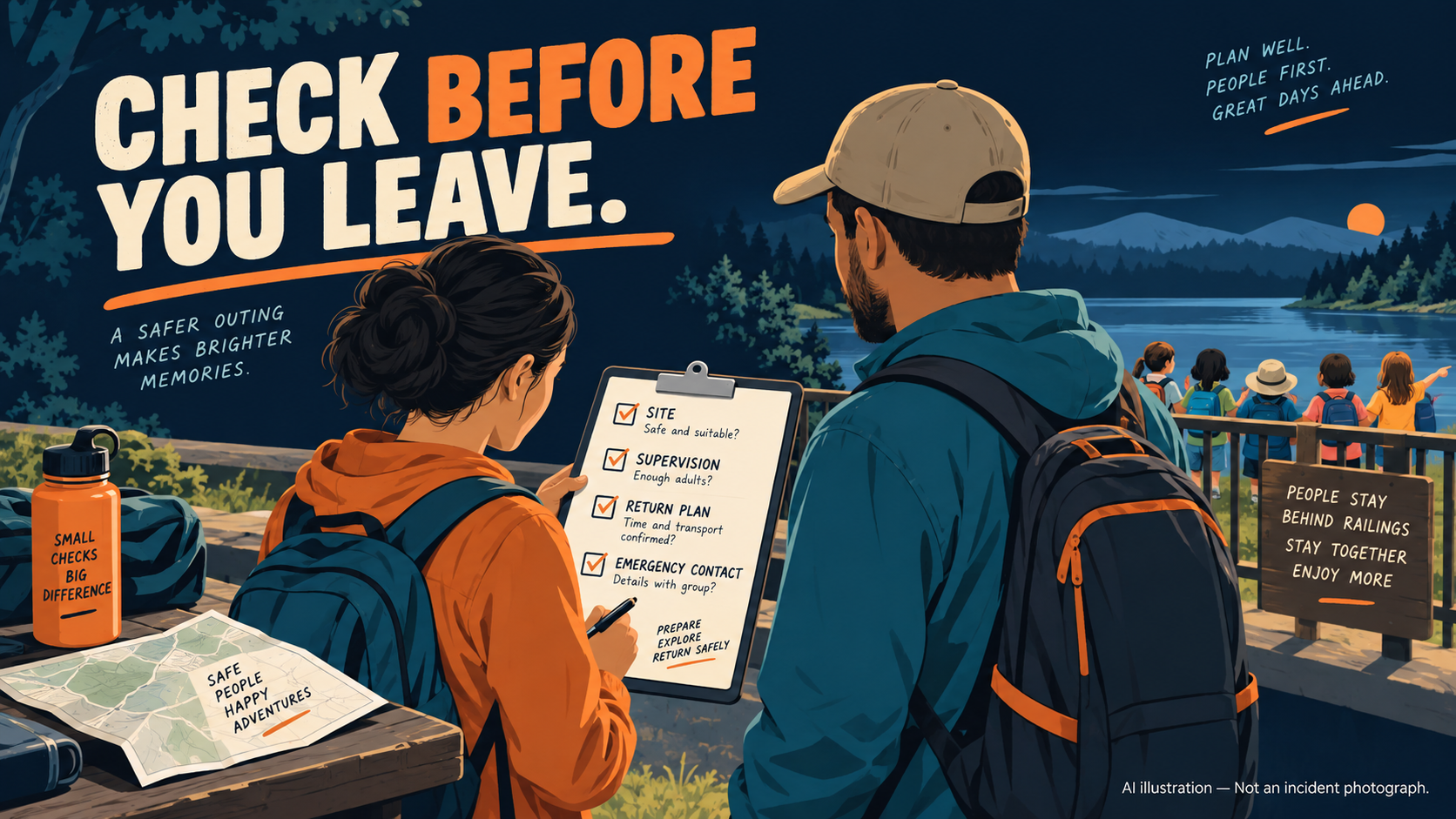
What needs attention
- Site designation is the start of the check, not its end. Families still need to know whether the site is operating at the intended time and where staff expect them to wait. General guidance cannot validate a particular lake on a particular evening.
- Supervision fails easily when responsibility is assumed rather than assigned. The organiser should make it explicit who watches participants while other adults handle the idol, transport or photographs. A named handover prevents the assumption that someone else is counting.
- A practical stop rule removes pressure to continue simply because the group has travelled. If the protected route or staff are absent, pause away from the water. Do not replace the agreed plan with a shortcut that no responsible organiser has assessed.
- Emergency preparation should simplify communication. Keep the waterbody name and access point available, distinguish last-seen information from assumptions and let trained rescuers direct the response.
Controls that reduce risk
- Group leader: confirm the current site and save the local organiser’s contact before departure. Tell participants that a changed site requires a fresh check.
- Supervising adult: keep a name list, make the waiting boundary clear and account for participants at every transition. Arrange a specific handover if you need to leave your role.
- Family member: explain that watching from shore is participation. Do not allow a child to follow someone into water or cross a barrier for a photograph.
- Site arrival contact: identify the staff member and emergency route. Keep the group away from vehicle movements and the water edge while checking arrangements.
- Emergency caller: call 112, describe the water emergency and exact access point, and follow instructions. Avoid guesses about the number missing; update the operator as names are checked.
- After the visit: confirm return and document hazards. Share the concern with the responsible organiser so the next group does not inherit the same uncertainty.
Understand and apply the guidance
Make the decision before reaching the water
A group outing should not depend on improvising at the edge of a lake. Decide where the group is going, who supervises it and how site staff will receive it. This guide combines official water-safety principles with an editorial planning checklist. It is not a certification that a particular site is safe.
Confirm the site and its operating arrangements
Ask the local authority or event organiser for the current designated location, opening period and contact. The CPCB revised idol-immersion guidance hosted by the Maharashtra Pollution Control Board addresses designated arrangements, crowd management, barriers, staffing and public information. Use the current local notice to turn those general arrangements into a specific destination. An old map pin is not confirmation that staff are operating today.
Ask where the group waits, who receives the idol and whether spectators must remain behind barriers. Confirm access for people who need assistance. If the organiser cannot explain the handover or emergency access, obtain clarification before departure. Do not substitute an unstaffed nearby pond because a queue is long.
Give supervision an owner
Name a group leader and a second contact. Divide supervision clearly so everyone knows whom to stay with. A headcount alone cannot show whether a particular child is missing: use a participant list and reconcile names at departure, arrival, before leaving the site and after return. This is an editorial organisational recommendation, not a universal legal staffing ratio.
Explain the simple boundary beforehand: participants stay in the waiting area and do not follow an idol or another person into the water. Agree on a visible meeting point away from the edge. Keep the person supervising children focused on them while someone else handles transport, ceremony arrangements or photography.
Check again on arrival
Plans need a visible reality check. Locate the staff member, protected waiting area and exit. Look for crowd pressure, an obstructed route or a missing barrier. Do not test depth by walking in. If the planned protection is absent, hold the group in a safe place and contact the organiser. Leaving or rescheduling is an acceptable outcome.
If someone is in difficulty
Immediately alert trained site rescuers and call 112 in India. Say what happened, the named waterbody, the accessible entrance and where the person was last seen. If several people are missing, distinguish confirmed names from an uncertain estimate. Send someone to guide responders only when the remaining group still has supervision.
The American Red Cross reaching-and-throwing lesson demonstrates assistance that avoids entering the water. Do not jump in or improvise a human chain. Follow the dispatcher and trained rescuers. Once someone is recovered, follow emergency instructions; provide first aid within your training and do not delay calling for professional help.
Close the outing properly
Before departure, reconcile the participant list and hand children back to the responsible adult through the agreed arrangement. Record any missing barrier, unsafe instruction or access problem and report it to the organiser. A near miss is useful only if it changes the next visit’s plan.
What this guide does and does not measure
There is no tested claim here that a checklist reduces risk by a particular percentage. WHO drowning-prevention guidance provides general context for supervision, barriers and rescue capability. The linked Sangareddy case explains why details matter, but one incident cannot establish the frequency of immersion emergencies across India.
Common unsafe practices
- A familiar waterbody is not evidence that today’s immersion route is supervised.
- A crowded location is not proof that the entry point is suitable.
- Swimming confidence is not a substitute for trained rescue arrangements.
- A group photograph cannot replace a named headcount and handover.
- A life-saving attempt should not begin with untrained entry or an improvised chain of people.
- A generated illustration must not be presented as an actual site photograph or technical design.
Leave a comment