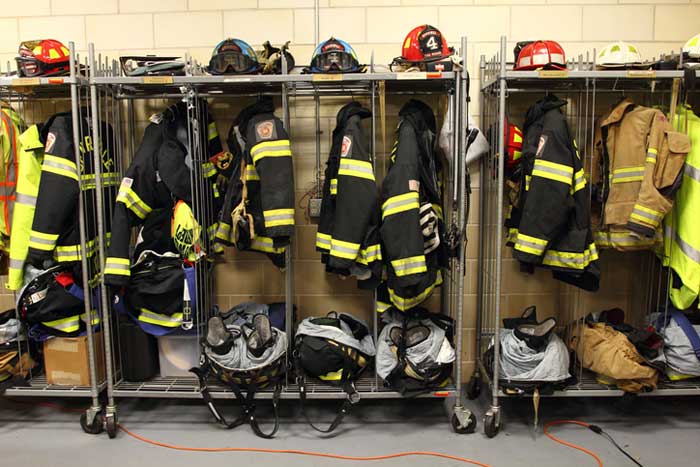
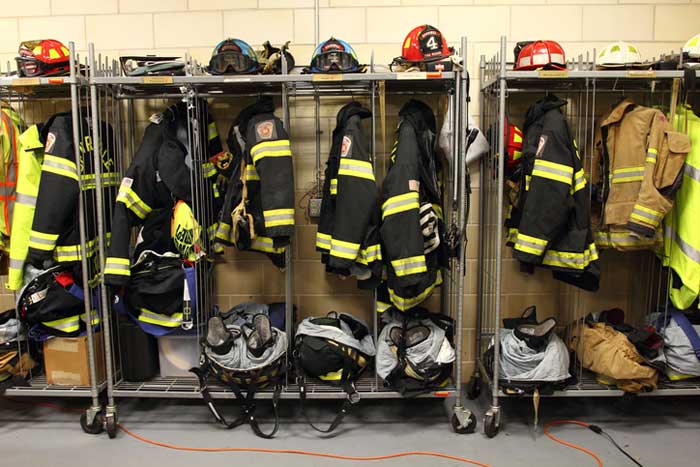
Firefighter PPE is a system: helmet, protective hood, coat and trousers, gloves, boots, eye and hearing protection where required, self-contained breathing apparatus, facepiece, personal alert safety system and communications. Each component covers a hazard and must work at its interfaces. The ensemble reduces heat, flame, impact, cut, liquid and inhalation exposure, but it does not make interior fire conditions safe or prevent every burn. Heat can pass through layers, moisture can become steam, stored thermal energy can burn after exposure, and heavy encapsulating gear can accelerate heat strain. Smoke deposits hazardous substances on clothing, skin, apparatus and stations, so protection continues through controlled doffing, on-scene exposure reduction, bagging, cleaning, inspection and clean storage. Safe operations still depend on size-up, command, crew integrity, accountability, air management, communications, rehabilitation and an early withdrawal decision.
TopicFire Safety · WorkplaceUpdated2026-08-31
01
The guide
Personal Protective Equipment
Key risks
What needs attention
The exported article correctly recognized heat, flame, impact and mobility hazards but treated PPE too broadly and did not explain its limits
Its statement that full-face respirators with high-efficiency filters provide clean air in fire smoke was unsafe; filters neither supply oxygen nor cover every unknown toxic gas
Firefighter protective clothing is layered and performance-based; naming a fibre such as Nomex or Kevlar does not prove that a complete garment is suitable
A moisture barrier helps limit liquid penetration but water and sweat inside an ensemble can still contribute to steam or compression burns
Reflective trim supports visibility but cannot replace accountability, lighting, radio discipline or crew integrity in dense smoke
Greater thermal insulation can also increase heat strain, bulk and reduced dexterity; protection and physiological burden must be managed together
PPE components can pass individual tests yet fail operationally if their interfaces leave gaps or restrict movement
SCBA rated duration is not working time; exertion, cylinder pressure, user physiology and conditions change consumption
Removing a facepiece during overhaul can expose firefighters after visible fire is controlled
Dirty gear is an exposure source; keeping it in cabs, bedrooms, offices, kitchens or personal vehicles spreads contamination
Cleaning must preserve the ensemble: unapproved bleach, solvents, excessive heat or home-machine methods can damage components
A helmet, hood or coat involved in severe heat, chemical exposure, impact or suspected failure needs controlled evaluation rather than a quick visual return to service
PPE selection must follow the incident hazard; no single ensemble covers structural fire, wildfire, hazardous materials, electrical arc, proximity and medical response
Prevention checklist
Controls that reduce risk
Inventory every PPE component by wearer, model, size, issue date, inspection status and compatible ensemble
Confirm that procurement specifications cite the applicable Indian standard and required performance level
Remove unverified, counterfeit, expired, damaged or incompatible equipment from operational issue
Create a written pre-use check for clothing, helmet, hood, gloves, boots, SCBA, facepiece, cylinder, PASS, radio and accessories
Provide medical clearance, quantitative or accepted fit testing and model-specific SCBA training
Prohibit facial hair or equipment that crosses a required tight facepiece sealing surface
Train crews to don fully, close all interfaces and perform functional and seal checks before entry
Set air-management and withdrawal rules that preserve reserve air for exit and emergencies
Integrate MAYDAY, PASS, emergency bypass, entanglement and reduced-visibility drills
Monitor heat strain and provide structured rehabilitation, cooling, hydration and medical evaluation
Keep SCBA on through overhaul until monitoring and command confirm respiratory protection can be reduced
Establish on-scene exposure reduction, clean doffing, skin cleaning, bagging and separate transport
Provide approved laundering, drying, inspection, repair and clean storage—never living-space storage
Document any adverse heat, chemical, impact or equipment event and quarantine affected components
Audit interface fit and mobility while crawling, climbing, reaching, kneeling and handling tools
Use incident-specific selection for wildland, hazardous-material, electrical, proximity, rescue and medical work
Practical guide
Understand and apply the guidance
Introduction
When disaster strikes and flames engulf, firefighters stand as the unsung heroes battling the elements to save lives and property. These brave men and women often put their lives on the line to protect us. Yet, they are not invincible. In the perilous world of firefighting, Personal Protective Equipment (PPE) is their armor – an arsenal of gear that not only enhances their safety but also empowers them to carry out their duties effectively. In this article, we delve into the profound significance of PPEs in firefighting and why they are the backbone of every firefighter’s toolkit.
The Evolution of Firefighting PPE
Historically, firefighting was a hazardous endeavor with little to no protection for firefighters. However, the realization of the critical role PPE plays in ensuring their safety led to a significant evolution in the design and technology of firefighting gear. The modern firefighter’s ensemble is a carefully crafted combination of materials, engineering, and innovation – a testament to the commitment to safeguarding those who risk their lives to save others.
Shielding from Heat and Flames :- The most visible and arguably the most critical role of PPE in firefighting is shielding firefighters from the intense heat and flames they encounter on the front lines. Fire- resistant outer layers, often made of advanced materials like Nomex or Kevlar, form the first line of defense. These materials not only withstand high temperatures but also have the ability to self-extinguish, minimizing the risk of secondary burns. Additionally, the gear includes layers of moisture barriers that prevent the penetration of water, which could otherwise cause steam burns. The layers work together to create a thermal barrier that allows firefighters to approach the flames, conduct rescues, and control the blaze without succumbing to the intense heat.
Respiratory Protection :- In any fire, smoke and toxic gases are as formidable as the flames themselves. PPE includes full-face respirators with high-efficiency filters to ensure firefighters have a clean air supply, protecting them from inhaling dangerous particles and noxious fumes. These respirators also prevent smoke inhalation, which can lead to respiratory issues and long-term health problems.
Impact and Puncture Resistance :- Firefighters often encounter debris, falling objects, and structural hazards during their operations. PPE includes reinforced helmets, gloves, and boots to provide impact and puncture resistance. These elements not only guard against physical injuries but also allow firefighters to navigate challenging environments more confidently, enabling them to focus on the task at hand.
Enhancing Visibility :- Navigating through a smoke-filled environment is a daunting task. PPE incorporates high- visibility elements such as reflective strips and patches, making firefighters more visible to their team members and improving coordination during operations. This visibility is crucial for ensuring the safety of the entire firefighting crew and preventing accidents within the chaotic environment.
Ergonomics and Mobility :- Modern PPE is designed with ergonomics and mobility in mind. Firefighters need to move quickly and efficiently in high-stress situations. The gear is engineered to allow for flexibility while maintaining the highest level of protection. Articulated joints, lightweight materials, and well-fitted suits enable firefighters to perform their duties without feeling restricted by their equipment.
Conclusion
In the realm of firefighting, the significance of Personal Protective Equipment cannot be overstated. It’s not merely gear; it’s a lifeline. PPE empowers firefighters to confront the most hostile environments, to save lives and property without compromising their own safety. The evolution of firefighting PPE showcases the dedication of the firefighting community to continuously innovate and adapt to the challenges they face. As we witness the awe-inspiring bravery of firefighters battling blazes, let us also acknowledge the instrumental role that PPE plays in making these feats possible. The commitment to protecting those who protect us is evident in the meticulous design and construction of these gear ensembles. So, the next time you see a firefighter in action, remember the layers of protection they wear – a shield against the heat, a barrier against toxins, and a symbol of unwavering courage.
Mistakes to avoid
Common unsafe practices
Entering smoke without positive-pressure SCBA because a filter mask is available
Using air-purifying respirators in an unknown, oxygen-deficient or IDLH atmosphere
Assuming a material name or product appearance proves compliance
Mixing certified components without checking ensemble and interface compatibility
Wearing the wrong size or leaving coat, trouser, hood, glove or boot interfaces open
Skipping facepiece fit testing, seal checks or medical clearance
Allowing facial hair, eyewear or straps to interfere with the face seal
Starting work with an underfilled cylinder, damaged facepiece or untested alarm
Treating cylinder rated duration as guaranteed operating time
Working alone, separating from the crew or ignoring accountability
Waiting for the low-air alarm before planning withdrawal
Removing the facepiece during overhaul before atmospheric monitoring confirms safety
Continuing despite heat-illness signs, damaged gear or changing fire conditions
Carrying soot-covered gear in passenger cabs or personal vehicles
Taking contaminated turnout gear home or into living areas
Cleaning gear with household bleach, solvents or unapproved high heat
Returning damaged or heavily exposed equipment to service without documented evaluation
Using structural turnout gear for a chemical, electrical, wildland or proximity hazard without proper selection
02
Watch & learn
Related Videos
Captions
SCBA parts, checks and donning overview; supplement with department/manufacturer training
SCBA (BA Set) कैसे Use करें?
Fire Safety Educate · Hindi · Verified
Verified with YouTube oEmbed
03
Facts & action
Evidence, Cases & Next Steps
1 ensembleMinimum unit of evaluationComponents and interfaces must work together
100%Required face-seal integrityHair, straps or eyewear must not cross the sealing surface
0Acceptable interior-fire entries without suitable SCBAUnknown smoke can be toxic and oxygen deficient
Evidence chart
Wrong gear can expose the responder even when fully wornCorrect hazard-specific ensemble
Protects breathing in qualifying toxic or oxygen-deficient atmospheresPositive-pressure SCBA and seal
Gaps can expose skin to heat, flame, liquids and contaminantsComplete interface closure
PPE cannot rescue a firefighter who runs out of air or becomes isolatedAir management and crew integrity
Encapsulating gear adds major physiological loadHeat-strain controls and rehab
Damage, wear and contamination degrade performanceInspection and maintenance
Reduces transfer to skin, apparatus and stationOn-scene decontamination and clean doffing
Prevents suspect equipment returning unnoticedDocumentation and quarantine
Helpful, but limited in dense smokeReflective trim and visibility
Does not establish ensemble compliance or correct useBrand or fibre name alone
PPE is an ensemble | Helmet, hood, coat, trousers, gloves, boots, SCBA, facepiece and alarms must be compatible and correctly worn
Respiratory rule | Smoke and unknown or oxygen-deficient atmospheres require suitable positive-pressure SCBA; ordinary filter respirators do not supply oxygen
Indian clothing standard | IS 16890:2018 specifies design, performance and testing requirements for firefighters' protective clothing for heat and flame hazards
Fit matters | Incorrect sizing or gaps at hood-mask, glove-sleeve, boot-trouser and coat-trouser interfaces can defeat otherwise compliant components
SCBA preparation | Medical clearance, fit testing, training, inspection, seal checks and air-management practice are essential
Facial hair | Hair in the sealing surface can prevent a tight-fitting facepiece from sealing correctly
Thermal limit | Turnout gear delays heat transfer; it does not provide unlimited protection or guarantee freedom from burns
Heat strain | Heavy, insulated PPE restricts heat loss and increases physiological workload; rehab, hydration and work-rest controls remain necessary
Contamination | Soot and combustion products can transfer from gear to skin, vehicles, stations and homes
Doffing | Remove contaminated equipment using a trained sequence that limits skin contact; keep respiratory protection on until the atmosphere is confirmed safe
Cleaning | Follow the manufacturer and department procedure; do not use improvised chemicals that can damage protective performance
Hazard-specific selection | Structural gear is not automatically suitable for wildland, chemical, electrical, proximity or medical response
Do This Today
Immediate prevention actions
Check the identity, size and condition record for every assigned PPE component
Inspect the facepiece lens, seal, straps, regulator, hoses, cylinder pressure, alarms and PASS
Perform the approved SCBA functional and seal checks with the actual assigned model
Confirm no facial hair or equipment crosses the facepiece sealing surface
Don the complete ensemble and inspect hood-mask, glove-sleeve, coat-trouser and boot-trouser interfaces
Practise moving, crawling, climbing and handling tools without opening protective gaps
Review the crew's air-management and low-air withdrawal rule
Identify where contaminated gear is doffed, bagged, transported, cleaned and stored
Remove dirty gear from passenger cabs, offices, bedrooms and eating areas
Quarantine damaged or heavily exposed items and document the reason
Confirm rehab, cooling, drinking water and medical support for training and incidents
Schedule any overdue medical clearance, fit test, competency drill or inspection
If Fire Starts
Emergency survival steps
Members of the public must evacuate and call 112; do not enter a fire because protective clothing or a respirator is available
Firefighters should enter only under incident command, in the correct ensemble, with functioning positive-pressure SCBA, accountability, communications, a crew and a protected withdrawal plan
If the facepiece leaks, regulator fails or air supply changes unexpectedly, notify the crew and command, use the trained emergency procedure and withdraw immediately
At the low-air alarm, leave with the crew; do not treat reserve air as working time
If lost, trapped, injured or separated, declare MAYDAY early with identity, location, problem and needs; activate or confirm PASS and conserve air
Do not remove the facepiece in smoke or during overhaul until monitoring and command confirm a safe atmosphere
If gear becomes dangerously hot, damaged or penetrated, communicate and move to a safer area without delay
Recognize confusion, dizziness, cramps, headache, weakness, unusual fatigue and altered behaviour as possible heat illness or exposure; leave the hazard and obtain medical assessment
After exposure, complete controlled decontamination and doffing, clean skin, change clothing and isolate gear from clean spaces
Report any burn, inhalation, chemical exposure or equipment malfunction even when symptoms appear minor
Quarantine suspect equipment after severe heat, chemical contact, impact, near miss, serious injury or failure
Re-enter only after command reassessment, air and crew readiness, and correction of the condition that forced withdrawal
What the data does not show
Limitations
Public Indian sources do not provide one national open dataset for firefighter PPE failures, burns, contamination or fit-test compliance
IS 16890 addresses protective garments, not every component of a complete firefighter ensemble
Exact inspection, cleaning, retirement and testing intervals vary by standard, manufacturer, department, exposure and jurisdiction
NIOSH and OSHA requirements cited are U.S. references and may exceed or differ from Indian legal duties
SCBA selection depends on atmosphere, duration, work, certification and departmental programme
Video demonstrations may show different models and procedures; users must follow their own equipment instructions and approved training
The legacy images have no verified caption, date, photographer or licensing metadata in the export
This article cannot authorize entry, replace hands-on training or assess whether any specific item is serviceable