
Case Study
What happened here
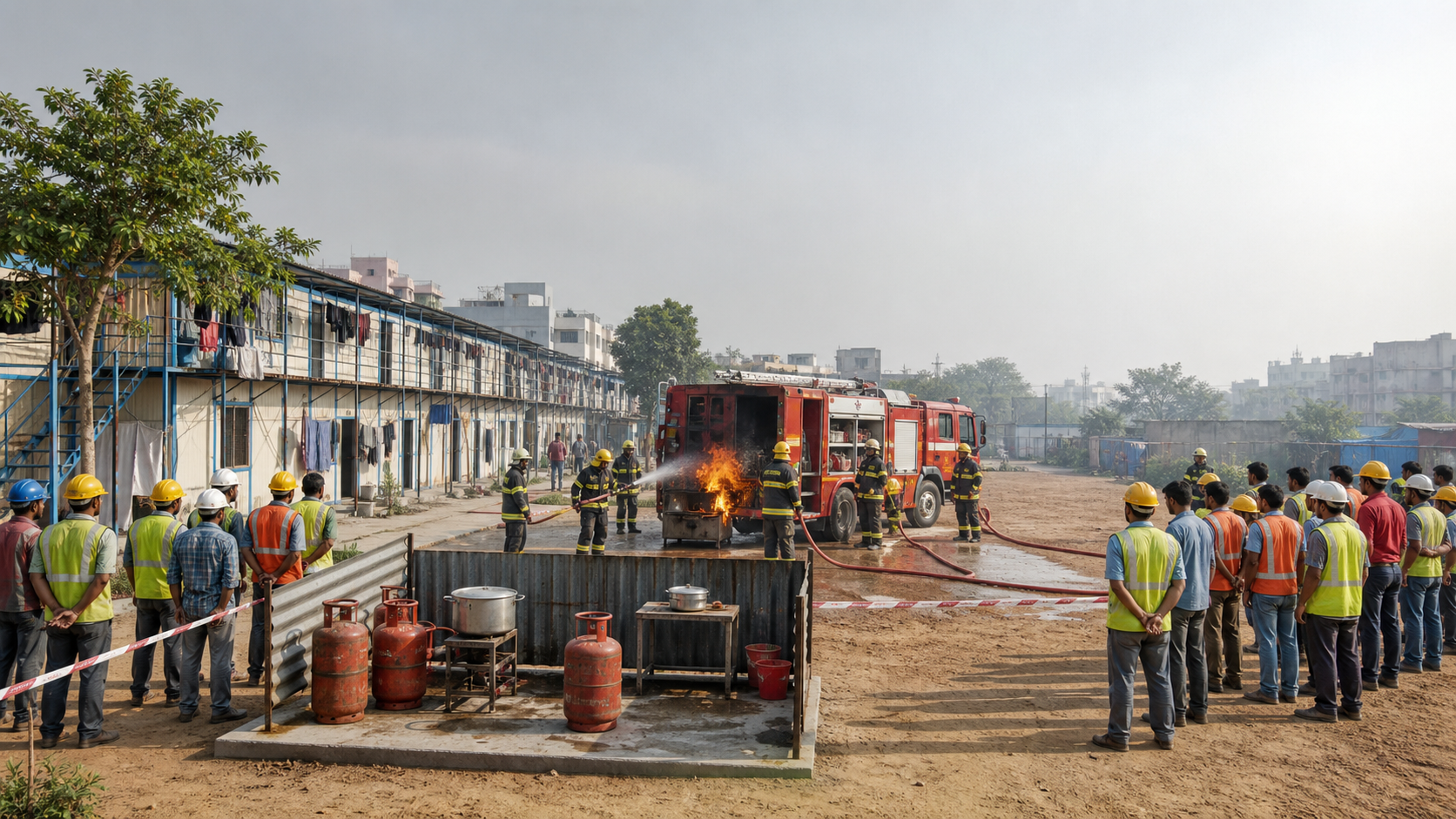
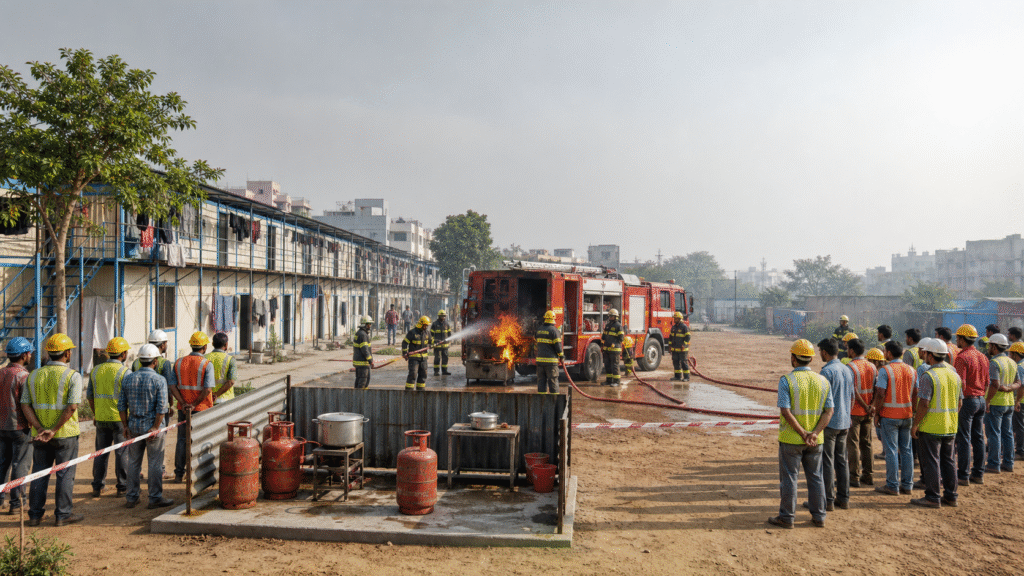 1 / 2
1 / 2 Reported cylinder explosionsAt least 12
Temporary sheds damaged67 of 127
Fire tenders5
Reported control timeAbout 2.5 hours
Deaths or injuriesNone reported
A canteen-area fire spread through temporary worker shelters and reportedly involved at least 12 LPG cylinders; workers evacuated and no casualties were reported.
Coimbatore LPG Shelter Fire: Safety Lessons from the Nava India Cylinder Explosions
**HowToSurvive.in | Know Before You Need to Know**
## 📅 Date & Location
– **Incident date:** 29 August 2026, approximately 12:30 PM
– **Location:** Nava India area, Avinashi Road, Coimbatore, Tamil Nadu, India
– **Occupancy:** Temporary sheds housing workers employed at a nearby construction project
– **Incident type:** Rapid fire spread through temporary accommodation followed by multiple LPG-cylinder explosions
– **Outcome:** No injuries or deaths reported in the principal sources reviewed
## 🕯️ What Happened?
A fire began in or near a canteen/cooking area within a group of temporary worker shelters at Nava India. Workers reportedly escaped before the fire spread through adjacent sheds and heated LPG cylinders, causing a series of explosions.
Five fire tenders were deployed in the two most detailed English-language reports reviewed. Firefighters brought the blaze under control after roughly two and a half hours, evacuated people from the area and removed additional cylinders before they could become involved.
The New Indian Express reported that 67 of 127 sheds were damaged, at least 12 cylinders exploded and nearly 14 cylinders were recovered. The Times of India also reported more than 12 explosions, but quoted a larger recovery figure of more than 24 cylinders, including ten described as bulged. Other reports published different totals. The safe conclusion is therefore **at least 12 cylinders exploded and multiple additional cylinders were removed**, not that one precise total has been independently established.
## 📊 Incident Snapshot
| Item | Verified or carefully reported information |
| Time | Approximately 12:30 PM on 29 August 2026 |
| Location | Nava India, Coimbatore |
| Fire tenders | Five in the two principal detailed reports |
| Fire duration | Approximately two and a half hours in one fire-service account |
| Cylinder explosions | At least 12; higher totals appeared in other reports |
| Additional cylinders removed | Multiple; published totals differ |
| Sheds damaged | 67 of 127 reported by The New Indian Express |
| Casualties | No injuries or deaths reported |
| Cause | Cooking/cylinder use and a reported gas leak were described; final investigation finding not reviewed |
## ⏱️ Reported Timeline
**Around 12:30 PM**
A fire reportedly began while tea was being prepared in a canteen or shelter cooking area.
**Minutes later**
The fire spread rapidly through neighbouring temporary sheds. Workers moved away from the area.
**During the fire**
Multiple LPG cylinders became heated and exploded in succession. Fire and rescue personnel established operations while ambulances were positioned as a precaution.
**Over the next hours**
Five fire tenders fought the blaze. Firefighters removed additional cylinders and brought the fire under control.
**Initial outcome**
No injuries or deaths were reported, but dozens of shelters and workers’ belongings were damaged or destroyed.
## ✅ Confirmed Facts vs ⚠️ Unsettled Details
### Supported by the principal reports
– The incident occurred in temporary accommodation for construction workers at Nava India.
– Fire spread through multiple sheds and involved numerous LPG cylinders.
– At least 12 cylinders reportedly exploded.
– Firefighters removed additional cylinders and prevented further escalation.
– No casualties were reported.
### Not sufficiently settled
– The exact number of cylinders that exploded.
– The exact number and condition of cylinders recovered.
– Whether the first event was a cylinder leak, appliance/connection failure or another ignition sequence.
– The full storage arrangement, cylinder ownership, inspection history and compliance status.
– Whether every sleeping shed and cooking area had adequate separation, detection, extinguishers and exits.
## 🔍 Why the Fire Escalated
### 1. Lightweight shelters can permit fast spread
Closely spaced temporary structures may have combustible contents, limited compartmentation and little resistance to heat transfer between units.
### 2. Cooking and sleeping risks may share one compound
When cooking, cylinder storage, sleeping and personal belongings occupy the same dense layout, a small fire can threaten many people and cylinders before responders arrive.
### 3. One heated cylinder can become a multi-cylinder emergency
LPG cylinders exposed to severe heat can vent, rupture or become involved as conditions deteriorate. The correct protection is distance, cooling by trained firefighters, evacuation and control of the whole cylinder inventory—not crowds attempting close-range firefighting.
### 4. Temporary housing is often treated as temporary risk
The people living there face the hazard every night. Fire detection, clear exits, emergency lighting, safe cooking areas and evacuation drills cannot be postponed because the buildings are temporary.
### 5. Language and shift patterns matter
Migrant and guest workers may speak different languages or work different shifts. Alarms, signage and drills must reach everyone, including people sleeping during daytime operations.
## 🧯 Prevention Layers
### SEPARATE
– Keep cooking and LPG-cylinder areas away from sleeping accommodation and escape routes.
– Prevent excess or standby cylinders from accumulating in living areas.
– Maintain clear spacing and firebreaks between rows of shelters.
### STORE SAFELY
– Keep cylinders upright and protected from being knocked over, consistent with PESO guidance.
– Use approved cylinders, regulators, hoses and appliances.
– Keep cylinders away from heat, electrical panels and combustible storage.
– Assess whether the quantity stored requires specific licensing, separation or a dedicated storage arrangement.
### DETECT AND WARN
– Provide suitable smoke/heat detection and a site-wide alarm people can recognise.
– Use multilingual visual and audible warnings.
– Ensure night workers and day sleepers can hear the alarm.
### PROVIDE ESCAPE
– Maintain at least two independent escape directions wherever practicable.
– Keep passages illuminated, unlocked and free of stored materials.
– Mark an outdoor assembly point away from cylinders and fire-service access.
### PREPARE
– Train wardens on alarm, evacuation, LPG isolation only when safe, headcounts and emergency calls.
– Keep extinguishers suitable for the risk, maintained and accessible.
– Give responders a site plan showing cooking areas, cylinder locations, electrical isolation and occupancy.
## 🛡️ What Workers Should Do
### If you smell gas before a fire
– Do not operate electrical switches or create a flame.
– Extinguish open flames if this can be done immediately and safely.
– Move people away and ventilate naturally when safe.
– Close the cylinder valve only if it is safe and you know how.
– Call the LPG emergency helpline **1906** and site management from a safe location.
### If fire reaches a cylinder area
– Raise the alarm and evacuate immediately.
– Move away from the direction of smoke and cylinders.
– Do not return for belongings.
– Do not crowd around or film the fire.
– Keep access clear for fire tenders and ambulances.
– Call **112** and provide the exact entrance and number of people unaccounted for.
## ⚖️ Truth You Must Know
**“No casualties” does not mean “acceptable safety.”**
Workers escaped, firefighters prevented further escalation and lives were spared. But dozens of homes within the worksite were damaged. A near miss is a warning delivered before a higher human cost.
## 📢 Systemic Lesson
Employer-provided accommodation is part of the workplace safety system. The duty to protect workers does not end when a shift ends.
Temporary housing needs permanent standards: safe construction, separated cooking, controlled LPG inventories, working alarms, clear exits, multilingual training and accountable inspections.
## 💡 What You Can Do Today
– Inspect every employer-provided accommodation block as seriously as the worksite.
– Separate cooking and cylinder storage from sleeping rooms.
– Check cylinders, hoses and regulators for damage and approved markings.
– Post **112**, **101** and LPG emergency helpline **1906** in workers’ languages.
– Run a headcount-based evacuation drill for every shift.
– Ask one question: **If one cooking fire starts, what stops it reaching every bed and cylinder?**
## 🔚 Closing Line
Housing may be temporary. The people inside it are not. Their fire protection must never be temporary either.
- Fire reportedly begins near a canteen shelter
- Adjacent temporary accommodation becomes involved
- At least 12 LPG cylinders reportedly explode
- Occupants reach safety without reported casualties
- Five tenders control the incident in about 2.5 hours
Why consequences escalated
- Temporary accommodation needs permanent-grade separation, detection and escape
- Bulk LPG cylinders must not be dispersed through combustible sleeping shelters
- Canteens should be separated from sleeping accommodation
- Cylinder inventories and shut-off access aid responders
- Evacuation prevented a mass-casualty outcome
Failures and risk multipliers
- Allowing sleeping or crowd occupancy without a risk-specific plan
- Depending on one escape path
- Treating an unverified cause claim as a final investigation finding
- Failing to control fuel, combustible stock or structural loads
- Leaving inspection defects unresolved
People closest to the evidence
““Safety principle””
Detection, separation, stable construction and redundant escape must be established before people enter the hazard area.
Actions that reduce risk
- Verify alarms and two escape routes
- Keep exits and emergency access clear
- Separate sleeping areas from fuel, cooking and storage
- Control crowds outside structural fall zones
- Record inspections and close every defect
- Call 112 with the exact location
Leave a comment