
Case Study
What happened here
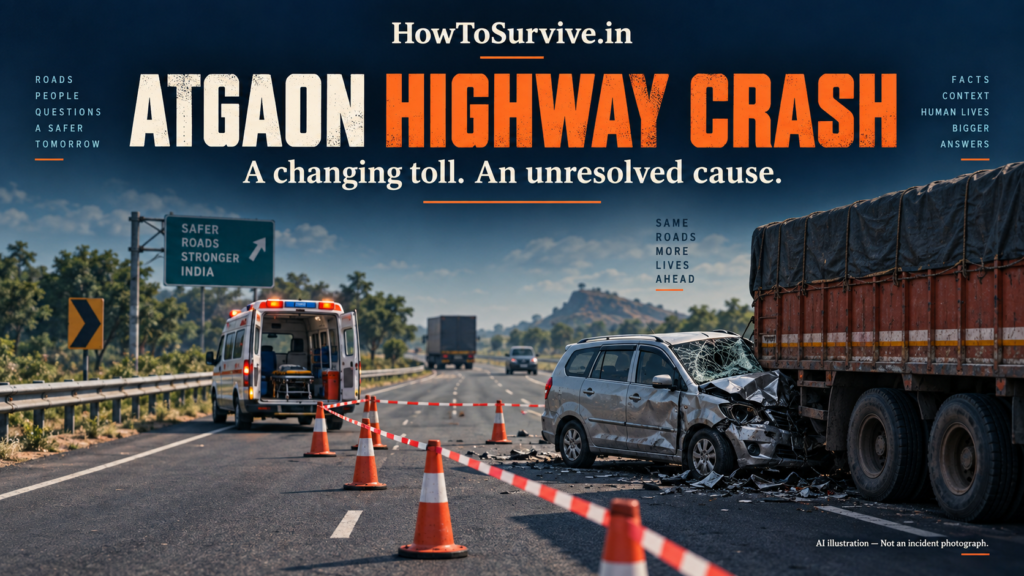
EventA family’s MPV struck a stationary roadside truck while returning towards Mumbai.
Reported timeApproximately 13:15 IST on 16 September, Loksatta updated 18:41 IST and Amar Ujala 23:35 IST.
Latest reported casualtiesFive deaths and six injured in later reporting; not an independently obtained final hospital register.
Earlier snapshotMaharashtra Times reported four deaths and seven injured at 20:06 IST; publication order alone does not establish when each newsroom received an update.
ChildrenTwo children among the reported dead; names and portraits are unnecessary for the safety analysis.
Vehicle occupancyEleven people reported in the family vehicle. Seat allocation, restraint use and registered seating particulars were not verified.
CausePossible brake/steering problems reported, without a published technical finding.
Damage and responseMPV extensively damaged; crane clearance reported. Rupee loss, responder counts and timed rescue milestones unavailable.
What we can say safely
A family MPV struck a stationary truck near Shahapur on 16 September. Later reports recorded five deaths and six injuries; the reported mechanical fault remains unconfirmed.
- Family members from Jogeshwari travelled to Trimbakeshwar; exact departure time differs between accounts and is not needed to establish the collision.
- Reported collision near Atgaon during the Mumbai-bound return journey. This is a reported event time, not a verified emergency-call timestamp.
- Local people and Shahapur police assisted; injured people were taken for hospital care. No dispatch, arrival or extrication log was obtained.
- Early article reported four deaths and six injuries. This incomplete early snapshot should not be treated as a total occupancy list.
- Article reported five deaths and six injured; older search snippets and its image caption still carried the four-death version.
- Report retained four deaths and seven injured, demonstrating that later publication time does not necessarily mean a newer casualty count.
- Five deaths and six injured reported, with one death during transfer described. The next morning’s Hindustan Times report corroborated the 5/6 toll.
- No final crash reconstruction, mechanical report or complete medical outcome record found in the reviewed sources.
Why consequences escalated
- The incident boundary is specific: a returning family group, a car/MPV, a stationary truck and the Mumbai-bound highway near Atgaon on 16 September. It is not the older Shahapur girder collapse, a separate train-station demolition accident or a motorcycle crash in Malvan. All appeared near relevant video searches. Matching a general place name or a headline mentioning children is insufficient to identify the footage.
- Loksatta’s updated account places the collision at about 13:15 and reports five deaths and six injuries. Its page illustrates a common reporting problem: the live article had been revised while a search excerpt and photograph caption still reflected the earlier toll. This case uses the dated updated account, while retaining the earlier numbers only to explain the evidence trail. It does not add successive counts together.
- Amar Ujala describes eleven relatives in the vehicle, people trapped in the damaged car and assistance by residents and police. It reports care across Shahapur and Sion hospitals and the death of an older relative during transfer. Those details explain why a count could change, but they do not establish a medical cause of death or prove that any transfer decision was inappropriate.
- The stationary truck is a material part of the reported collision setting. Maharashtra Times describes it as having stood off the road for a long period. Its account attributes the preliminary steering-lock theory to the local police officer. Establishing the truck’s exact position, visibility, ownership and removal history would require records or scene evidence that were not obtained. A report of longstanding abandonment raises a road-management question; it does not by itself establish legal responsibility.
- A passenger’s reported account of brake failure and steering lock is testimony to investigate. The phrase technical fault in a headline should not be mistaken for an engineering conclusion. A competent reconstruction would examine the vehicle, the approach path and any usable recordings, and distinguish pre-impact damage from damage caused by the crash. This article has no such technical report and assigns no definitive ignition, braking, steering or driver-error mechanism.
- Neither the photographs nor the occupant count establishes who wore a seat belt, which seats were occupied, whether child restraints were present, or whether a particular injury would have been prevented by a different arrangement. Those are important investigation questions, especially because children died, but an evidence-led case must not fill them with assumptions about this family.
Failures and risk multipliers
- Do not publish four and five deaths as two separate losses or describe all eleven occupants as both injured and dead. The latest paired tally is a reporting snapshot; later medical changes remain possible.
- Do not use the term brake failure as a settled finding, blame the driver from a short clip or assume the presence of a roadside truck proves the full causal chain. Reported conditions are not the same as proven causes.
- Do not copy a bystander’s physical rescue method from news footage. An unstable vehicle, live traffic, leaking fuel or trapped occupants can require specialised rescue. Public assistance and professional extrication are not interchangeable.
- Do not use an illustrative stock crash image as a real photograph of this event. Amar Ujala explicitly labels its image illustrative. The supplied cover is also an AI illustration, and is visibly labelled.
Actions that reduce risk
- What is documented about help: local people reached the scene, police participated and injured people received hospital care. ABP’s early report describes prompt local involvement and the police being called. These are reported actions, not measured response times. There is insufficient evidence to score the rescue, compare hospitals or claim that a particular intervention saved a named person.
- Roadside safety review should separate collision prevention from injury mitigation and emergency response. For the road operator, the unanswered issues include whether the parked truck had been logged as a hazard, which authority was responsible and what action followed. For investigators, the key issue is why the moving vehicle left its intended path. For response planners, it is how access, extrication and medical transfer were coordinated. These are different questions with different evidence needs.
- A comparable fleet or family vehicle should have reported steering or braking concerns assessed by a competent workshop rather than dismissed or diagnosed from this news story. Drivers should follow the vehicle maker’s instructions and obtain professional advice about a defect. This case offers no improvised driving manoeuvre for a sudden failure and no claim that a specific repair would have prevented the Atgaon collision.
- For witnesses, useful help begins without creating another collision. Call from a safe position, give the direction of travel and a recognisable location, describe visible hazards and tell the operator if people are trapped. Leave technical rescue and traffic control to responders. The accompanying guide explains the boundary between useful assistance and unsafe intervention.
- Follow-up evidence needed: a police or authorised technical finding, a consolidated casualty update, emergency-call and arrival records, the truck’s documented location and removal history, and any verified restraint findings. A later report should update this stable incident record. A repeat headline about the same event is not a new daily case.