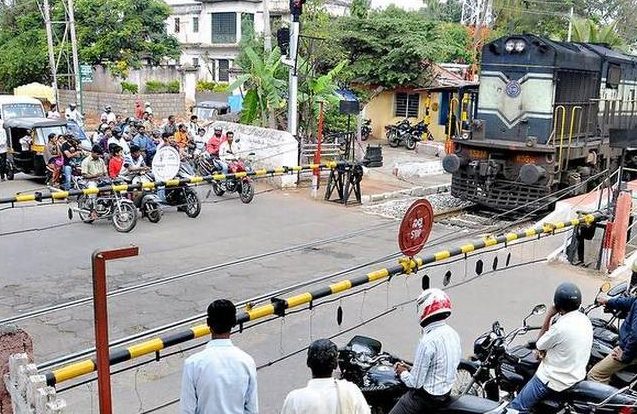
A level crossing is where a road or path meets a railway line at the same height. It is not a shortcut across open tracks. This guide covers ordinary road users and pedestrians, not train operations.
Before you reach the crossing
Slow down and look for the crossing signs, lights, alarm, barrier and any instruction from railway staff. Leave room between your vehicle and the gate so you can stop without blocking a junction or being trapped on the tracks. Put away the phone and remove headphones that prevent you hearing warnings. If you are walking with children or someone who needs support, stay together behind the marked waiting point.
When the gate is closed or warnings are active
Stop and wait. Southern Railway explicitly tells road users not to cross a closed level-crossing gate. Never walk around, climb under, drive through or lift a barrier, even if you cannot see a train. A train may be approaching from either direction, and another may follow the first. Do not photograph, take selfies or gather beside the track while waiting. If the wait is long, use an authorised road-overbridge, underpass or another marked route rather than crossing the rails.
When the gate opens
Wait until the barrier has fully opened, warnings have stopped, and the designated path is clear. Check both directions and proceed without stopping on the tracks. Keep enough space ahead for your whole vehicle to clear the crossing. A green or open road-side signal is not permission to ignore a railway employee’s stop direction or an obstruction ahead.
If a vehicle is stuck on the tracks
Get all occupants away from the vehicle and the railway line immediately. Do not remain on the tracks to retrieve possessions or attempt an unsafe rescue. Warn others from a safe place and contact the gateman or station staff. Call 112 for immediate danger and give the crossing number or nearby landmark if visible; follow the operator’s directions. Do not assume a train can stop in the distance you can see.
If you cannot use the crossing safely
Do not improvise a track crossing for a wheelchair, bicycle, pram or animal. Ask railway staff for the designated accessible route, or use a marked overbridge, underpass or alternative crossing. If a barrier or signal appears faulty, stay out of the railway area and report it to staff; do not test the track yourself.
Why an older video is labelled historical
The Ministry of Railways’ 2017 “Unmanned Level Crossing Awareness Movie” illustrates the danger of crossing without checking. It is educational context, not proof that unmanned broad-gauge crossings remain in normal use today: the Railway Ministry reported that all unmanned broad-gauge level crossings had been eliminated by 2019. The current instruction at a guarded crossing remains simple: obey the gate and signals, wait, and use only the authorised route. The video may need to be opened at its publisher if embedding is unavailable.
Reviewed 6 October 2026. This is general public-safety guidance based on Southern Railway’s crossing warning, Indian Railways’ gate rules, the Ministry’s 2026 status update, and India’s 112 emergency system. Local signs and authorised staff directions control at a particular crossing. The cover is a generated editorial illustration of a generic crossing, not a photograph of a real site.
What needs attention
- A closed barrier and active warning mean stop, even when no train is visible.
- The designated route, not an informal track shortcut, is the safe route.
- Broad-gauge unmanned crossings were eliminated by 2019; a 2017 Ministry video is historical awareness content, not a description of today's network.
- An obstruction on the line must be reported to railway staff promptly; the gateman has prescribed procedures to protect trains.
Controls that reduce risk
- Use only authorised crossings or an overbridge/underpass.
- Make sure the road ahead has room for the whole vehicle before entering.
- Teach children to wait behind the barrier and stay together.
- Report a faulty gate or obstruction from a safe place to railway staff.
- If a vehicle becomes stuck on the tracks, evacuate and call for help.
Common unsafe practices
- Walking under or around a closed barrier.
- Assuming a second train cannot follow the first.
- Stopping a vehicle on the rails because traffic ahead has not cleared.
- Taking a selfie or looking at a phone beside the track.
- Remaining in a stalled vehicle on the crossing to retrieve belongings.
Leave a comment