
Quick answers
Can I attend a peaceful protest?
Article 19(1)(b) protects Indian citizens' peaceful, unarmed assembly, subject to lawful, reasonable restrictions. Check the current place, time and route conditions.
What if I am only passing by?
Use an open alternative route if the area is crowded; do not block exits or emergency access to film. Call 112 for immediate danger.
What if I lose a friend or child?
Do not push back into a dense crowd. Go to your planned meeting point, tell responders the last-known location and time, and call 112 if there is immediate danger.
What if a route closes or people push a barricade?
Step away from the pressure, check current official directions and use a safe open exit. Seek legal advice later if you dispute an order.
What should I ask if police take me away?
Ask whether you are free to leave, detained or arrested, the grounds and destination, and how to reach a lawyer and someone you nominate. Request medical help if injured.
Does a short video prove misconduct?
No. Keep the original recording and verify its date, place and full sequence before alleging that an individual did something wrong.
Can I still protest at Jantar Mantar?
As of 21 October 2026, Delhi Police has removed Jantar Mantar from its list of designated protest venues (standing order of 11 October) and named Ramlila Maidan, Burari Ground and CBD Ground. The Supreme Court has issued notice on a challenge, so this may change. Check the latest police order before you travel.
What is a Section 163 order?
It is a prohibitory order a magistrate can issue under the BNSS, which replaced Section 144 of the old CrPC. In Delhi in October 2026 such orders barred gatherings of five or more people, processions and dharnas without written permission. Read the actual order for your area and date; challenges to the orders are listed in the Supreme Court for 19 November 2026.
What happened to the CJP leaders held after the Jantar Mantar protests?
On 19 October a Special Executive Magistrate in New Delhi extended the judicial custody of Saurav Das and Ashutosh Ranka by two days, to 21 October, in preventive proceedings under BNSS Sections 126 and 170, over an alleged breach of peace bonds. Their lawyer says there is no FIR in the matter. The court's reasons rest on police material at this stage and are not a finding of guilt. On 20 October they moved the Delhi High Court against the order. On 21 October the High Court allowed them to withdraw that petition without deciding it, and that evening the magistrate ordered both men released from judicial custody; the reports we read do not give the terms of release. Delhi Police has moved both related cases to the Crime Branch. The release is not a finding on the allegations. Check the latest report before relying on this.
What do rights groups say about the policing of the Delhi protests?
On 19 October Amnesty International, CIVICUS, Front Line Defenders and South Asians for Human Rights alleged mass arbitrary detention, unlawful use of force, ill-treatment in detention and a 24-hour mobile internet shutdown in central Delhi on 10 October, and asked for releases and an independent investigation. These are the groups' claims; we did not find a police reply in the reports we read.
Does the release of the CJP leaders mean Jantar Mantar is open for protests again?
No. The reports we read on the release say nothing about any change to the Delhi Police standing order of 11 October that removed Jantar Mantar from the designated protest venues, and the challenge to it is still before the Supreme Court. Check the latest police order before you travel.
This is a practical guide for anyone attending or passing a protest in India. It explains safer choices and basic rights in everyday language. Local rules can change, and a lawyer should advise on an individual case.
Before you go: make a simple safety plan
For Indian citizens, Article 19(1)(b) of the Constitution protects peaceful assembly without arms, subject to lawful, reasonable restrictions. That does not mean every march can use every road or venue at any time. Restrictions may apply: in central Delhi in October 2026, Section 163 orders barred gatherings of five or more people without written permission. Before leaving, check the organiser’s latest message and the relevant official police or local-authority notice for the place, time and route. If you cannot confirm where people may gather or an open way to leave, do not assume the usual route is safe or permitted.
Tell one trusted person where you plan to go and when you will check in. If attending with a friend, agree on a meeting point outside the crowd in case you become separated. Charge your phone; carry drinking water, prescribed medicine, ID and an emergency contact. Notice at least one open exit that does not require crossing a barricade, a busy road or a narrow gate. If you are with a child, older person or someone who may find it hard to move or breathe in a crowd, plan to leave earlier.
Do not take anything intended to hurt someone. If the scene already looks tense or exits are blocked, it is reasonable to turn back. Leaving is a safety decision, not a judgment about the protest.
Delhi: can you still protest at Jantar Mantar?
Not as a designated site, going by the reports we have read up to 21 October 2026. On 11 October, Delhi Police Commissioner Anurag Kumar issued a standing order that removed Jantar Mantar from the list of designated protest venues. It named Ramlila Maidan, Burari Ground and the CBD Ground in Shahdara instead, and said detailed rules for these three would be issued separately. The police said the change followed the recommendations of a committee set up by the Union Home Ministry (ETV Bharat, 12 October).
The order is being challenged. On 15 October the Supreme Court issued notice to the Centre and Delhi Police on a plea against it. The Solicitor General told the Court that a committee report, not the Court’s 2018 judgment, was the basis for the order, while Delhi Police had told the Delhi High Court on 12 October that it acted on the Supreme Court’s directions (DT Next; ThePrint). The reports we read gave no ruling yet and no separate date for this plea. Related petitions on Section 163 orders and on Section 172 of the BNSS are listed for 19 November 2026 (LiveLaw).
The 2018 judgment, Mazdoor Kisan Shakti Sangathan v Union of India (23 July 2018), is often quoted in this debate. It said a blanket ban on protests is not the answer, and asked the Delhi Police Commissioner to frame guidelines for limited, regulated use of Jantar Mantar Road, with prior permission. It did not give any group a right to protest there whenever it likes.
The fight over the venue has now reached the people who led the protests. On 19 October a Special Executive Magistrate in New Delhi extended by two days the judicial custody of two leaders of the Cockroach Janta Party (CJP), Saurav Das and Ashutosh Ranka, who had been in custody since 14 October. The proceedings are preventive ones under Sections 126 and 170 of the BNSS, over an alleged breach of the peace bonds of ₹50,000 each that they furnished after being stopped at Delhi airport on 10 October. The police said the two had again called people to Jantar Mantar and to other places that are not designated sites, and asked for five more days. The magistrate said the police material raised a serious worry of a breach of the peace, said the two men’s assurance that they would not repeat the conduct did not inspire confidence, and rejected the sureties they produced as unfit. They have to file written submissions and are due back in court on 21 October at 2 pm (LiveLaw; The News Minute). Their lawyer said there is no FIR against them in this matter and called the custody preventive, and Delhi Police moved the related trespassing case to its Crime Branch the same day (Times of India, citing ANI). What the magistrate said is the court’s view at this stage, on the police material. It is not a finding of guilt in any criminal case. That custody has since ended, as described further down.
Three things were reported on and after 20 October. On 20 October the two men moved the Delhi High Court against the custody order. They argue that they were held for six days although they offered sureties, that the magistrate wrongly treated default on the bond as a ground for custody, and that protesting at a site that is no longer designated is a matter for regulation and not a threat to public order. The High Court is closed for the Dussehra vacation, so they asked for a night hearing. It was not listed that evening, and The Hindu reported that the court was likely to take the petition up on Wednesday 21 October (LiveLaw; The Hindu; Bar and Bench). Also on 20 October, Delhi Police moved a second case against the two men to the Crime Branch, which now has both cases linked to the 13 October entry into Jantar Mantar. Police say 14 members of the group were detained that day and two FIRs were registered, and the reports we read do not give the sections of either (PTI, via The Hindu and ThePrint). And on 20 October the CJP founder, Abhijeet Dipke, said in a video message that the party had no plans for more protests till Diwali and asked supporters to spend the festival period with their families (India Today).
Then came 21 October, when the custody question was settled for now. Earlier that day, before the magistrate sat, the Delhi High Court (Justice Subramonium Prasad) heard the petition during the vacation. The judge asked why a writ petition had been filed when the BNSS gives a remedy against an order of this kind, suggested that the two men wait for the magistrate’s hearing at 2 pm and, if they were still aggrieved, go to the appellate court, and noted the allegation that they had returned to Jantar Mantar after giving the peace bonds. Their lawyer then withdrew the petition, and the court allowed it without deciding the merits (LawBeat; National Herald). Some headlines call this the court “declining to interfere”, which describes the same hearing. Later that day Delhi Police asked the Special Executive Magistrate for a further three days of custody, the magistrate reserved the order, and in the evening ordered both men released from judicial custody. Their sureties were submitted during the hearing (PTI, via The Tribune; LiveLaw; Navbharat Live). The reports we read do not give the amount of any bond or surety, any other condition of release or the magistrate’s reasons, and we have not seen the order. Some Hindi headlines call it bail; the English reports say release from judicial custody, and we use the second. The release does not decide the allegations against the two men or the bond proceedings, and the police position after the order was not reported.
Other cases are also pending. On 19 October the Bombay High Court asked the Maharashtra government to respond to a plea against police detentions in Mumbai during the anti-CEC protests, and the AISA president, Neha Bora, asked the Delhi High Court to set aside a police notice directing her to sign a bond of ₹10,000 and maintain peace (Bar and Bench). We found no report of a ruling in either when we checked on the evening of 21 October, and none of this decides who is right.
Rights groups have also spoken. On 19 October Amnesty International, CIVICUS, Front Line Defenders and South Asians for Human Rights issued a joint statement on the policing of the 10 October protests in Delhi. They alleged mass arbitrary detention (at least 10,000 people reportedly held across India before the march), unlawful use of force, ill-treatment in detention, the detention of nearly 40 journalists, and a 24-hour mobile internet shutdown in central Delhi on 10 October. They asked for the release of everyone held only for protesting and for an independent investigation, and said the right to protest should not depend on police permission, at most on notice to the authorities. These are the groups’ claims. We did not find a police reply in the reports we read, and their figures are not the same as the police counts quoted elsewhere on this page (Amnesty International).
What this means for you, then: do not assume Jantar Mantar is open, and do not assume it is shut for good. Read the latest police order for the day you plan to go. If you are sent to Ramlila Maidan, a report of 13 October says a small part of it can be used without booking for up to 150 people, while a full-day booking through the MCD costs about ₹1.21 lakh including a refundable deposit, and needs a Delhi Police no-objection certificate (Outlook). Whichever ground you use, the basics stay the same: a meeting point outside the crowd and an open exit.
If you are only passing by
You do not have to enter a protest to be affected by it. If a pavement, metro exit or street is crowded, use another open route. Do not stop in an exit or in the path of an ambulance just to record video. If someone is hurt or in immediate danger, call 112 and give the nearest landmark.
If your metro station or route suddenly closes
Stop following the old plan. Check a current official transit or police update, find a safe open exit and message your companion with the new meeting point. Do not push through a narrow gap or try to get around a barricade through traffic. If you cannot find a safe route, leave the area.
For example, on 2 October 2026 Sansad Marg, Tolstoy Marg and Jantar Mantar Road were barricaded and internet services were suspended in the area for several hours (Outlook). Before the 10 October protest call, the Delhi Metro closed about 45 stations for security reasons, according to a notice quoted by ANI, and on 16 October Central Park in Connaught Place was shut to the public (ThePrint; The Tribune). On 19 October the approach roads to Jantar Mantar, including the route from Janpath metro station, were still barricaded, with no protesters at the barricades (Daily Pioneer). The useful lesson is to update your route as the day goes on; the video does not tell you what the rule is at a different protest or on a different day.
If the crowd gets too tight
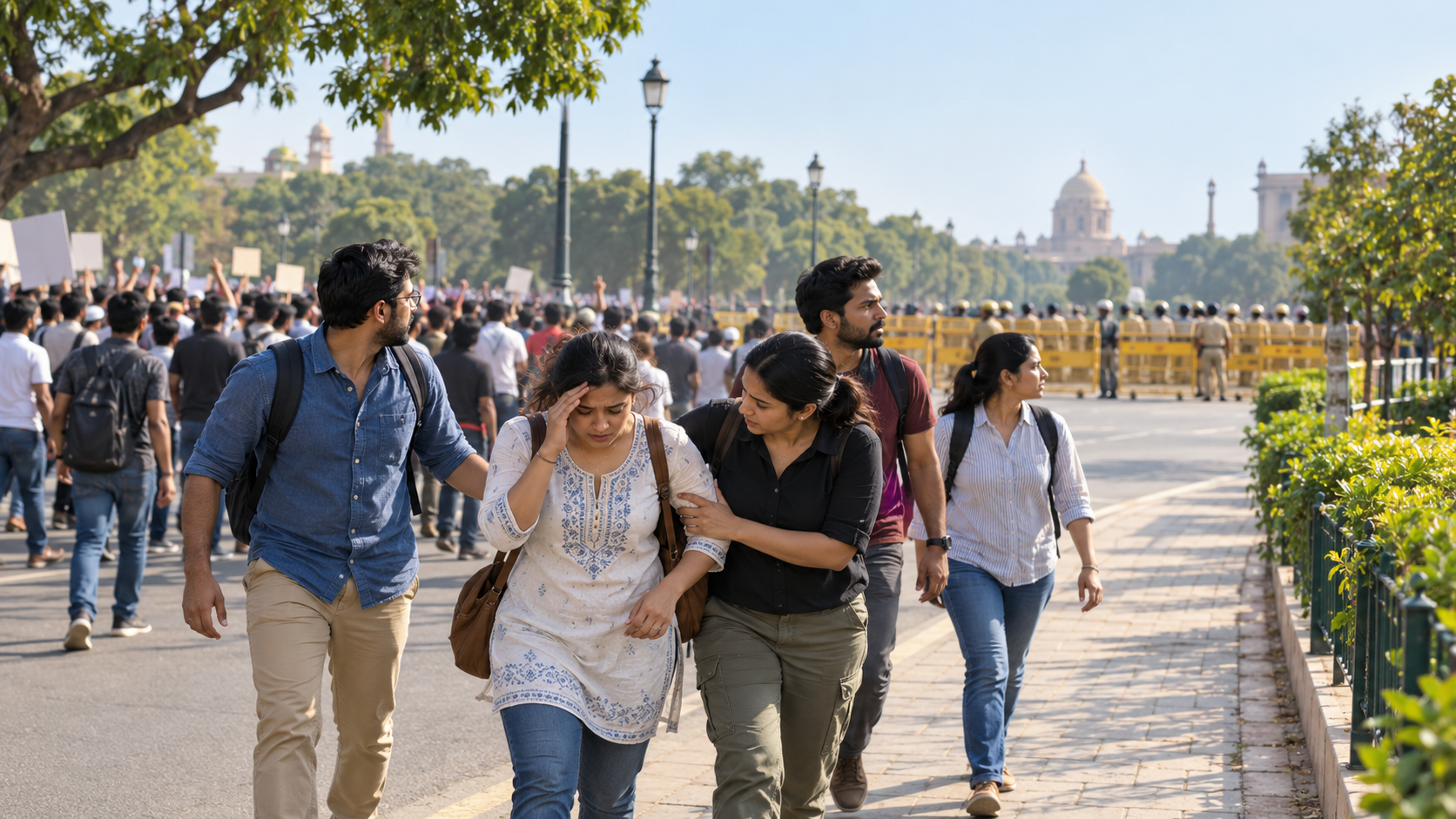
Do not wait for someone to fall. If you cannot move your arms freely, your breathing is restricted, or people are pushing you without your control, look for a less crowded open side route and move there steadily. Do not run into traffic, climb an unstable barrier or push against people to reach a closed gate. If a companion is separated, do not go back into the pressure; use your agreed meeting point when clear.
Tell police, stewards or medical responders if someone is trapped or injured. Give a clear landmark. Do not enter a moving crush to attempt a rescue yourself; you may become another person needing help.
If people start pushing a barricade or police ask people to leave
Step back from the barricade before people on either side start pushing. Do not help move it or rush through a gap. Listen for a clear instruction and ask where the open exit is if you cannot see one. Leave calmly without running into vehicles or another crowd.
You may disagree with a restriction. The safer place to question its legality is after you are out of immediate danger, with the actual written order and legal advice—not in a physical contest at a barrier. A Jantar Mantar ground video illustrates how quickly pressure can build at a barricade. It cannot by itself prove who started the pushing or whether every action was lawful.
If violence starts—or someone throws an object
Move away. Do not throw anything back, damage property or join a confrontation. Keep emergency routes clear. If a protester, police officer, journalist or bystander is injured, alert responders and call 112 for serious injury. Help from a safe position; do not place yourself between two moving groups.
If someone is struck or an irritant such as tear gas is released
First get away from the danger without rushing into traffic or crowd pressure. If someone has a head injury, heavy bleeding, fainting, chest pain or breathing trouble, call 112 and seek medical care. Do not delay care to collect a video.
If your eyes or skin are exposed to an irritant, move to fresh air. Avoid a low-lying cloud. When safe, remove contaminated clothing and wash your skin with plenty of soap and water. If your eyes burn or vision is blurred, rinse them with plain water for 10–15 minutes. Remove contact lenses and do not put them back in. Do not rub your eyes or apply oil or unknown home remedies. Seek urgent care if breathing or eye symptoms are severe or do not improve.
This is general first aid. Reports documented tear-gas use during the July 2026 Jantar Mantar protests. Outlook reported that water cannons and tear gas were not used on 2 October, and the reports we read on 10 and 16 October describe detentions, alleged stone-pelting and scuffles, but not tear gas. Officials told PTI that two police personnel were injured by stone-pelting on 10 October, and protesters have alleged rough handling during detentions; these are allegations and claims, not findings. Do not label an old clip as footage of a new protest.
If you lose contact with a friend or child
Go to the safe meeting point you chose earlier; do not push back through a dense or dispersing crowd. Call or message the person. Tell responders the person’s last-known place and time if they may be injured or vulnerable. Call 112 for immediate danger. Avoid publicly sharing a child’s identity or live location while looking for help.
Your rights, in everyday words
Indian citizens have a constitutional right to assemble peacefully and without arms. Lawful, reasonable restrictions may apply in the interests stated in Article 19(3). A familiar protest place is not automatic permission for a particular march. Check the actual order, not a forwarded message.
A Section 163 order under the BNSS (the successor to Section 144 of the old CrPC) is issued by a magistrate. The Delhi orders of October 2026 barred gatherings of five or more people, processions and dharnas without prior written permission. On 15 October the Supreme Court declined to examine whether Section 163 itself is valid, because it had upheld Section 144 CrPC in 1961, but it told Delhi Police to place the orders on record and listed petitions against them for 19 November (LiveLaw). Meanwhile, Delhi Police registered cases against leaders and supporters of the 12 October opposition march for alleged violation of these orders (ETV Bharat). Whether a particular order or case is lawful is for a court to decide, not for the crowd to argue at the barricade.
If police stop you, ask a simple question: “Am I free to leave, or am I being detained or arrested?” Stay calm and do not physically resist. Ask where you are being taken. A news report saying people were “detained” does not tell you the legal status of every person in a video. In October 2026 many people were reportedly stopped or taken off trains far from Delhi, and the word “detained” covered everything from a short hold to a formal arrest. Section 172 of the BNSS lets police detain or remove a person who disregards their lawful directions; in one Uttarakhand High Court case this year the State relied on it for stopping an activist who was travelling to Jantar Mantar (Bar and Bench). On 15 October the Supreme Court issued notice on a challenge to Section 172, so this area of law is still being tested. Preventive custody is also in use: the two CJP leaders mentioned above were held in proceedings under Sections 126 and 170 of the BNSS rather than on an FIR, which is another reason to ask which law you are being held under.
If you are arrested, ask for the reason and a lawyer. The law requires communication of the grounds of arrest. Ask that a relative, friend or another person you name be told about the arrest and where you are held. An arrested person must normally be taken before a magistrate within 24 hours, not counting necessary travel time; legal exceptions and individual circumstances need a lawyer’s advice. If hurt, request medical care. The law also provides for a medical examination after arrest and a copy of that report for the arrested person or a person they nominate. If police arrest you without a warrant for a bailable offence, they must inform you of your entitlement to release on bail and that you may arrange sureties; ask a lawyer about your particular case.
Women have additional safeguards. Except in exceptional circumstances, a woman should not be arrested after sunset and before sunrise. For that exception, a woman police officer must make a written report and obtain prior permission from the relevant first-class magistrate. A woman’s personal search must be carried out by another woman with regard for decency. The medical examination of an arrested woman’s body must be by or under the supervision of a female medical professional as the law specifies. These rules do not mean an arrest or search can never happen. If you believe a safeguard was ignored, record the details when safe and speak to a lawyer.
For urgent legal-aid guidance, call NALSA 15100. Women and children are among the categories eligible for free legal aid under the Legal Services Authorities Act; other people may also qualify. NALSA can explain how to apply and what help is available in an individual case. This section is general information, not a substitute for case-specific legal advice.
If you are harassed, injured or witness possible misconduct
Get to a safer place and seek medical help first. When safe, write down the time, location, what you personally saw, visible vehicle details and witnesses. Keep original photos or videos without editing them. Do not spread a short clip as proof of guilt: it may miss what happened just before or after. Do not share a complainant’s name, face or location without consent, especially if the person is a child or reports sexual harassment.
Ask a lawyer or legal-aid service how to make the appropriate complaint and preserve medical records. The same care with facts applies whether the injured person is a protester, officer, journalist or passer-by.
What organisers, stewards and police can do
Clear exits, simple audible instructions and medical access help everyone. Organisers should tell participants when the route changes and where to get help. Police and stewards should communicate a safe way out and keep access open for responders. International human-rights guidance calls for care to avoid harming bystanders and for prompt assistance to injured people. This is a planning principle, not a finding about any particular Delhi officer or protester.
Five things to remember
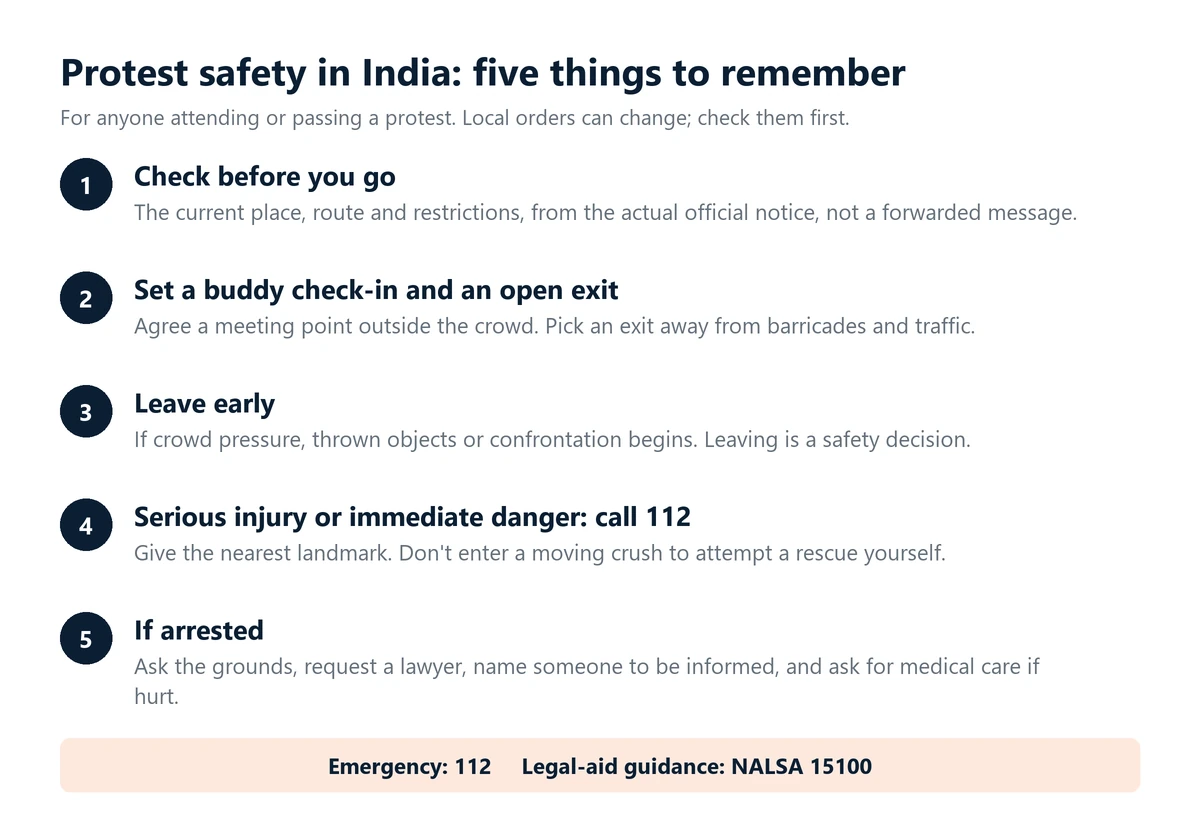
- Check the current place, route and restrictions before going.
- Set a buddy check-in and an open exit away from barricades and traffic.
- Leave early if crowd pressure, thrown objects or confrontation begins.
- For serious injury or immediate danger, call 112 and give a landmark.
- If arrested, ask the grounds, request a lawyer, name someone to be informed, and ask for medical care if hurt.
Reviewed 5 October 2026; updated 21 October 2026 with the release order and the High Court withdrawal of 21 October, the High Court petition of 20 October, the second case moved to the Crime Branch, the Jantar Mantar venue order of 11 October, the Supreme Court hearing of 15 October, police action up to 18 October, the custody order of 19 October and the rights groups’ statement of the same day. Protest restrictions, court cases and investigations can change. Follow emergency responders’ instructions at the scene and obtain local legal or medical advice when needed.
What needs attention
- A peaceful, unarmed protest is a constitutional right subject to lawful restrictions; a familiar venue does not mean a particular march is automatically permitted.
- A clear exit, buddy plan and timely departure are practical ways to reduce crowd risk.
- A route closure, barricade or dispersal is a reason to seek an open alternative, not to push through.
- Medical care and preservation of original evidence matter more than filming during danger.
- July and October Jantar Mantar reporting describe separate events; historical footage must not be passed off as a new incident.
- Jantar Mantar was removed from Delhi Police's designated protest venues on 11 October 2026 and the order is being challenged in court, so the venue and its rules must be checked afresh before every protest.
- On 19 October a magistrate extended the custody of two CJP leaders in preventive proceedings over alleged breach of peace bonds; the reasons are the court's view on police material, not a finding of guilt.
- Rights groups allege mass detention, unlawful force and an internet shutdown in the 10 October Delhi policing; these are claims, and no police reply to them was found.
- On 20 October the two CJP leaders challenged the custody extension in the Delhi High Court, which was on vacation; a hearing was expected on 21 October. Delhi Police moved both related cases to the Crime Branch. These are claims and procedural steps, not findings on the merits.
- On 21 October the High Court allowed the two CJP leaders to withdraw their petition without deciding it, and the magistrate ordered their release; the reports give no surety amounts or conditions, and none of the allegations has been decided.
Controls that reduce risk
- Before going: verify the current order and route, arrange a check-in, and identify an open exit.
- If passing by: use an alternative route and keep exits and ambulance access clear.
- If pressure builds: leave steadily toward an open side route; do not run into traffic or a closed gate.
- If police ask people to leave: ask where the safe exit is and seek legal advice about disputed orders after reaching safety.
- If anyone is hurt: call 112 for serious injury, give a landmark, and seek medical help.
- If arrested: ask for the grounds, a lawyer, a nominated contact and care for injuries.
Common unsafe practices
- Assuming a familiar protest place automatically permits every march, time or route.
- Entering a dense crowd without a buddy plan or open exit.
- Pushing a barricade, throwing an object or obstructing responders.
- Going back into a crowd squeeze to find a separated companion.
- Delaying medical care to collect a video.
- Treating a short or old clip as proof of an individual's guilt or as footage of a later protest.
Leave a comment