
Quick answers
Do all sprinklers go off at once during a fire?
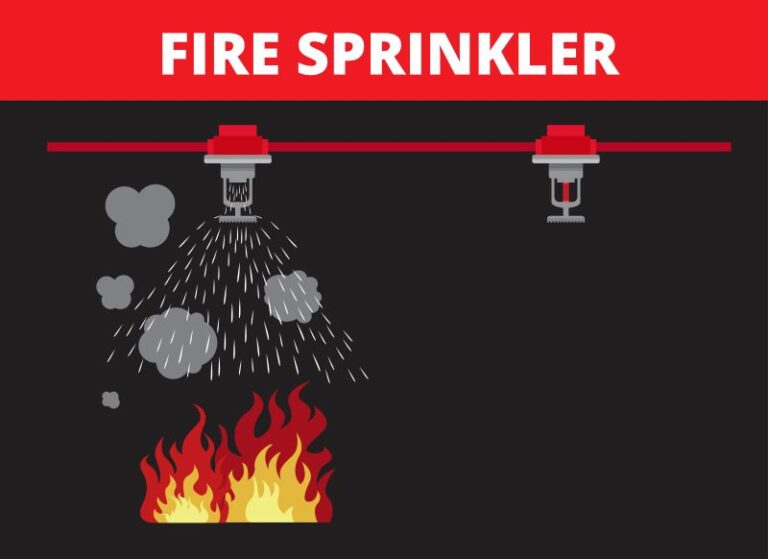
No. In a standard system only the heads heated by the fire open, spraying water at the fire source rather than the whole floor. In 88% of US home fires with operating sprinklers, just one head opened. Each head opens only when the temperature crosses its threshold.
Do fire sprinklers make a fire worse?
No. Sprinklers cool the area, suppress flames and reduce smoke spread, which is the top killer in building fires.
Can I paint over or cover a sprinkler head?
No. Never cover or paint sprinkler heads, as this can stop them working in a fire.
How can I check the sprinkler system in my building?
Check whether sprinkler heads are installed in your home or workplace, and ask your society or builder for the latest fire system test report and when the system was last tested.
In US fires large enough to set them off, sprinklers operated and controlled the fire in 88% of cases. Properties with sprinklers also had an 87% lower death rate per 1,000 reported fires than properties with no automatic extinguishing system.
(Source: NFPA, U.S. Experience with Sprinklers, July 2017, covering 2010 to 2014. These are US figures; India does not collect this data.)
The myths
We hear these all the time from society committees, shop owners and even builders:
- “Sprinklers spread the fire.”
- “Sprinklers will flood the whole flat.”
- “Only big buildings need sprinklers.”
These beliefs are wrong, and they are dangerous. They delay installation, and they lead people to switch off or cover sprinklers that are already there.
The facts
Sprinklers do not all go off at once like in the films. In a standard system, only the heads heated by the fire open, and they spray water on the fire below them, not on the whole floor. NFPA found that in 88% of US home fires where sprinklers operated, just one head opened.
Each head is held shut by a small glass bulb filled with liquid. When the air around it gets hot enough, the liquid expands and the bulb breaks. The most common red bulbs break at about 68°C; bulbs of other colours are rated for higher or lower temperatures. Cigarette smoke or steam from cooking will not set them off.
Far from making a fire worse, sprinklers cool the fire and the room, stop the fire from growing and cut down the smoke that kills most people in building fires. They start working while people are still escaping, long before the fire brigade arrives.
What the records show
| Measure | Figure | Source |
|---|---|---|
| Fire accidents in India, 2024 | 5,971 cases; 5,888 deaths | NCRB ADSI 2024 |
| Share of those deaths in residential buildings | 60.4% (3,555 deaths) | NCRB ADSI 2024 |
| US reported fires with sprinklers present, 2010 to 2014 | 10% | NFPA, 2017 |
| US: sprinklers operated, in fires large enough to set them off | 92% | NFPA, 2017 |
| US: sprinklers operated and controlled the fire | 88% | NFPA, 2017 |
| US: death rate per 1,000 fires, sprinklered vs no system | 87% lower | NFPA, 2017 |
NCRB does not record whether a building had sprinklers, so there is no reliable Indian figure for deaths in sprinklered versus unsprinklered buildings. Country-by-country sprinkler coverage figures are not shown because we found no reliable source for them.
Myth or fact?
| Myth | Fact |
|---|---|
| “All the sprinklers go off during any fire.” | Each head opens only when the fire heats it. The rest stay shut. |
| “The water causes more damage than the fire.” | In 88% of US home fires where sprinklers operated, only one head opened, which limits the water used. A small, controlled fire with some water damage is far better than a burnt-out home. |
| “I will just use extinguishers.” | Portable extinguishers are meant for small fires in their early stage. Sprinklers keep working while people escape, even at night when everyone is asleep. |
| “Only big buildings need sprinklers.” | Fires kill people in homes of every size. Building rules decide where sprinklers are required, but any building where people sleep or gather benefits from them. |
| “Installing sprinklers is too expensive.” | Cost depends on the building. Ask a qualified fire engineer for a quote and weigh it against the lives and property at stake. |
What you can do today
- Check whether your home, office or shop has sprinkler heads.
- Ask your society or builder for the latest fire system test report, and ask whether the sprinkler pump and valves are kept switched on.
- Never cover, paint or hang anything from a sprinkler head. A painted head may not open.
- Do not stack goods right up to the ceiling. Sprinklers need clear space below them to spray.
- Support stronger sprinkler rules for buildings where people sleep or gather, such as hospitals, hostels, hotels and high-rises, and their proper enforcement.
- Share this article with your society committee or school management.
Ask your builder one question
“When was our sprinkler system last tested?” If nobody knows, insist on a test by a qualified agency. A sprinkler system that is switched off or never maintained gives a false sense of safety.
References
- NFPA, U.S. Experience with Sprinklers (Marty Ahrens, July 2017)
- NCRB, Accidental Deaths & Suicides in India 2024, Chapter 1
- BIS IS 15105:2021, Design and Installation of Fixed Automatic Sprinkler Fire Extinguishing Systems, Code of Practice
- BIS, Learning Science via Standards: Fire Extinguisher
What needs attention
- Only the sprinkler heads heated by the fire open; the rest stay shut
- In most US home fires with sprinklers operating, just one head opened
- Sprinklers cool the fire and cut smoke, the main killer in building fires
- US properties with sprinklers had a much lower death rate per fire
- India does not record whether a building that caught fire had sprinklers
Controls that reduce risk
- Ask for the latest fire system test report
- Keep sprinkler pumps and valves switched on and maintained
- Keep space clear below sprinkler heads
- Get the system tested by a qualified agency
- Support sprinkler rules for hospitals, hostels, hotels and high-rises
Common unsafe practices
- Believing sprinklers spread fire or flood the whole building
- Painting, covering or hanging things from sprinkler heads
- Switching off the sprinkler pump or closing valves after a false alarm
- Stacking goods up to the ceiling below sprinklers
- Never testing the system

Leave a comment