
What happened here
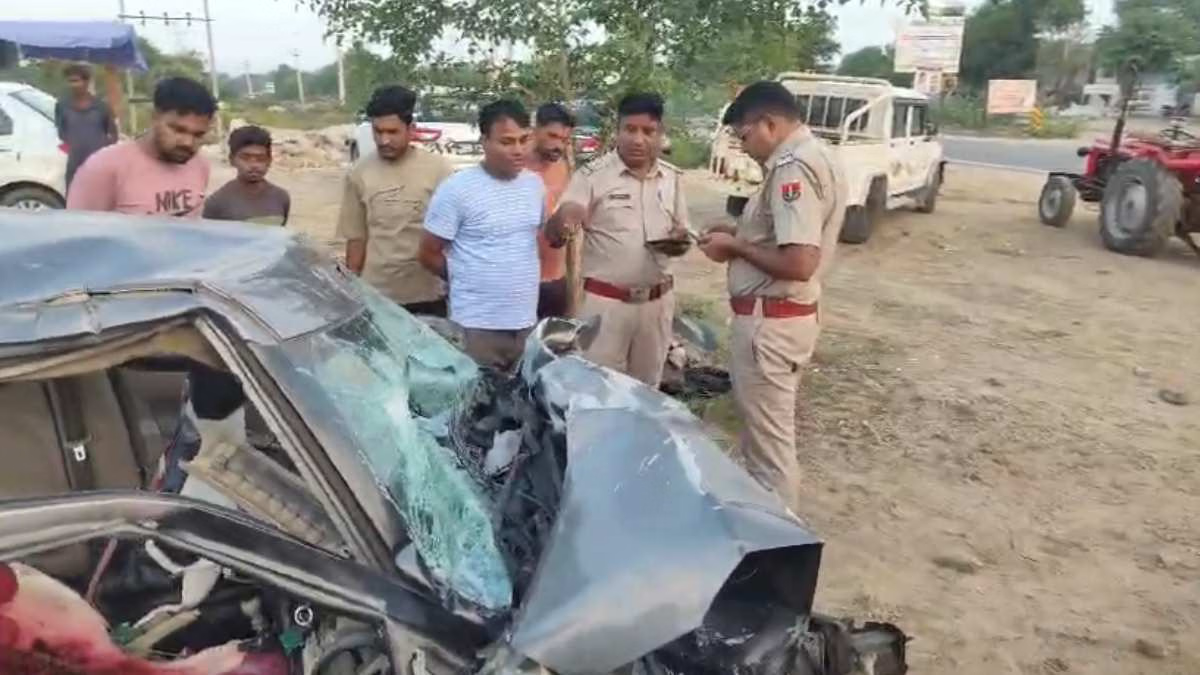
A car and dumper collided near Mithri bypass in Nawa, Rajasthan, around 5 am on 16 September 2026. Four car occupants died. Reporting supports the toll and recovery operation, but a final cause, response interval and complete damage assessment are unavailable.
A fatal collision before dawn
Four people died when a car and a dumper collided in the Nawa area of Didwana-Kuchaman district, Rajasthan, on 16 September 2026. The Times of India places the collision at about 5 am. Amar Ujala identifies Mithri bypass and reports police and ambulance attendance. The dead included three members of one family and the car driver.
What can be reconstructed
The reports describe a head-on collision, major damage to the car and occupants trapped inside. Police and local people helped recover them. A roughly thirty-minute extraction description appears in newspaper reporting, but it is not a dispatch record: it cannot establish how long emergency vehicles took to arrive, when a call was made, or when medical care began. The broad sequence is therefore more defensible than a minute-by-minute account: collision, notification, responder attendance, recovery and hospital mortuary transfer. Any later police reconstruction should distinguish those events using separate timestamps.
Cause remains an investigation question
Several headlines refer to speed. The reviewed material does not include a measured vehicle speed, scene diagram, brake inspection, CCTV reconstruction or final finding. A dramatic photograph cannot establish lane position before impact. Nor can the early hour alone establish fatigue, fog or poor visibility. Those are questions to test, not causes to assign. Jagran’s police-attributed report describes a search for the dumper driver. Other reporting says the vehicle was seized. These describe investigative steps at the reporting date, not a verdict or a confirmed current custody position. Travel-direction descriptions also differ, so this case does not adopt a definitive origin-to-destination route.
Response assessment
Local reporting establishes that help was mobilised and people were recovered from the damaged car. It does not identify every appliance, the number of responders, extraction equipment or a complete clinical chronology. Without those records it would be unfair to claim either a delay or exemplary response speed. The relevant lesson is to preserve a reliable handover between witnesses, dispatchers and responders.
What another road user can do
A witness should first avoid becoming another casualty. Stay clear of moving traffic, call 112 and describe the road, nearest landmark, vehicles, apparent casualties and whether anyone is trapped. Do not improvise cutting or vehicle movement. St John Ambulance explains that scene safety and professional help for entrapment are central to crash response. Follow the dispatcher and provide assistance within your training. For fleet managers and trip organisers, this case is a reason to review how vehicle condition, driver readiness and route risks are documented. It does not prove that a specific check was omitted here. Keep the preventive recommendation distinct from a retrospective allegation.
Comparisons and updates
The data panel compares Nawa with the previously documented Atgaon collision. Both involve a passenger vehicle and a truck, but one is reported as head-on and the other as a collision with a stationary truck. They are two selected examples, not a national road-risk dataset. No rate or causal ranking is calculated. Reviewed 19 September 2026. The six-field video records distinguish publisher matching from playback. Direct YouTube research could not be completed because browser access failed; one matching original NDTV report was found through the publisher’s indexed video archive. This limitation does not mean other footage is unavailable.
- A car and dumper were travelling in the Nawa area. Full route, driver duty history and vehicle condition are unverified.
- Head-on collision reported near Mithri bypass; no verified second-by-second reconstruction.
- Amar Ujala reports police and ambulance attendance. Call, dispatch and arrival times are not available.
- Entrapped occupants were removed; one account describes about thirty minutes of extraction effort, not a verified response interval.
- Vehicle seizure and search for the dumper driver reported; subsequent custody and final findings require fresh official records.
- Corroborated facts retained; unmeasured causes, travel direction and missing response data remain explicit.
Why consequences escalated
- The reporting converges on a four-person fatal outcome in a car–dumper collision. The evidence base is newsroom reporting attributed to police and witnesses, not an independently obtained final collision report. Shared police sourcing should not be mistaken for multiple forensic examinations.
- Entrapment is a practical response issue in this case. The damaged passenger compartment required recovery work. The available record does not establish the tools used or whether all occupants were clinically assessed at the same point in the operation.
- The roughly thirty-minute description concerns recovery effort in a newspaper account. An emergency-response performance assessment would need call receipt, dispatch, arrival, access and extrication milestones separately. Subtracting an approximate crash time from a loosely described recovery duration would create false precision.
- Investigation should distinguish impact geometry from blame. Measured scene evidence, vehicle inspection, driver accounts and recordings could help reconcile lane position and pre-impact movement. The reviewed reports do not justify declaring fatigue, fog, a mechanical defect or a precise speed as the cause.
- What worked is limited to documented mobilisation and recovery assistance. What may have failed remains a set of questions about collision prevention and occupant protection; there is no verified restraint audit or road-safety inspection in the source set.
Failures and risk multipliers
- Do not call an extraction estimate a verified ambulance response time.
- Do not infer speed from the appearance of the wreckage.
- Do not infer drowsiness or fog simply because the event occurred early in the morning.
- Do not combine a separate Tonk crash mentioned in some statewide articles with this Nawa toll.
- Do not publish an AI-generated news illustration as a real incident photograph.
- Do not treat an initial search for a driver as proof of guilt or a current custody update.
Actions that reduce risk
- For witnesses: give dispatchers the road and landmark, whether traffic is still moving, how many people appear involved and whether anyone is trapped. Update uncertain counts as responders establish them instead of presenting guesses as facts.
- For drivers approaching the scene: follow police directions and avoid stopping where you create another obstruction. A clear approach gives ambulances and rescue vehicles space to work.
- For trained responders and investigators: preserve distinct operational timestamps and the source of each observation. A witness estimate and a logged arrival time are different kinds of evidence.
- For transport organisers: review driver readiness, vehicle checks and route planning through your normal safety process. Record issues and closure rather than relying on a verbal assurance that a vehicle is ready.
- For editors and community groups: preserve original source dates and correct a changing detail visibly. Do not circulate victim imagery or accuse a driver on the basis of an unverified clip.
Leave a comment