
What happened here

A car struck a median worksite near Ram Chowk, Gurugram, early on 17 September 2026. Later reports recorded three worker deaths. This review separates the reported sequence from unresolved cause, protection and response questions.
A worksite struck before dawn
Three workers died after a car entered a roadwork area near Ram Chowk on the Dwarka Expressway in Gurugram, Haryana, early on 17 September 2026. The Tribune’s follow-up records the toll increasing from two to three. This case examines exposure to live traffic during infrastructure work. It does not establish the driver’s intent or a final engineering cause.
The reported sequence
The Indian Express describes workers installing an iron fence on the central median. Police placed the collision between approximately 1:50 and 2:30 am. The complaint describes a car striking temporary safety arrangements, hitting workers and then a parked work vehicle. One worker and the driver were reported seriously injured. This police- and complaint-attributed account is not a complete collision reconstruction.
Why the video has an earlier toll
NDTV’s original Hindi video was published on 17 September and reported two deaths and two seriously injured workers. Later coverage records three worker deaths. Keep the date beside each figure. Do not add initial injuries to subsequent deaths as separate people. Names, ages and individual death timings differ across accounts, so this review does not attempt a patient-by-patient chronology.
Protection was reported; adequacy is unresolved
The Times of India reports barricades and trestles in the FIR account, and says police were checking how the car reached the median and whether arrangements were adequate. An NHAI official said the work took place at night because traffic was lower. The presence of a device and the effectiveness of the complete arrangement are different questions. A photograph cannot establish the approval, positioning or performance of every measure.
What an investigation would need
Useful evidence would include the approved traffic arrangement, pre-impact site photographs, available CCTV, vehicle examination, lighting records and independent witness accounts. Investigators could compare vehicle movement with the position of the workforce and work vehicle. This is an evidence checklist, not a claim that documents were absent. The early hour alone does not prove fatigue or poor visibility. Lower traffic volume does not establish that the remaining exposure was adequately controlled.
Keep allegations separate from findings
The Indian Express reports that allegations concerning alcohol required forensic confirmation. No final toxicology conclusion or judicial finding was located. This review therefore does not describe impairment as proved or estimate speed from damage. A forceful headline is not a substitute for a measured reconstruction. The distinction matters both to a fair account and to useful prevention: a wrongly assumed cause can divert attention from other questions that need examination.
Response and its limits
Times of India describes notification by passersby, police and ambulance arrangements, hospital transfer and vehicle seizure. Separate call, dispatch, arrival and treatment timestamps were not supplied. Those records are necessary before assessing response delay. The eventual toll cannot establish whether assistance arrived quickly or slowly. Emergency access and an accurate location description remain practical planning questions for comparable sites, irrespective of the unresolved response chronology here.
Lessons for drivers and worksite teams
Maharashtra Highway Traffic Police guidance emphasises obeying signs and avoiding phone use while driving. Temporary roadwork instructions deserve attention even on a familiar route. For those organising work, MoRTH’s official circular index lists the 16 March 2023 National Highway construction-zone safety circular. Use the applicable approved plan and competent site team. A general case study cannot prescribe a barrier type, separation distance or speed for an uninspected site.
A practical shift review
A useful handover asks what changed since the previous shift, who checks the protection, how workers report a dangerous condition, who can suspend exposed work, and how emergency vehicles reach the location. These are recommendations for review, not proved omissions in this incident. Record the answer and its owner rather than relying on an informal assumption that someone else has checked. When conditions change, the team needs a clear route to reassessment.
Comparisons without false precision
NIOSH’s highway work-zone overview supplies US figures for 2022. They illustrate the wider hazard category, but cannot yield an Indian risk rate. This article contains one selected Indian incident and no denominator for traffic or worker-hours. Existing road-crash posts do not automatically qualify as work-zone comparisons; no weak match is added to fill a related section. The chart tracks reported deaths in this one incident, not separate crashes.
Review and correction
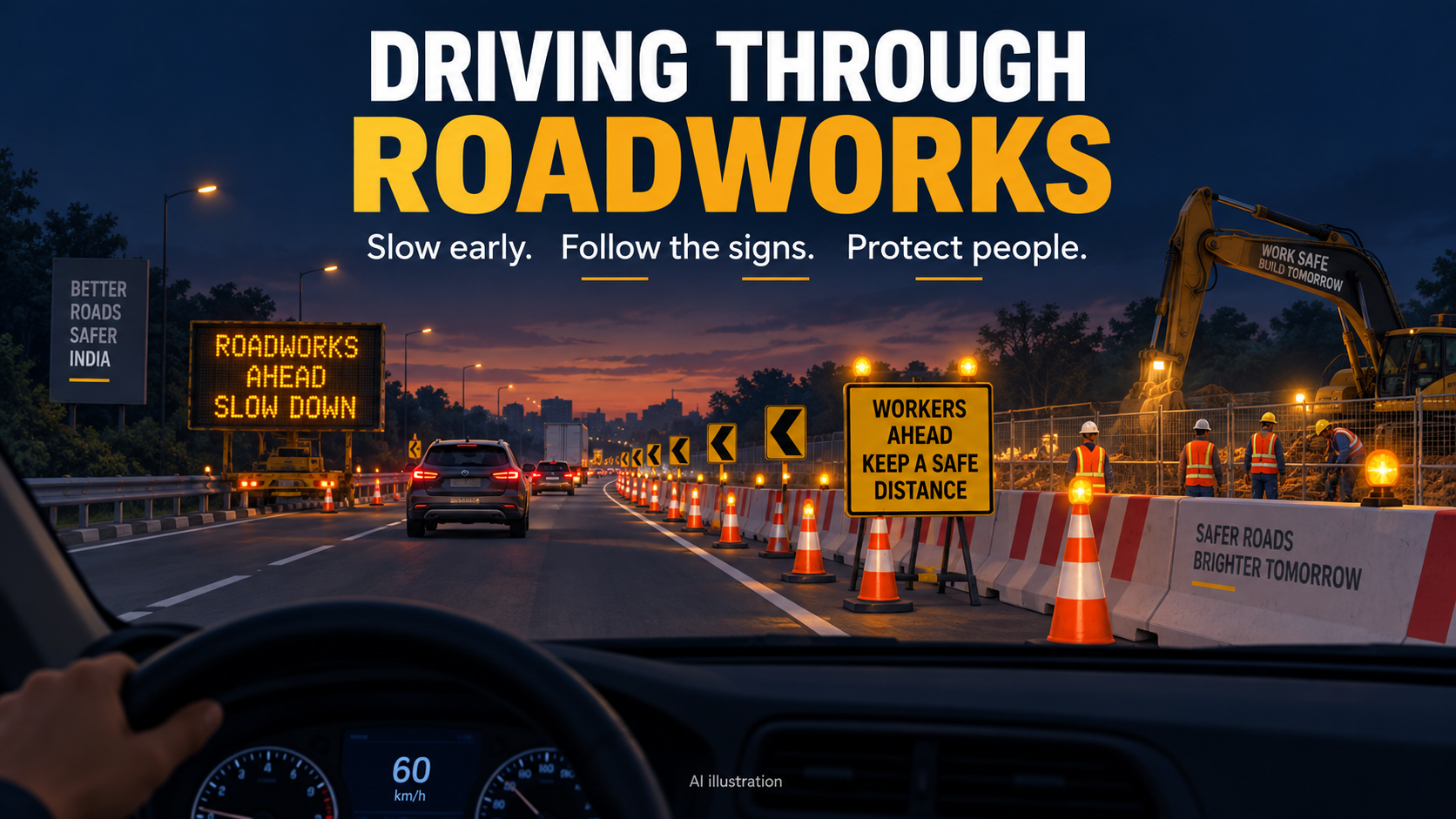
Reviewed 20 September 2026. Update the assessment only when an attributable later report or official finding changes it. Preserve the earlier video’s date when explaining the revised toll. The cover is an AI illustration rather than an incident photograph. The map shows the Gurugram area and is not a surveyed crash pin.
- Roadwork was under way; the approved plan and shift inspection records are not available in this review.
- Collision at the worksite; approximate reported window 1:50–2:30 am, not a dispatch timestamp.
- NDTV publishes an early report identifying two worker deaths and two seriously injured workers.
- Police notification, ambulance arrangements and hospital transfers reported. Intervals not supplied.
- The Tribune follow-up records the toll rising to three.
- Review retains the later toll and explains the earlier video; cause remains unresolved.
Why consequences escalated
- People working on the median were exposed to a live traffic environment. The detailed arrangement needs evidence, not inference from the toll.
- Reports describe protection devices, but their presence alone cannot establish adequacy or performance.
- The casualty count changed with reporting time; dated records must remain distinguishable.
- Notification and transfer are reported, while quantitative response performance remains unassessed.
Failures and risk multipliers
- No final fault allocation is available. These are interpretation risks, not proved failures by a named person.
- Do not convert an impairment allegation into a confirmed cause before forensic findings.
- Do not estimate speed from photographs or assume the early hour proves fatigue.
- Do not use the eventual toll to establish a response delay.
- Do not assume a lower-traffic shift removes the need for effective protection.
People closest to the evidence
“Adequate safety measures were put in place at the site in keeping with the prescribed protocol”
Unnamed NHAI official quoted by Times of India · Reported official position, not an independent finding · Source ↗
Actions that reduce risk
- Drivers: respond to temporary directions early and leave space for changed queues and lane paths.
- Worksite managers: review the applicable approved plan with the competent safety team.
- Shift handover: record changes to protection, access and equipment movement, with a named check owner.
- Evidence: retain dated records and distinguish observations from interpretations.
- Editors: reconcile dated tolls and correct the account when authoritative evidence changes it.
 ↗
↗ ↗
↗ ↗
↗ ↗
↗ ↗
↗
Leave a comment