
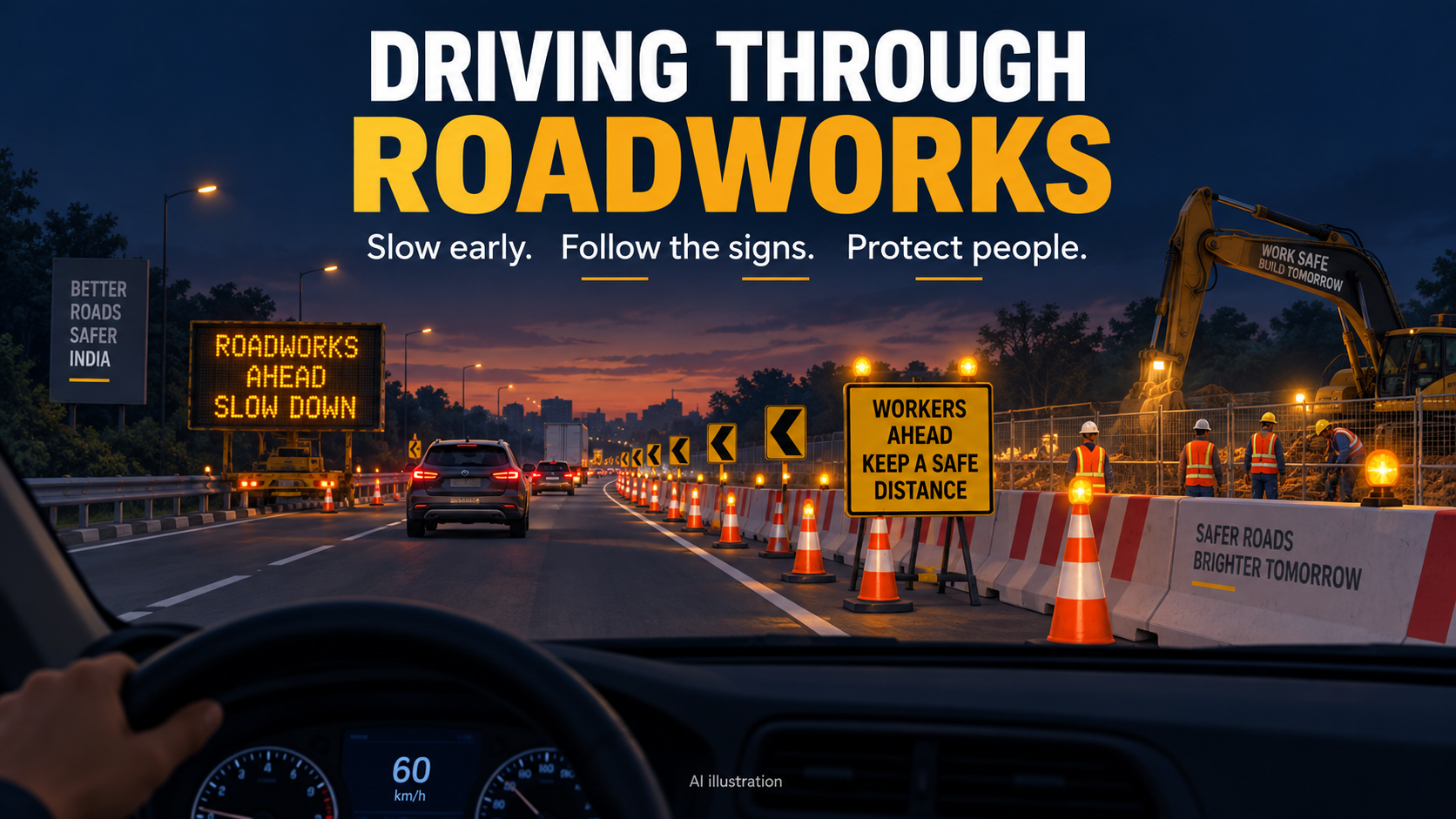
A familiar road can become a different road
Roadworks change the decisions a driver must make. The first hazard may be a queue or lane shift before any worker becomes visible. Notice the warning, adapt early and follow the permitted route. This guide concerns ordinary drivers and passengers in India. It does not replace an approved traffic plan or directions from authorised traffic controllers. Images are conceptual: any dashboard number is not a recommended speed for a real work zone.
Prepare before leaving
Allow for a slower journey and set navigation while parked. Maharashtra Highway Traffic Police advises drivers to follow signs and avoid mobile-phone use. Ask a passenger to handle messages or route changes so attention stays on the road. If nobody can help, wait for a safe stopping place. Being nearly at your destination does not remove the need to drive attentively.
Respond to the first warning
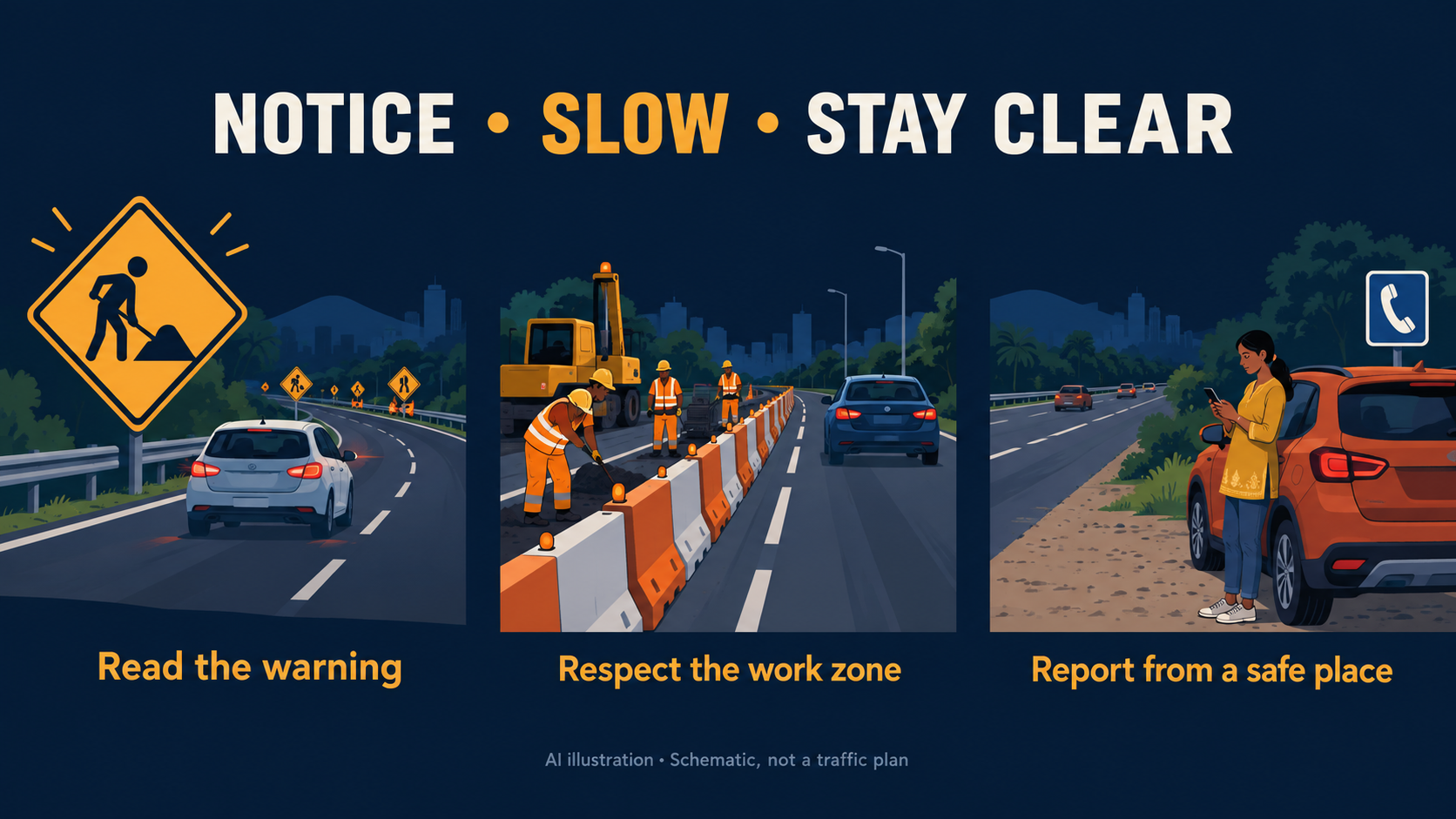
Look for traffic already slowing and signs explaining the path through the work. Reduce speed progressively, considering vehicles around you. Follow the posted restriction and any lower speed required by conditions. This guide cannot assign one safe number to every location. MaineDOT’s official guidance promotes attention, space and patience. These principles are useful; overseas road signs and legal requirements must not be substituted for Indian ones.
Change lanes deliberately
A closure is not an invitation to race for the last gap. Follow the temporary direction, check mirrors and blind spots, signal and move when safe. If a controller or lane signal provides instructions, follow them instead of copying another driver’s mistake. A gap between cones is not permission to enter: it may lead to people, equipment or an unfinished surface that is difficult to see from your vehicle.
Pass the work without staring at it
NIOSH distinguishes hazards from passing traffic and construction equipment. Watch the permitted route and equipment near it without letting curiosity distract you from the queue ahead. Leave room to respond to slowing vehicles. Reflective clothing does not make someone visible from every angle, and a cone is not vehicle-impact protection. A worker appearing to see your car is not an invitation to pass close.
Be more cautious when the view is poor
Glare, rain and a dirty windscreen can make temporary directions difficult to interpret. Prepare the vehicle’s visibility before leaving and use lighting suitable for the conditions and other road users. If the intended path is unclear, slow further and follow the traffic control provided. Do not guess a shortcut through the works. An unfamiliar edge or surface change calls for a careful reassessment, not an abrupt manoeuvre into another lane.
Stay attentive in a stopped queue
A queue may move in short bursts or wait for traffic from the opposite direction to be released. Keep watching it rather than picking up your phone. Avoid repeated lane changes for a small advantage. Passengers should not walk into the work area to investigate a delay. Restricted space already has a purpose; adding a curious pedestrian can make the situation harder to manage.
Report a problem from a safe place
Do not stop in a live lane to photograph a damaged sign, move a barrier yourself or walk back through traffic. When safely stopped, record the road, direction, nearest landmark and what you observed. India’s Emergency Response Support System uses 112 for immediate emergencies. A passenger can make a report while the driver maintains control. For a non-emergency defect, use the relevant road operator’s channel and provide location details rather than an unsupported diagnosis.
If there has already been a collision
Avoid creating another collision. Remain clear of moving traffic, communicate the location and apparent hazards, and follow emergency-service instructions. Do not enter the work area to investigate or move machinery. Assist within your ability and training. This guide concerns approaching roadworks; it does not teach clinical treatment, extrication or vehicle recovery.
Leave the works carefully
The last visible worker may not mark the end of the controlled area. A final merge or queue can extend beyond the activity. Continue to follow temporary restrictions until the signs and conditions indicate they have ended. Resume normal travel only when the route permits. If a confusing location needs reporting, do so later from a safe place with enough detail for the operator to identify it.
Use statistics for context
The data panel contains a dated US national work-zone series, not an Indian total or a worldwide estimate. It cannot give the probability of a crash on your next journey. The useful question is whether you can interpret the changing road and respond safely to what is ahead. An average cannot answer that for a particular bend, queue, weather condition or shift.
Agree on a simple routine
Before the trip, decide who handles navigation and allow time for works. A late arrival is preferable to an unsafe manoeuvre. Discuss confusing locations only when stationary. This practical routine has no claimed numerical risk reduction. Reviewed 20 September 2026. The video collection below concerns roadwork driving; unrelated fire, battery, flood and electrical clips are excluded.
What needs attention
- A queue or lane shift may be the first hazard, before workers are visible.
- Passing traffic and construction equipment create different hazards.
- Glare and poor visibility can make temporary instructions harder to interpret.
- Impatience encourages rushed decisions where the route is less predictable.
Controls that reduce risk
- Before leaving: set navigation and allow extra time.
- Approach: read warnings and reduce speed progressively for restrictions and conditions.
- Lane change: check mirrors and blind spots, signal and wait for safe space.
- Pass the works: maintain room from traffic and stay outside the closed area.
- Queue: remain attentive and patient through stop-start movement.
- Exit: follow temporary restrictions until they actually end.
- Report: use a safe place and a precise road/direction/landmark description.
Common unsafe practices
- Ignoring temporary signs because navigation suggests a different path.
- Assuming the familiar road still has its usual layout.
- Racing for a gap or driving through a coned-off area.
- Filming workers or a crash while driving.
- Moving barriers or walking into the works.
- Treating an illustration’s dashboard number as a safe speed.
Leave a comment