
Quick answers
Can I attend a peaceful protest?
Article 19(1)(b) protects Indian citizens' peaceful, unarmed assembly, subject to lawful, reasonable restrictions. Check the current place, time and route conditions.
What if I am only passing by?
Use an open alternative route if the area is crowded; do not block exits or emergency access to film. Call 112 for immediate danger.
What if I lose a friend or child?
Do not push back into a dense crowd. Go to your planned meeting point, tell responders the last-known location and time, and call 112 if there is immediate danger.
What if a route closes or people push a barricade?
Step away from the pressure, check current official directions and use a safe open exit. Seek legal advice later if you dispute an order.
What should I ask if police take me away?
Ask whether you are free to leave, detained or arrested, the grounds and destination, and how to reach a lawyer and someone you nominate. Request medical help if injured.
Does a short video prove misconduct?
No. Keep the original recording and verify its date, place and full sequence before alleging that an individual did something wrong.
This is a practical guide for anyone attending or passing a protest in India. It explains safer choices and basic rights in everyday language. Local rules can change, and a lawyer should advise on an individual case.
Before you go: make a simple safety plan
For Indian citizens, Article 19(1)(b) of the Constitution protects peaceful assembly without arms, subject to lawful, reasonable restrictions. That does not mean every march can use every road or venue at any time. Restrictions may apply. Before leaving, check the organiser’s latest message and the relevant official police or local-authority notice for the place, time and route. If you cannot confirm where people may gather or an open way to leave, do not assume the usual route is safe or permitted.
Tell one trusted person where you plan to go and when you will check in. If attending with a friend, agree on a meeting point outside the crowd in case you become separated. Charge your phone; carry drinking water, prescribed medicine, ID and an emergency contact. Notice at least one open exit that does not require crossing a barricade, a busy road or a narrow gate. If you are with a child, older person or someone who may find it hard to move or breathe in a crowd, plan to leave earlier.
Do not take anything intended to hurt someone. If the scene already looks tense or exits are blocked, it is reasonable to turn back. Leaving is a safety decision, not a judgment about the protest.
If you are only passing by
You do not have to enter a protest to be affected by it. If a pavement, metro exit or street is crowded, use another open route. Do not stop in an exit or in the path of an ambulance just to record video. If someone is hurt or in immediate danger, call 112 and give the nearest landmark.
If your metro station or route suddenly closes
Stop following the old plan. Check a current official transit or police update, find a safe open exit and message your companion with the new meeting point. Do not push through a narrow gap or try to get around a barricade through traffic. If you cannot find a safe route, leave the area.
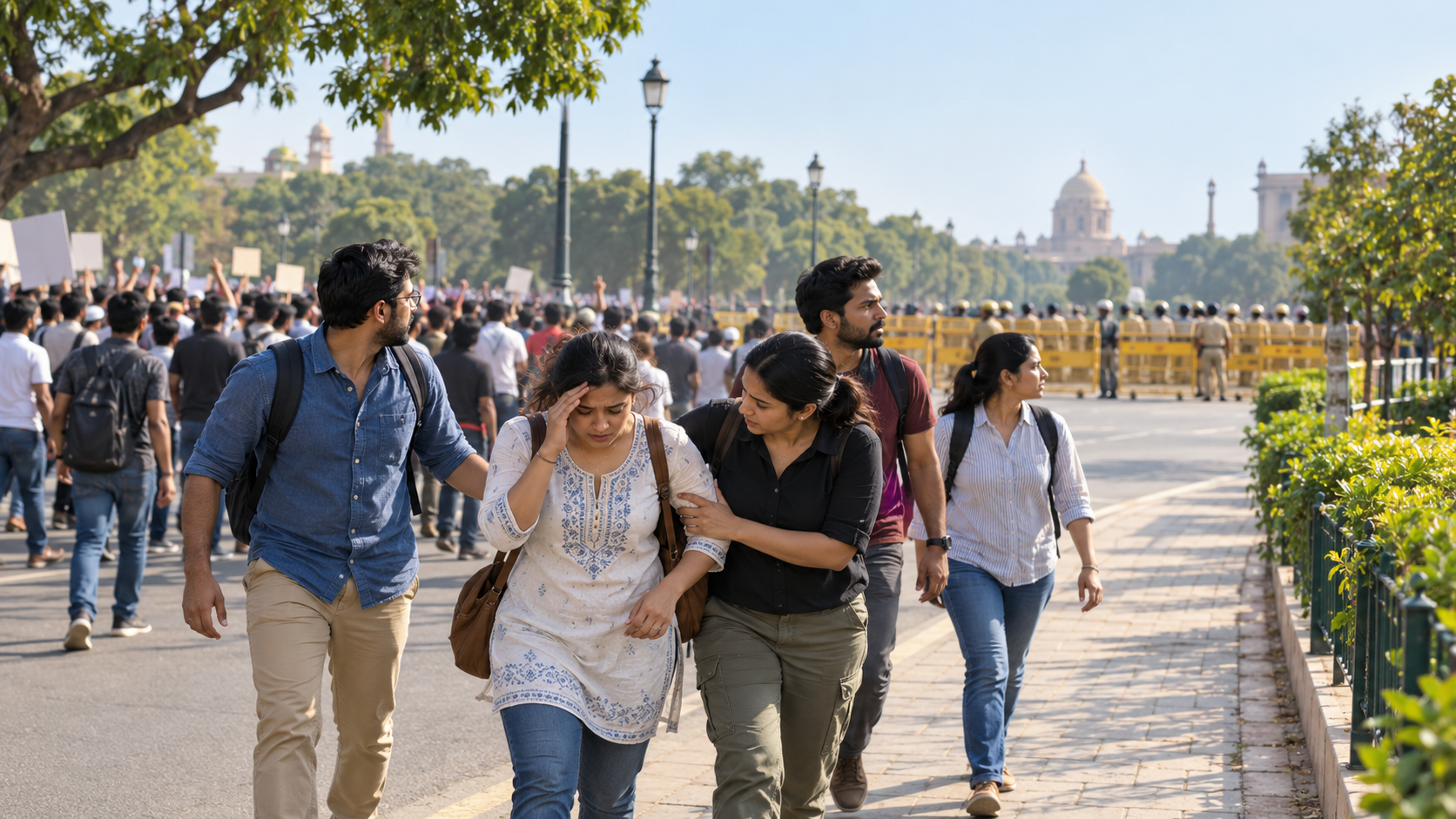
For example, on-street reporting during the October 2026 Jantar Mantar demonstrations showed that access and police deployment changed during the day. The useful lesson is to update your route; the video does not tell you what the rule is at a different protest or on a different day.
If the crowd gets too tight
Do not wait for someone to fall. If you cannot move your arms freely, your breathing is restricted, or people are pushing you without your control, look for a less crowded open side route and move there steadily. Do not run into traffic, climb an unstable barrier or push against people to reach a closed gate. If a companion is separated, do not go back into the pressure; use your agreed meeting point when clear.
Tell police, stewards or medical responders if someone is trapped or injured. Give a clear landmark. Do not enter a moving crush to attempt a rescue yourself; you may become another person needing help.
If people start pushing a barricade or police ask people to leave
Step back from the barricade before people on either side start pushing. Do not help move it or rush through a gap. Listen for a clear instruction and ask where the open exit is if you cannot see one. Leave calmly without running into vehicles or another crowd.
You may disagree with a restriction. The safer place to question its legality is after you are out of immediate danger, with the actual written order and legal advice—not in a physical contest at a barrier. A Jantar Mantar ground video illustrates how quickly pressure can build at a barricade. It cannot by itself prove who started the pushing or whether every action was lawful.
If violence starts—or someone throws an object
Move away. Do not throw anything back, damage property or join a confrontation. Keep emergency routes clear. If a protester, police officer, journalist or bystander is injured, alert responders and call 112 for serious injury. Help from a safe position; do not place yourself between two moving groups.
If someone is struck or an irritant such as tear gas is released
First get away from the danger without rushing into traffic or crowd pressure. If someone has a head injury, heavy bleeding, fainting, chest pain or breathing trouble, call 112 and seek medical care. Do not delay care to collect a video.
If your eyes or skin are exposed to an irritant, move to fresh air. Avoid a low-lying cloud. When safe, remove contaminated clothing and wash your skin with plenty of soap and water. If your eyes burn or vision is blurred, rinse them with plain water for 10–15 minutes. Remove contact lenses and do not put them back in. Do not rub your eyes or apply oil or unknown home remedies. Seek urgent care if breathing or eye symptoms are severe or do not improve.
This is general first aid. Reports documented tear-gas use during the July 2026 Jantar Mantar protests; the reviewed reports do not establish that tear gas was used during the separate October detentions. Do not label an old clip as footage of a new protest.
If you lose contact with a friend or child
Go to the safe meeting point you chose earlier; do not push back through a dense or dispersing crowd. Call or message the person. Tell responders the person’s last-known place and time if they may be injured or vulnerable. Call 112 for immediate danger. Avoid publicly sharing a child’s identity or live location while looking for help.
Your rights, in everyday words
Indian citizens have a constitutional right to assemble peacefully and without arms. Lawful, reasonable restrictions may apply in the interests stated in Article 19(3). A familiar protest place is not automatic permission for a particular march. Check the actual order, not a forwarded message.
If police stop you, ask a simple question: “Am I free to leave, or am I being detained or arrested?” Stay calm and do not physically resist. Ask where you are being taken. A news report saying people were “detained” does not tell you the legal status of every person in a video.
If you are arrested, ask for the reason and a lawyer. The law requires communication of the grounds of arrest. Ask that a relative, friend or another person you name be told about the arrest and where you are held. An arrested person must normally be taken before a magistrate within 24 hours, not counting necessary travel time; legal exceptions and individual circumstances need a lawyer’s advice. If hurt, request medical care. The law also provides for a medical examination after arrest and a copy of that report for the arrested person or a person they nominate. If police arrest you without a warrant for a bailable offence, they must inform you of your entitlement to release on bail and that you may arrange sureties; ask a lawyer about your particular case.
Women have additional safeguards. Except in exceptional circumstances, a woman should not be arrested after sunset and before sunrise. For that exception, a woman police officer must make a written report and obtain prior permission from the relevant first-class magistrate. A woman’s personal search must be carried out by another woman with regard for decency. The medical examination of an arrested woman’s body must be by or under the supervision of a female medical professional as the law specifies. These rules do not mean an arrest or search can never happen. If you believe a safeguard was ignored, record the details when safe and speak to a lawyer.
For urgent legal-aid guidance, call NALSA 15100. Women and children are among the categories eligible for free legal aid under the Legal Services Authorities Act; other people may also qualify. NALSA can explain how to apply and what help is available in an individual case. This section is general information, not a substitute for case-specific legal advice.
If you are harassed, injured or witness possible misconduct
Get to a safer place and seek medical help first. When safe, write down the time, location, what you personally saw, visible vehicle details and witnesses. Keep original photos or videos without editing them. Do not spread a short clip as proof of guilt: it may miss what happened just before or after. Do not share a complainant’s name, face or location without consent, especially if the person is a child or reports sexual harassment.
Ask a lawyer or legal-aid service how to make the appropriate complaint and preserve medical records. The same care with facts applies whether the injured person is a protester, officer, journalist or passer-by.
What organisers, stewards and police can do
Clear exits, simple audible instructions and medical access help everyone. Organisers should tell participants when the route changes and where to get help. Police and stewards should communicate a safe way out and keep access open for responders. International human-rights guidance calls for care to avoid harming bystanders and for prompt assistance to injured people. This is a planning principle, not a finding about any particular Delhi officer or protester.
Five things to remember
- Check the current place, route and restrictions before going.
- Set a buddy check-in and an open exit away from barricades and traffic.
- Leave early if crowd pressure, thrown objects or confrontation begins.
- For serious injury or immediate danger, call 112 and give a landmark.
- If arrested, ask the grounds, request a lawyer, name someone to be informed, and ask for medical care if hurt.
Reviewed 5 October 2026. Protest restrictions and investigations can change. Follow emergency responders’ instructions at the scene and obtain local legal or medical advice when needed.
What needs attention
- A peaceful, unarmed protest is a constitutional right subject to lawful restrictions; a familiar venue does not mean a particular march is automatically permitted.
- A clear exit, buddy plan and timely departure are practical ways to reduce crowd risk.
- A route closure, barricade or dispersal is a reason to seek an open alternative, not to push through.
- Medical care and preservation of original evidence matter more than filming during danger.
- July and October Jantar Mantar reporting describe separate events; historical footage must not be passed off as a new incident.
Controls that reduce risk
- Before going: verify the current order and route, arrange a check-in, and identify an open exit.
- If passing by: use an alternative route and keep exits and ambulance access clear.
- If pressure builds: leave steadily toward an open side route; do not run into traffic or a closed gate.
- If police ask people to leave: ask where the safe exit is and seek legal advice about disputed orders after reaching safety.
- If anyone is hurt: call 112 for serious injury, give a landmark, and seek medical help.
- If arrested: ask for the grounds, a lawyer, a nominated contact and care for injuries.
Common unsafe practices
- Assuming a familiar protest place automatically permits every march, time or route.
- Entering a dense crowd without a buddy plan or open exit.
- Pushing a barricade, throwing an object or obstructing responders.
- Going back into a crowd squeeze to find a separated companion.
- Delaying medical care to collect a video.
- Treating a short or old clip as proof of an individual's guilt or as footage of a later protest.
Leave a comment