
What happened here
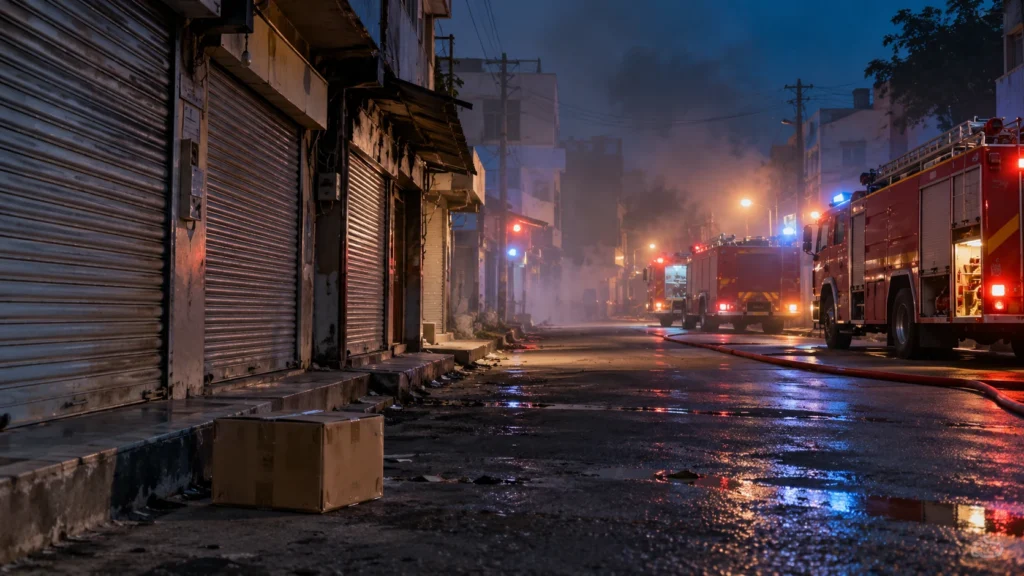
A fire involving reported firecracker storage in Hingoli's Marwadi Galli led to repeated explosions and a difficult response. The initial toll of two later rose to four in subsequent reporting; the investigation remains open.
Quick answers
What is the latest reported death toll in the Hingoli firecracker fire?
The latest reviewed report, published 12 October, said the reported toll had risen to four after two municipal firefighters died during treatment.
Were the firecrackers proven to have been stored illegally?
Early reporting attributed a preliminary allegation to officials and reported a police case. That is not a final forensic or court finding, so this article does not state it as settled fact.
What should people do near an explosion or firecracker fire?
Move away, keep responder access clear, call 112 from a safe location, follow authorities and do not return until the area is declared safe.
What is currently reported
On 5 October 2026, a fire involving a large reported stock of firecrackers broke out in Marwadi Galli, Kapda Bazar, Hingoli city, Maharashtra. Times of India reported two deaths and 12 injuries in its initial account, describing repeated explosions that spread the fire to adjoining homes and complicated firefighting.
A later Times of India report said the death toll rose to four after two Hingoli Municipal Council fire brigade employees died during treatment. It identified the two initial deaths through forensic analysis and said the police had registered a case under relevant provisions of the Bharatiya Nyaya Sanhita and Explosives Act. This article uses four as the latest reported death toll, while retaining the injury figure as an initial report rather than a final hospital total.
What is and is not known about the cause
Authorities reportedly investigated the circumstances of storing firecrackers and the cause of the explosion. Early reporting that stock was illegally stored is attributed to the district collector and police reporting; it is not a final judicial or forensic finding. The precise ignition source, licence status, accountability, final injury outcomes and property-loss assessment were not established in the reviewed material.
Why dense-neighbourhood storage raises response risk
- Explosive or rapidly burning materials can prevent responders from approaching safely and can spread fire to nearby homes.
- Keep lanes, hydrant access and fire-engine routes clear; crowds and parked vehicles can delay rescue.
- Residents should move away from the blast and smoke zone, follow police/fire directions and not return for belongings.
- Only trained, equipped personnel should conduct firefighting or rescue where explosions may continue.
- For burns or smoke exposure, seek urgent clinical assessment; do not rely on a person appearing able to walk away.
Why later follow-up changed the case record
The initial death figure was two. Later reporting of two firefighter deaths during treatment raised the reported toll to four. This illustrates why early casualty counts must be dated and rechecked rather than treated as final.
- Fire and repeated explosions are reported in Marwadi Galli, Hingoli
- Firefighters, police and emergency teams respond; nearby residents are reportedly evacuated
- Two deaths and 12 injuries are reported while rescue/firefighting continues
- Later reporting says an FIR is registered under BNS and Explosives Act provisions
- Latest reviewed report says two injured municipal firefighters have died during treatment, raising reported deaths to four
Why consequences escalated
- Later casualty follow-up changed the reported death toll from two to four.
- The 12-injury figure is an initial news count, not a final clinical register.
- Reported storage conditions and the ignition source remain matters for investigators, not editorial inference.
Failures and risk multipliers
- Do not enter an active explosion or fire zone to retrieve possessions or record footage.
- Do not crowd narrow lanes needed by fire vehicles and ambulances.
- Do not state that storage was illegal or identify fault as final without an official finding.
- Do not treat an initial death count as final when patients remain in treatment.
Actions that reduce risk
- Move away from explosions, smoke and falling debris; follow police/fire directions.
- Call 112 and give the exact lane, known hazards and whether people may be trapped.
- Keep roads and water access clear for responders.
- Seek urgent care for burns or smoke exposure, even when symptoms seem mild.
Leave a comment