
What happened here
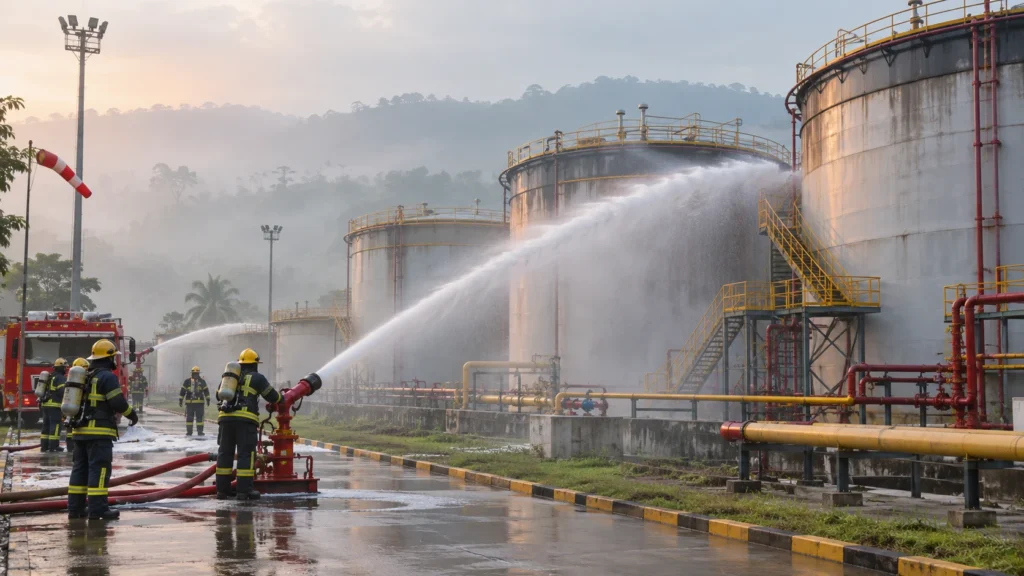
Oil India said a fire broke out at about 9:05 am while maintenance work was under way at its Tengakhat Intermediate Tank Farm in Assam. In the later company statement reported by PTI, one contract worker had died and six people had burn injuries; Oil India said its fire service controlled the blaze. An earlier ANI report had described five injuries and one missing worker, so those earlier figures are not added to the later update.
Quick answers
Was the fire cause confirmed?
No. Reviewed sources reported a fire during maintenance, but no authoritative ignition-cause or investigation finding was published.
Why does the article show two casualty sets?
ANI’s earlier breaking report was five injured and one missing. A later Oil India statement reported one death and six burn injuries; the later figure is used as the current count and is not added to the earlier snapshot.
Can workers fight a tank-farm fire themselves?
Only trained, assigned responders following the site emergency plan should do so. Everyone else should evacuate and report to the muster point.
Is the map the exact fire location?
No. It marks Tengakhat for geographic context only; it is not a verified gate, tank or incident coordinate.
What happened
Oil India said a fire broke out at about 9:05 am on 6 November 2026 while maintenance work was under way at its Intermediate Tank Farm in Tengakhat, Dibrugarh district, Assam. A later company statement reported by PTI said one contract worker had died and six people had burn injuries; Oil India said its fire service brought the blaze under control.
An earlier ANI report described five injured workers and one worker missing while information was still developing. This article does not add those earlier numbers to the later company update. It uses the later Oil India statement as the current count.
What is known and not yet known
- Reported by Oil India: a fire during maintenance, one death, six burn injuries and a controlled blaze.
- Not established: ignition source, exact work activity, equipment condition, clinical follow-up, property or environmental impact, and investigation findings.
- No blame is inferred: a report that maintenance was under way is not proof of a procedural failure by the company, contractor or worker.
Safety lessons
Work around flammable liquids and vapours needs a current permit-to-work assessment, isolation and gas testing where applicable, controlled ignition sources, exclusion zones, communications, muster arrangements and trained emergency response. These are general safeguards, not claims about what was or was not present at Tengakhat.
What workers and bystanders should do
- Follow the site alarm and leave by the designated route.
- Do not approach an industrial fire to record video or retrieve property.
- Report to the muster point and give incident command accurate information about anyone who may still be in a work area.
- Keep facility approaches clear for emergency vehicles.
- Do not re-enter until trained responders and the site emergency command say it is safe.
- Oil India said fire broke out during maintenance work at the Tengakhat Intermediate Tank Farm.
- ANI reported five workers injured and one missing while information was still developing.
- Oil India said one contract worker had died and six people suffered burn injuries; its fire service brought the blaze under control.
- No authoritative public finding on ignition source, maintenance task, equipment failure, environmental impact or accountability was located.
Why consequences escalated
- A fire during maintenance at a hydrocarbon-storage facility is a high-consequence event even when the fire is controlled. The reviewed reporting does not establish what caused this event or whether any procedure failed. It is therefore not evidence of fault by Oil India, the contractor or any worker.
- The practical safety lesson is preventive: work around flammable liquids and vapours needs a current permit-to-work assessment, isolation and gas testing where applicable, controlled ignition sources, clear exclusion zones, communications, muster arrangements and an emergency response plan. These are general safeguards, not claims about what was or was not present at Tengakhat.
Failures and risk multipliers
- Do not combine an early missing-person count with a later death-and-injury update.
- Do not describe a preliminary valve or maintenance detail from breaking coverage as a confirmed ignition cause.
- Do not share identifiable worker names or unverified casualty images.
- Do not enter an industrial fire perimeter unless assigned and equipped by the emergency command structure.
People closest to the evidence
“Oil India, as reported by PTI”
The company said its fire service controlled the blaze and reported one death and six burn injuries.
“ANI, early report”
Reported five injuries and one missing worker while information was still developing.
“Editorial note”
The later company update is used as the current count; cause remains under investigation.
Actions that reduce risk
- If you work at an industrial fuel or chemical facility | Follow the site alarm and leave by the designated route; do not approach a tank fire to record video or retrieve property.
- If you are outside the immediate hazard area | Keep away from the facility perimeter and make room for emergency vehicles; rely on official instructions rather than rumours.
- For supervisors | Account for personnel at the muster point, report missing persons only through incident command and preserve the scene for trained responders and investigators.
- For employers | Review maintenance permits, isolation, gas testing, contractor coordination, emergency communications and post-incident welfare without assuming the cause of this incident.
Leave a comment