
What happened here
 1 / 2
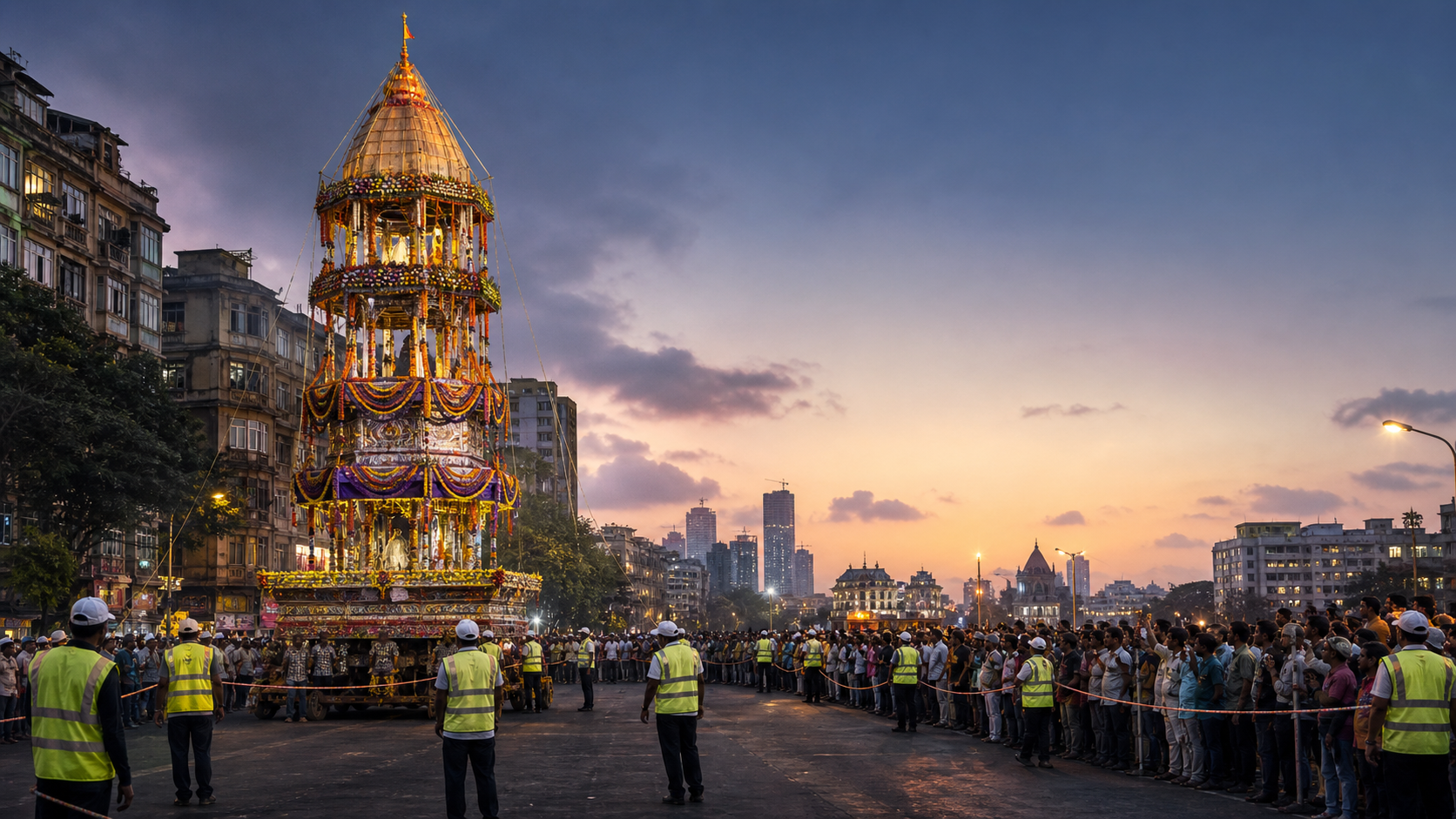
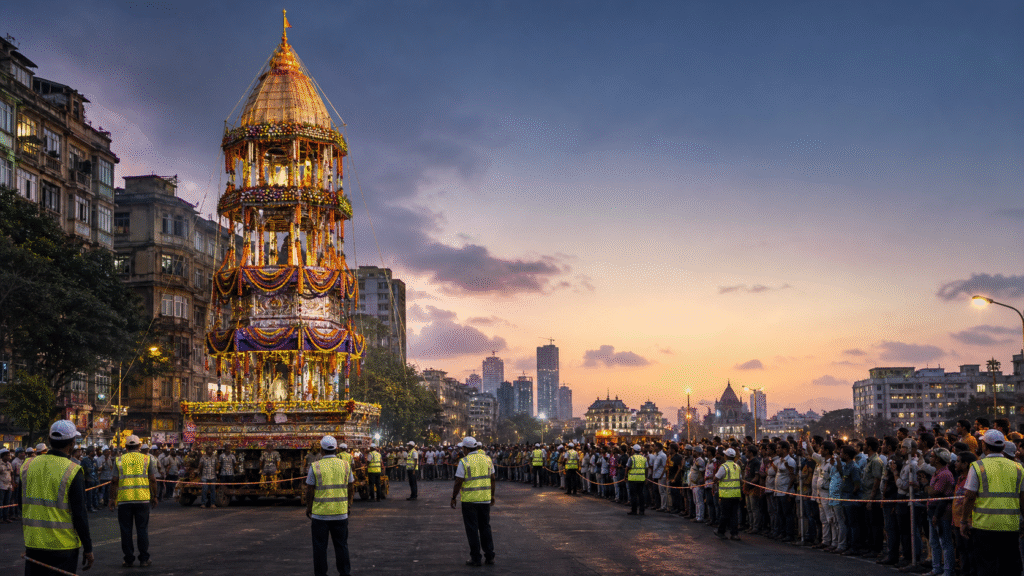
1 / 2 A large Ganpati idol collapsed during its arrival procession, killing two people and injuring five. Police began examining construction, welding and possible overhead obstruction factors.
Bhuleshwar Ganpati Idol Collapse: Safety Lessons from the Mumbai Procession Tragedy
**HowToSurvive.in | Know Before You Need to Know**
## 📅 Date & Location
– **Incident date:** 22 August 2026, approximately 9:50–10:00 PM
– **Location:** Jay Ambe Chowk, Bhuleshwar, South Mumbai, Maharashtra, India
– **Event:** Arrival procession of the Bhuleshwaracha Raja Ganpati idol
– **Incident type:** Collapse of a large transported idol/temporary supporting structure onto people in a crowd
## 🕯️ What Happened?
A large Ganpati idol was being transported through Bhuleshwar during an arrival procession when it fell towards people accompanying or standing near the procession. Reporting places the incident close to the destination pandal.
Two adults died from their injuries. Five other people were injured, including two children aged five and seven. Civic emergency personnel, the Mumbai Fire Brigade, police, traffic police and the 108 ambulance service responded, and the injured were taken to nearby hospitals.
News reports describe the idol as approximately 22 feet tall. One report also describes it as weighing about two tonnes; that figure should be treated as reported rather than independently verified.
The tragedy demonstrates that a procession is not only a crowd-management event. When it includes a tall, heavy or moving installation, it also becomes a temporary-structure and lifting/transport safety operation.
## 📊 Incident Snapshot
| Item | Reported information |
| Time | Approximately 9:50–10:00 PM |
| Location | Jay Ambe Chowk, Bhuleshwar, South Mumbai |
| Structure | Approximately 22-foot Ganpati idol |
| Deaths | 2 |
| Injured | 5, including two children |
| Emergency response | BMC/civic teams, fire brigade, police, traffic police and 108 ambulance |
| Reported preliminary failure | Failure of a supporting/welded part; final technical cause not established in the sources reviewed |
## ⏱️ Reported Timeline
**Before approximately 9:50 PM**
The idol was being transported from the workshop towards the Bhuleshwar pandal as people accompanied the arrival procession.
**Approximately 9:50–10:00 PM**
The idol or part of its supporting arrangement failed and fell towards the crowd near Jay Ambe Chowk.
**Immediately afterward**
Emergency services were mobilised. Seven injured people were transported to hospitals.
**Hospital outcome**
Two people were declared dead. Five injured people were reported to be receiving treatment and in stable condition in the initial reporting.
**Following the incident**
Police initiated an accidental-death process/inquiry. Preliminary reporting referred to a failed welding support or loose fastening, but a complete final engineering finding was not available in the sources reviewed for this article.
## ✅ Confirmed Facts vs ⚠️ Preliminary Claims
### Confirmed across multiple reports
– A large Ganpati idol fell during an arrival procession in Bhuleshwar.
– The incident occurred at about 10 PM on 22 August 2026.
– Two people died and five were injured.
– Two of the injured were young children.
– Fire, police, civic and ambulance services responded.
### Preliminary or not independently established
– The precise component that failed.
– Whether poor welding, loose nuts and bolts, another support defect, instability during movement or a combination of factors initiated the collapse.
– The complete inspection, loading, fastening and movement history of the structure.
– Whether any required safety perimeter, engineering approval or route-specific risk assessment was absent or inadequate.
**A preliminary explanation is not a final forensic conclusion.** Responsibility should be determined only after the structure, support frame, connections, transport platform, movement conditions and safety arrangements have been examined by competent authorities.
## 🔍 What Went Wrong?
The final technical cause remains subject to investigation. However, the outcome reveals several hazards that every organiser of a large procession must control.
### 1. People were within the potential fall zone
A tall structure creates a danger area around it. If it tilts, separates or collapses, anyone inside that area may have almost no time to escape.
### 2. A moving structure faces changing forces
A tall installation may appear stable while stationary but behave differently during starts, stops, turns, slopes, braking, vibration or contact with overhead and roadside obstacles.
### 3. The public cannot judge hidden structural weakness
Spectators see decoration and scale. They cannot see the quality of welds, fasteners, bracing, anchorage or the load carried by individual connections. Safety therefore cannot depend on spectators recognising danger.
### 4. Celebration can reduce risk perception
Music, crowds, religious emotion, photography and excitement can draw people closer to a moving structure. These conditions make a physically enforced exclusion zone essential.
### 5. Children face added vulnerability
Children may be less visible to operators, slower to interpret warnings and more vulnerable to crushing forces. They should never be allowed close to the movement or fall zone of a heavy temporary installation.
## 🧯 How the Risk Could Be Reduced
No single measure can guarantee safety. Large public installations require multiple protective layers.
### ENGINEER
– Use a competent structural professional for the frame, supports and connection details.
– Calculate the centre of gravity, base stability, dynamic movement forces and safe turning limits.
– Design for the actual route and transport method—not only for the final stationary display.
– Avoid unapproved last-minute additions that change height, weight or balance.
### INSPECT
– Conduct documented pre-movement checks of welds, bolts, pins, braces, wheels, tyres, platform and tie-downs.
– Reinspect after loading and before entering crowded streets.
– Stop movement if any connection deforms, loosens or produces unusual movement or sound.
### ISOLATE
– Establish a visible exclusion zone at least beyond the credible fall path determined by the safety plan.
– Use trained marshals and physical barriers; verbal requests alone may fail in a noisy crowd.
– Keep children and spectators away from the front, sides and rear of the moving platform.
### CONTROL THE ROUTE
– Survey road width, turns, slopes, potholes, overhead cables, balconies, trees and emergency access.
– Define a low movement speed and safe stopping points.
– Keep an unobstructed route for ambulances and emergency vehicles.
### PREPARE FOR FAILURE
– Brief marshals on an emergency stop signal.
– Position first-aid capability and an ambulance appropriately for high-attendance events.
– Predetermine who calls 112, who stops crowd movement and who guides responders.
– Never allow an untrained crowd to rush beneath an unstable structure to lift it.
## 🛡️ How to Survive Near a Falling Heavy Structure
### Before anything goes wrong
– Do not stand close to a tall moving idol, stage element, lighting tower, hoarding or temporary arch.
– Identify which way the structure could fall and remain outside that zone.
– Keep children beside you—not ahead in the crowd or near the vehicle/platform.
– Avoid walking while filming; maintain awareness of movement and escape space.
### If the structure begins to tilt or fail
– Move **away from its fall path**, not alongside or underneath it.
– Shout a short warning such as **“Move back!”**
– Do not stop to record the incident.
– Do not attempt to catch, push or support a massive falling object.
– After it lands, watch for secondary collapse, broken electrical cables, moving vehicles and crowd surges.
### If someone is trapped
– Call **112** immediately and give the exact landmark and number of people trapped.
– Do not move a large load unless there is an immediate life threat and the action can be coordinated safely.
– Do not crawl underneath an unstable object.
– Keep the person still and reassured if the scene is safe.
– Control severe external bleeding with direct pressure when accessible and safe.
– Follow instructions from emergency responders; crush injuries can produce serious internal damage even when the skin appears relatively normal.
## ⚖️ Truth You Must Know
Crowd safety is not only about preventing stampedes.
A public procession may combine:
**crowd density + moving vehicles + temporary structures + electrical systems + restricted streets + limited emergency access.**
Each hazard must be planned independently and then evaluated as one connected system.
## 📢 Systemic Lesson
Faith and celebration deserve respect. Protecting the people who gather is part of that respect.
Organisers should treat every tall or heavy ceremonial installation as an engineered load. A beautiful structure is not necessarily a stable structure, and a route that is passable is not necessarily safe for a large moving installation.
The correct question is not only:
**“Can we move it?”**
It is:
**“Can we move it through this route without exposing anyone to its fall zone?”**
## 💡 What You Can Do Today
– Stay outside the fall zone of tall temporary structures.
– Ask event organisers to create visible safety perimeters.
– Never allow children to stand beside moving heavy installations.
– Report visibly unstable structures, damaged frames or unsafe crowding to organisers and police.
– Learn your location’s emergency access points before joining a large procession.
– Share this lesson without sharing graphic images of victims.
## 🔚 Closing Line
A celebration should create memories—not casualties. The safest procession is one in which engineering, crowd control and emergency readiness move together.
- Large idol travels through dense Bhuleshwar streets
- Part of the idol/structure falls near Jay Ambe Chowk
- Volunteers and emergency services lift debris and assist casualties
- Injured people, including children, receive treatment
- Construction, welding and obstruction factors are examined
Why consequences escalated
- Temporary tall structures need engineered stability and documented load paths
- A moving structure must be checked for road slope, turns and overhead clearances
- Crowds need a controlled exclusion zone outside the fall radius
- Emergency stops and spotters must have authority to halt movement
- Suspected welding or wire contact must remain labelled as investigated, not proven
Failures and risk multipliers
- Allowing sleeping or crowd occupancy without a risk-specific plan
- Depending on one escape path
- Treating an unverified cause claim as a final investigation finding
- Failing to control fuel, combustible stock or structural loads
- Leaving inspection defects unresolved
People closest to the evidence
““Safety principle””
Detection, separation, stable construction and redundant escape must be established before people enter the hazard area.
Actions that reduce risk
- Verify alarms and two escape routes
- Keep exits and emergency access clear
- Separate sleeping areas from fuel, cooking and storage
- Control crowds outside structural fall zones
- Record inspections and close every defect
- Call 112 with the exact location
Leave a comment