
Case Study
What happened here
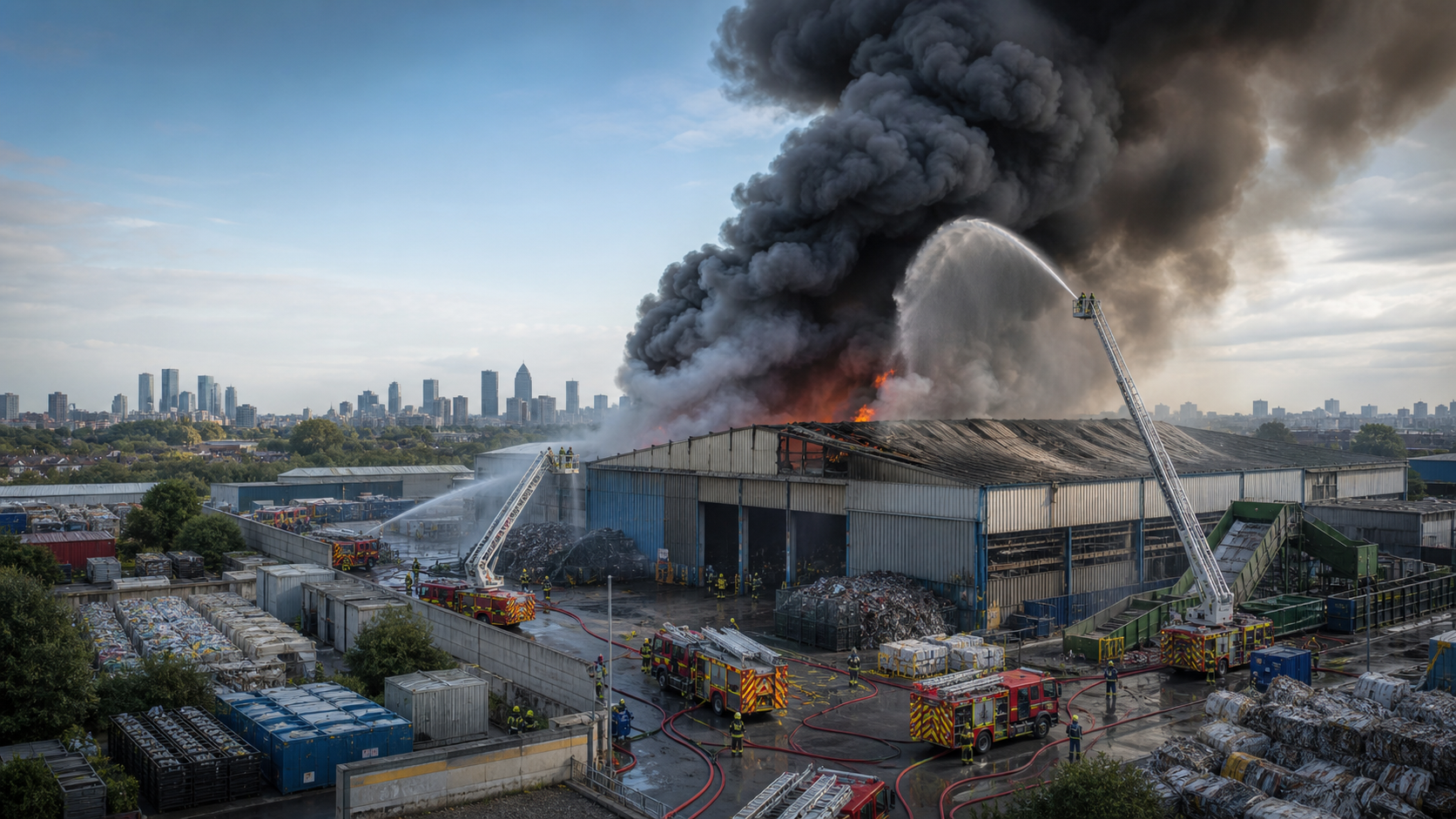
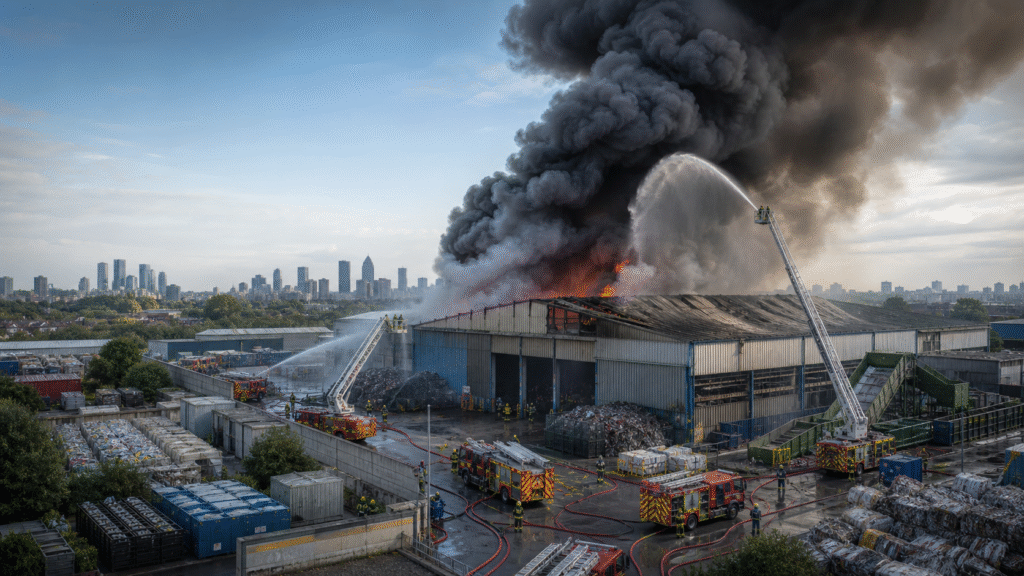 1 / 2
1 / 2 Firefighters reportedAbout 125
Primary off-site hazardSmoke plume
Public actionAvoid area, close windows when officially advised
CauseDo not state until fire-service investigation
Indian relevanceIndustrial emergency plans must address off-site populations
A large industrial fire reportedly required around 125 firefighters and produced a major smoke plume, illustrating why public warnings and exposure control extend beyond a site boundary.
Neasden Industrial Fire: Lessons from London’s Massive Recycling-Facility Blaze
**HowToSurvive.in | Know Before You Need to Know**
## 📅 Date & Location
– **Date:** 28 August 2026
– **First emergency calls:** Approximately 11:34 AM local time
– **Location:** Hannah Close, Neasden, north-west London, United Kingdom
– **Incident type:** Major industrial-estate fire involving a mixed-waste/recycling facility
– **Public impact:** Large smoke plume, precautionary shelter advice and substantial transport disruption
## 🕯️ What Happened?
A major fire broke out at an industrial estate on Hannah Close in Neasden, close to Wembley. London Fire Brigade mobilised 20 fire engines and approximately 125 firefighters after receiving more than 70 emergency calls.
The fire affected a large industrial unit at a mixed-waste or recycling facility. Aerial ladders, a drone team and additional water-supply capability were among the resources reported at the scene.
Large quantities of smoke moved across the surrounding area. The fire brigade advised nearby residents to remain indoors where possible and keep doors and windows closed. Metropolitan and Jubilee line services were affected, as were other rail movements. A neighbouring workplace was reportedly evacuated as a precaution and was not described as the seat of the fire.
The blaze was reported under control later in the afternoon, although crews were expected to remain for prolonged firefighting and monitoring. No injuries were reported in the principal sources reviewed at the time of writing.
The cause had not been established.
## 📊 Incident Snapshot
| Item | Verified/reported information |
| First calls | Approximately 11:34 AM |
| Fire engines | 20 |
| Firefighters | Approximately 125 |
| Calls received | More than 70 |
| Facility | Industrial mixed-waste/recycling site |
| Aerial capability | Three 32-metre ladders initially reported by LFB |
| Injuries | None reported in reviewed sources |
| Public warning | Stay indoors where possible; close doors and windows |
| Cause | Not known / under investigation |
## ⏱️ Timeline
**11:34 AM**
London Fire Brigade’s Control Room received the first of more than 70 calls.
**Late morning**
Twenty fire engines and around 125 firefighters were mobilised. A large smoke plume became visible across the area.
**During the response**
Residents nearby were advised to close windows and doors and remain inside where possible. Public-transport services were disrupted. A neighbouring facility was evacuated as a precaution.
**Approximately 5:00 PM**
Later reporting said the fire had been brought under control. Crews remained for extended operations and monitoring.
**At publication**
The cause was still under investigation.
## ✅ Confirmed Facts vs ⚠️ Preliminary Claims
### Confirmed by London Fire Brigade or supported by multiple reports
– The fire occurred at an industrial estate on Hannah Close, Neasden.
– London Fire Brigade sent 20 engines and around 125 firefighters.
– More than 70 calls were received.
– A large quantity of smoke prompted official shelter advice.
– Tube and rail services were disrupted.
– The cause was not known in the available official update.
### Preliminary, contextual or not yet established
– Reports of an explosion before or during the fire.
– The precise material first ignited.
– Whether a battery, electrical failure, hot work, deliberate act or another mechanism initiated the fire.
– The effectiveness of every onsite detection, suppression and waste-separation control.
Waste and recycling facilities have known fire hazards, including improperly discarded batteries, but that general risk must **not** be presented as the cause of this specific incident unless investigators confirm it.
## 🔍 Why This Fire Became a Major Public Emergency
### 1. Large combustible inventory
Mixed waste may contain paper, plastics, textiles, packaging and other combustible materials. Fire can spread through stored piles and remain deep-seated after visible flames reduce.
### 2. Uncertain contents
Waste streams may contain damaged batteries, aerosols, cylinders, chemicals or other items not correctly declared or separated. This can complicate firefighting and increase re-ignition or explosion risk.
### 3. Smoke travelled beyond the site
An industrial fire can expose people who are not close enough to see flames. Smoke may irritate the eyes and respiratory system, reduce visibility and affect roads, railways, businesses and homes.
### 4. High demand on emergency resources
The deployment of approximately 125 firefighters, aerial appliances, water-supply support and a drone illustrates the scale and duration such incidents can require.
### 5. Transport interdependency
Emergency operations, smoke and proximity to rail infrastructure disrupted public transport. Industrial-site risk assessments should therefore consider effects beyond the property boundary.
## 🧯 Prevention and Loss-Reduction Layers
### PREVENT
– identify and separate high-risk waste streams;
– establish safe battery collection and quarantine procedures;
– prevent ignition sources near combustible stock;
– maintain electrical installations, conveyors and processing equipment;
– use safe hot-work permits and post-work fire watches;
– control pile size, height and spacing.
### DETECT
– provide appropriate automatic fire detection;
– use thermal monitoring where justified by the risk;
– maintain surveillance of storage areas outside operating hours;
– ensure alarms reach responsible staff without delay.
### CONTAIN
– use fire-resisting compartmentation appropriate to the operation;
– maintain separation distances between stockpiles;
– preserve access routes and firebreaks;
– prevent uncontrolled external storage spread.
### SUPPRESS
– provide appropriate fixed and manual firefighting systems;
– maintain reliable onsite water supplies;
– ensure firefighters can access hydrants, isolation controls and site plans;
– account for contaminated firefighting water and environmental runoff.
### PLAN
– maintain an up-to-date inventory and emergency information pack;
– coordinate pre-incident planning with the fire service;
– practise evacuation and shelter instructions;
– plan public warnings, transport impacts and neighbouring-site communication.
## 🛡️ How to Protect Yourself from a Large Outdoor Smoke Plume
### If authorities advise you to stay indoors
– Go inside and close external doors and windows.
– Follow official fire-service, police, local-authority and public-health updates.
– Turn off systems that draw outside air indoors when official guidance or building procedures advise it and it is safe to do so.
– Bring children and pets indoors.
– Avoid travelling towards the incident or gathering to watch.
– Keep roads clear for emergency vehicles.
### If you are already outside
– Move away from the smoke and follow police cordons.
– Do not rely only on smell; visibility and official warnings are stronger indicators of risk.
– If smoke is affecting your breathing, seek clean air and medical advice promptly.
– People with asthma, heart or lung disease should follow their care plans and official health advice.
### If you are driving
– Do not stop on roads to film the fire.
– Close windows and follow diversions.
– Expect sudden visibility changes and emergency-vehicle movements.
– Never enter a closed road or industrial cordon.
## ⚖️ Truth You Must Know
“No injuries reported” does not mean “no major emergency.”
This incident demanded a very large firefighting response, affected public transport, produced widespread smoke and required protective advice for residents. Preventing deaths is the first objective, but community disruption, firefighter exposure, environmental damage and business interruption are also serious consequences.
## 📢 Systemic Lesson
Waste does not stop being hazardous after it enters a bin.
Battery disposal, material separation, stockpile management, ignition control and emergency planning connect household behaviour to industrial fire risk. The facility must manage the hazard, manufacturers and regulators must improve safe systems, and the public must dispose of batteries and hazardous items through appropriate channels.
## 💡 What You Can Do Today
– Never place lithium batteries or battery-powered devices in ordinary household waste where local rules prohibit it.
– Use authorised battery recycling/collection points.
– Follow official shelter advice during a smoke incident.
– Do not travel to a fire scene for photographs.
– Businesses near industrial sites should include smoke sheltering in emergency plans.
– Facility managers should verify waste segregation, detection, water supply and fire-service access.
## 🔚 Closing Line
The flames may remain inside one industrial site, but smoke, disruption and risk do not respect its boundary. Prevention must begin before hazardous waste reaches the pile.
- Conditions exceed normal control
- Occupants or witnesses identify danger
- People move or require assisted evacuation
- Public services control the incident
- Authorities examine cause, compliance and corrective action
Why consequences escalated
- Occupancy must match the approved use
- Detection and two usable escape routes are essential
- High-risk fuel, smoke, water or blast exposure requires separation
- Vulnerable occupants need planned assistance
- Reported cause and liability must follow evidence
Failures and risk multipliers
- Using unapproved or incompatible space
- Allowing one route to become a single point of failure
- Delaying alarm or evacuation
- Ignoring prior complaints or inspection findings
- Publishing unverified casualty or cause claims
People closest to the evidence
““Safety principle””
A building or industrial system must remain survivable after one foreseeable failure.
Actions that reduce risk
- Verify lawful occupancy
- Check detection and two exits
- Control fuel, water and structural hazards
- Plan assistance and accountability
- Practise evacuation
- Call the appropriate emergency service
Leave a comment