
Case Study
What happened here
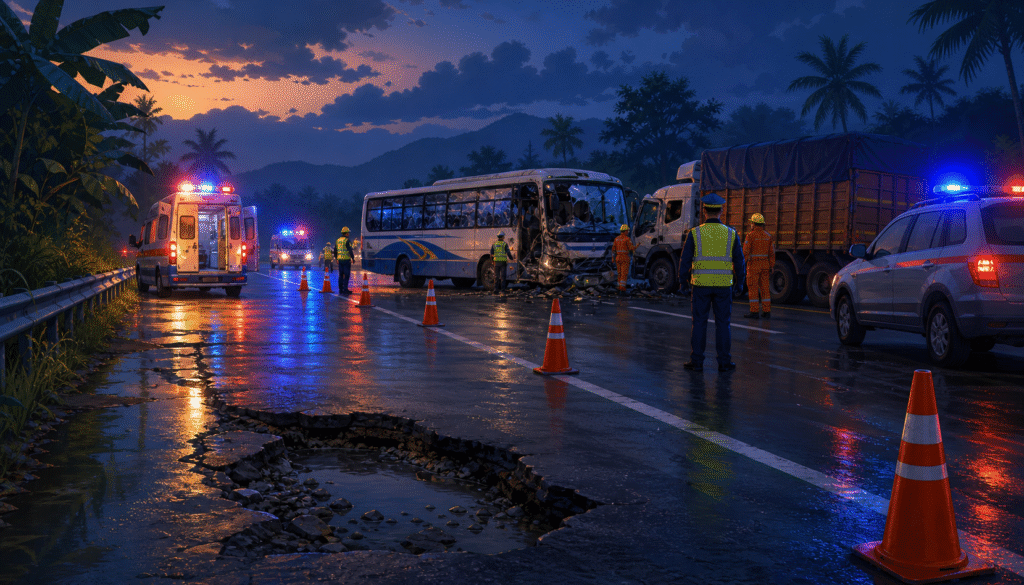
VehiclesPassenger minibus and goods truck.
Crash typeHead-on collision.
Road issuePoor maintenance/pothole involvement publicly reported; final causation unresolved.
Human impactSeven deaths in principal 31 August reporting; later local report stated eight.
Emergency principleProtect the scene from traffic and call 112 from a safe position.
A passenger minibus travelling toward Guwahati collided head-on with a goods truck on NH-27. Police and state reporting initially recorded seven deaths and five to six injuries. The Assam chief minister said poor highway maintenance contributed and ordered attention to repairs; a complete public forensic reconstruction was not located.
Sonapur NH-27 Bus–Truck Collision Case Study: Road Defects and Head-On Crash Risk
A passenger minibus and a goods truck collided head-on on NH-27 in the Sonapur–Khetri area outside Guwahati on Sunday evening. Police accounts reported by Hindustan Times put the death toll at seven and recorded five injured passengers; later local reporting described six injured. Six people reportedly died at the scene and another died at Gauhati Medical College and Hospital. The different injury totals should remain labelled as developing until authorities publish a consolidated list.
Assam Chief Minister Himanta Biswa Sarma visited the location and said poor highway maintenance contributed to the crash. Reports say the minibus lost control while avoiding a pothole, but the investigating officer also said the road condition was being examined. That sequence is therefore a reported investigative position, not a final reconstruction.
## Casualties, injuries and rescues
– **Deaths:** 7 reported by police and state officials.
– **Injured:** 5 in the Hindustan Times police account; another report listed 6. Treat the count as provisional.
– **Truck occupants:** Police said no truck occupant was injured.
– **Response:** Injured people were taken for hospital treatment; one victim later died at GMCH.
## Supported timeline
– **30 August, evening:** The minibus, carrying 14 people including driver and helper, travelled toward Guwahati.
– **At Khetri/Sonapur:** It collided head-on with a goods truck on NH-27.
– **Immediate aftermath:** Six deaths were reported at the scene and survivors were transported to hospital.
– **31 August:** A seventh person reportedly died at GMCH. The chief minister inspected the site, announced ₹5 lakh compensation for each bereaved family and directed attention to road repairs.
## Confirmed facts versus preliminary claims
**Confirmed/publicly reported by police:** the two-vehicle head-on collision, location, seven deaths, hospitalisation of survivors and absence of reported injuries in the truck.
**Still under examination:** whether a pothole initiated the loss of control; vehicle speeds; braking and steering condition; lane position; visibility; driver actions; restraint use; and the final injury count. No public forensic reconstruction or mechanical inspection report was located at publication time.
## Failure analysis without speculation
A severe head-on crash concentrates the closing speed of two vehicles and leaves little survival space. A road defect can prompt abrupt steering, but outcome severity is also shaped by speed, lane separation, sight distance, vehicle crashworthiness, seat-belt use and how quickly emergency care arrives. Because those variables have not been publicly resolved here, no single cause should be presented as established.
## Prevention layers
1. Repair and mark dangerous pavement defects promptly; provide advance warning until repair.
2. Use median separation, rumble strips, delineators and lighting where traffic and geometry justify them.
3. Require commercial-vehicle inspections covering tyres, steering, brakes and emergency exits.
4. Set safe speeds for road condition, rain, darkness and available sight distance.
5. Ensure every passenger has and uses an effective restraint where fitted.
6. Establish rapid crash notification, extrication and trauma-transfer plans along high-risk corridors.
7. Preserve roadway and vehicle evidence for an independent, published investigation.
## Survival guidance
– Wear the seat belt throughout the journey; avoid standing or sleeping unrestrained.
– Choose a seat with a working belt and identify the nearest usable exit before departure.
– If the driver swerves or brakes, brace your head against the seat, keep feet planted and protect your face.
– After impact, switch off ignition only if safe, move away from traffic and fuel leaks, and call 112.
– Do not pull a seriously injured person from a stable vehicle unless fire, water, traffic or collapse creates immediate danger.
– Warn approaching traffic from a protected position; never stand in an active lane.
## Incident snapshot
| Item | Verified position |
| Vehicles | Passenger minibus and goods truck |
| Crash type | Head-on collision |
| Human impact | 7 deaths; 5–6 injuries reported |
| Road factor | Poor condition/pothole reported; final cause pending |
| Government response | Site visit, compensation announcement and road-condition review |
## Systemic lesson
Road defects become lethal when they combine with speed, opposing traffic and limited recovery space. Maintenance warnings, vehicle controls and occupant protection must overlap rather than depend on a driver making one perfect manoeuvre.
## Reader actions
Passengers should refuse overcrowded or visibly unsafe vehicles and report dangerous highway defects with exact location, direction and a safe photograph. Fleet operators should document pre-trip checks and prohibit schedules that reward unsafe speed.
**Closing line:** A survivable road system assumes that drivers will sometimes face hazards—and gives them room to recover.
- A passenger Traveller/minibus carrying about 14 people travelled toward Guwahati on NH-27.
- The minibus collided head-on with a goods truck. Reporting said six people died at the scene and survivors were taken to hospital.
- A seventh death was reported after hospital treatment. Local reports differed between five and six injured people.
- Chief Minister Himanta Biswa Sarma visited the area and said poor maintenance contributed. Reporting described an attempt to avoid a pothole, but this remained part of the developing investigation.
- At least one local report raised the death toll to eight. Because a consolidated official victim list was not located, the panel preserves both dated positions rather than silently changing the headline.
Why consequences escalated
- A head-on collision combines the motion of opposing vehicles and can severely reduce survivable space. The public record supports the collision and substantial loss of life, but not every contributing factor needed for a final reconstruction.
- Road condition was identified publicly as a factor by the chief minister and subsequent reporting. That does not eliminate the need to examine speed, lane position, braking, steering, tyres, visibility, driver response, restraints and vehicle crashworthiness.
- The injury count changed between reports, and later local coverage reported an eighth death. Human-impact figures need a dated source and reconciliation rather than an apparently precise but unstable total.
- Maintenance is a prevention layer: dangerous defects need repair, interim warning and monitoring. Driver decisions and occupant protection remain additional layers rather than substitutes for safe infrastructure.
- Post-crash survival depends on restraints, safe egress, protection from moving traffic and rapid trauma care. Bystanders should not create a second collision while trying to assist.
Failures and risk multipliers
- Presenting the pothole account as a completed forensic cause.
- Using one early injury or death count without its date and source.
- Driving at a speed that leaves no recovery margin for visible road condition and sight distance.
- Travelling without a working seat belt where fitted.
- Standing in a live lane after the crash.
- Moving a seriously injured person from a stable vehicle without an immediate fire, traffic, water or collapse threat.
- Failing to preserve vehicle and road evidence for an independent review.
Actions that reduce risk
- Repair and mark dangerous pavement defects promptly; provide visible temporary warning until repair.
- Use median separation, rumble strips, delineation and lighting where traffic and geometry justify them.
- Document commercial-vehicle checks for tyres, steering, brakes, restraints and emergency exits.
- Set journey speeds for darkness, surface condition, visibility and available stopping distance.
- Provide a usable restraint for every occupant and require its use throughout the trip.
- Plan rapid notification, traffic protection, extrication and trauma transfer on high-risk corridors.
- Publish a reconciled casualty record and the investigation findings when available.
- Give defect reports an exact location, direction, time and safe photograph rather than a vague social-media warning.



Leave a comment