
Quick answers
What is the Golden Hour after a road accident?
It is the first hour after a crash, the most critical window when many victims can be saved, because heavy bleeding, a blocked airway or shock can still be treated. Indian law calls it the golden hour.
What first aid should I give at a road accident?
Park safely with hazard lights on, call 112 or 108 with the exact location and number of victims, start CPR if the person is unresponsive and not breathing normally, control bleeding with firm direct pressure using a clean cloth, and keep the victim calm and still.
Should I move a road accident victim?
Do not move a person with a possible spinal injury unless it is necessary, and do not pull victims recklessly from vehicles. Keep them still until help arrives.
What should I not do when helping an accident victim?
Do not pour water on an unconscious victim, do not ignore bleeding wounds assuming the ambulance will handle it, and focus on helping rather than recording videos.
1. Why You Must Know This
Road crashes killed 1,72,890 people in India in 2023, according to MoRTH. Many injured people can still be saved in the first hour, while heavy bleeding, a blocked airway or shock can still be dealt with. Indian law calls this the “golden hour”: the hour after an injury when prompt medical care has the best chance of preventing death. Your help in those minutes counts.
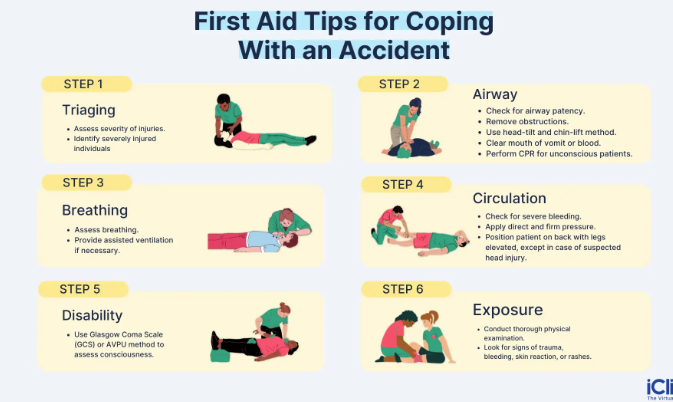
2. Step-by-Step First Aid for Accident Victims
- Ensure safety: Stop, park safely, turn on hazard lights.
- Call 112 or 108 immediately: Give the exact location and the number of people hurt.
- Check if the person responds and is breathing normally: If they are unresponsive and not breathing normally, start CPR.
- Control bleeding: Press firmly and directly on the wound with a clean cloth or dressing, and keep pressing. If an arm or leg is bleeding heavily and pressure does not stop it, a tourniquet placed 5–7 cm above the wound (not over a joint) can save a life. Use one only if you have been trained, and never loosen it yourself — leave that to doctors.
- Don’t move a person who may have a neck or spine injury unless they are in danger where they lie. Keep their head and neck still.
- Keep victim calm & still until help arrives.
3. Visual Infographic Suggestion
“Stop – Call – Check – Control – Care.”
4. Common Mistakes to Avoid
❌ Pouring water on unconscious victims.
❌ Pulling victims recklessly from vehicles.
❌ Ignoring bleeding wounds (“ambulance will handle it”).
5. Where Should This Be Practiced?
Driving schools, colleges, corporate transport systems.
6. What You Can Do Today
✔ Carry a basic first aid kit in your vehicle.
✔ Learn bleeding control and CPR.
✔ Share accident videos responsibly — focus on helping, not recording.
7. Related Case
“Picture a crash where a crowd gathers and phones come out, but no one presses on the bleeding wound. That person can bleed to death before the ambulance arrives. One person with a cloth and firm pressure can change that.” (Illustrative example, not a specific reported case.)
8. Final Words
“Golden Hour is not medical jargon — it’s the window between life and loss. Be the difference.”
What needs attention
- Road crashes killed 1,72,890 people in India in 2023
- Many injured people can still be saved in the first hour, the golden hour in Indian law
- Heavy bleeding, a blocked airway and shock are the main things a bystander can help with
- Firm direct pressure with a clean cloth stops most bleeding
- Moving a person with a possible neck or spine injury can make it worse
- Phones out and nobody helping costs lives; one person who acts can change that
Controls that reduce risk
- Keep a first-aid kit, gloves and a torch in every vehicle
- Learn bleeding control and CPR in a hands-on course
- Add crash first aid to driving school, college and company transport training
- Agree as a family that you stop and help when it is safe to do so
Common unsafe practices
- Recording videos instead of helping
- Pulling people out of vehicles roughly when there is no fire or other danger
- Pouring water on an unconscious person
- Ignoring bleeding and waiting for the ambulance
- Using a tourniquet without training, or loosening one yourself
- Stopping in a spot where other traffic can hit you


Leave a comment