
Quick answers
Can I use a lift during a building fire?
No. Always take the stairs during a fire. Lifts can lose power, fill with smoke or stop at fire-affected floors.
What should I do if I get stuck in a lift?
Stay calm, press the emergency button, call security on the intercom or phone, signal by banging on the doors or shouting at intervals, and wait for trained rescue. If smoke comes in, stay low, cover your nose and mouth, and call 101 or 112.
Should I force open lift doors if stuck between floors?
No. Do not try to force the doors open between floors, as fatal falls can happen. Wait for help after raising the alarm.
How can high-rise residents prepare for a lift fire or failure?
Learn where the staircases are, carry a torch and whistle on your keychain, ask management whether lifts have fire-rated doors and emergency power, and take part in stairs-only evacuation drills.
1. Why You Must Know This
High-rises are India’s urban future — but lifts are often used even during fires. In the Delhi Anaj Mandi fire (2019), at least 43 people died in a crowded building with just one narrow entrance; most were overcome by smoke and toxic gas before they could get out. Lifts fail during fires because power cuts, smoke infiltration, and heat expansion turn them into death chambers.
2. Step-by-Step Survival During Lift Fire/Failure
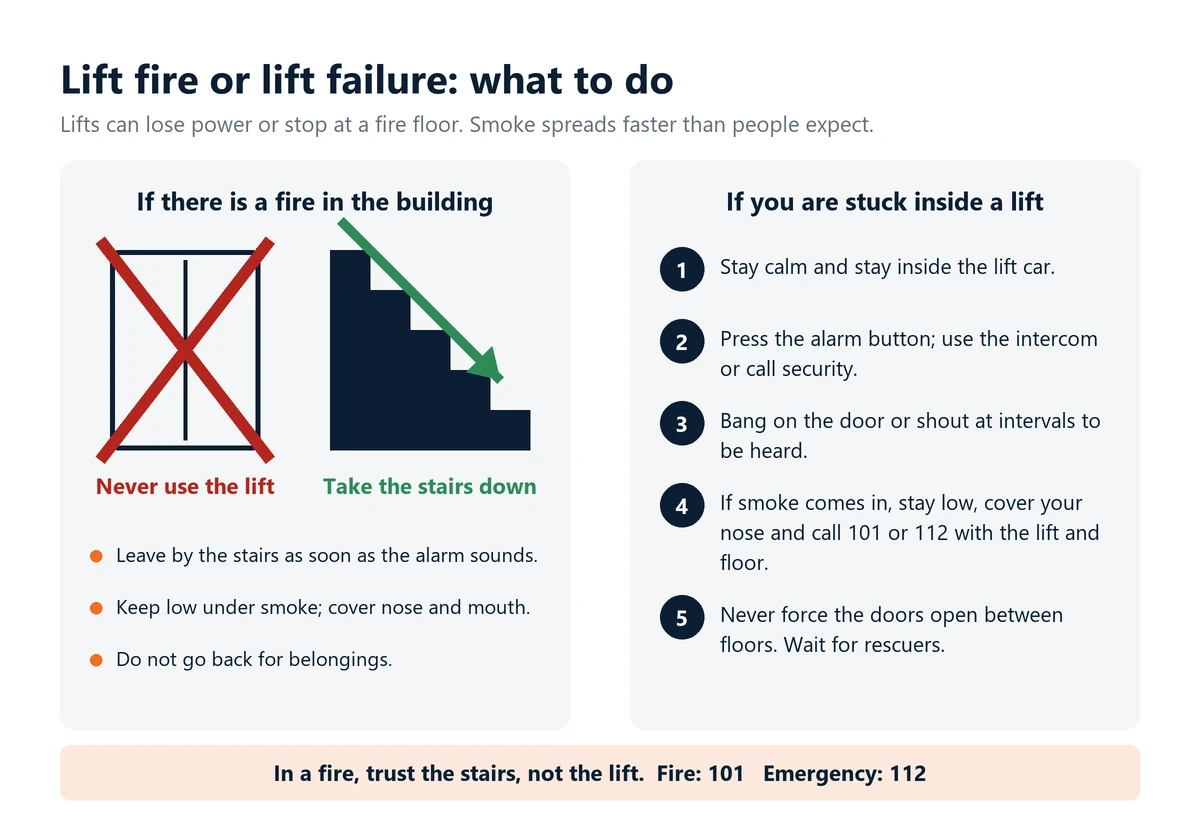
- If fire breaks out in building:
- Never use lifts. Always take stairs.
- Lifts may lose power or stop at fire-affected floors.
- If stuck in lift due to failure:
- Stay calm and stay inside the lift car.
- Press emergency button, call security using intercom/phone.
- Signal by banging doors or shouting at intervals.
- If smoke starts coming into the lift, stay low, cover your nose and mouth with a cloth, and keep telling security or the fire brigade (101 or 112) exactly which lift and floor you are on. Get out as soon as rescuers open the doors at a landing.
- Do not try to force doors open between floors.
3. Visual Diagram Suggestion
❌ Lift, ✅ stairs as escape.
4. Common Mistakes to Avoid
❌ Using lift as shortcut during fire evacuation.
❌ Forcing open doors between floors — fatal falls happen.
❌ Staying put, or going back for belongings, when the fire alarm sounds. Get out by the stairs, keep low under smoke and call 101 or 112.
5. Where Should This Be Practiced?
Every high-rise RWA should conduct evacuation drills highlighting “Stairs Only During Fire.”
6. What You Can Do Today
✔ Learn location of staircases in your building.
✔ Carry a torch and whistle on keychains.
✔ Ask management if lifts have fire-rated doors and emergency power.
7. Related Case
Delhi Anaj Mandi fire (2019): at least 43 people died, 39 of them from asphyxiation, according to the NHRC. Many were workers sleeping in a building with just one narrow entrance. The NHRC account does not mention lifts, but the lesson carries over — smoke spreads faster than people expect, and every building needs more than one usable way out.
8. Final Words
“Lifts are convenience machines, not escape routes. In a fire — trust your legs, not the lift.”
What needs attention
- Lifts can lose power, fill with smoke or stop at the fire floor during a building fire
- The stairs are the escape route in an ordinary building fire; the lift is not
- Forcing lift doors open between floors can lead to a fatal fall into the shaft
- In the 2019 Anaj Mandi fire most victims were overcome by smoke in a building with one narrow entrance
- A building with only one usable way out leaves people trapped when smoke fills it
Controls that reduce risk
- Put 'In case of fire, use stairs' signs at every lift landing
- Test the lift alarm button, intercom and emergency light regularly
- Ask the lift contractor how trapped people are rescued and who holds the keys
- Keep stair doors unlocked from inside and stairs free of junk
- Run stairs-only evacuation drills in every high-rise society
Common unsafe practices
- Taking the lift as a shortcut during a fire alarm
- Trying to force lift doors open between floors
- Not knowing where the staircases are
- Stair doors locked or stairs used for storage
- No working alarm button or intercom inside the lift

Leave a comment