
What happened here
 1 / 3
A reported drone strike and stored ammunition detonations caused a mass-casualty event near civilian buildings; conflict reporting and casualty counts require continuing verification.
Quick answers
What happened in the Myla warehouse explosion in Ukraine?
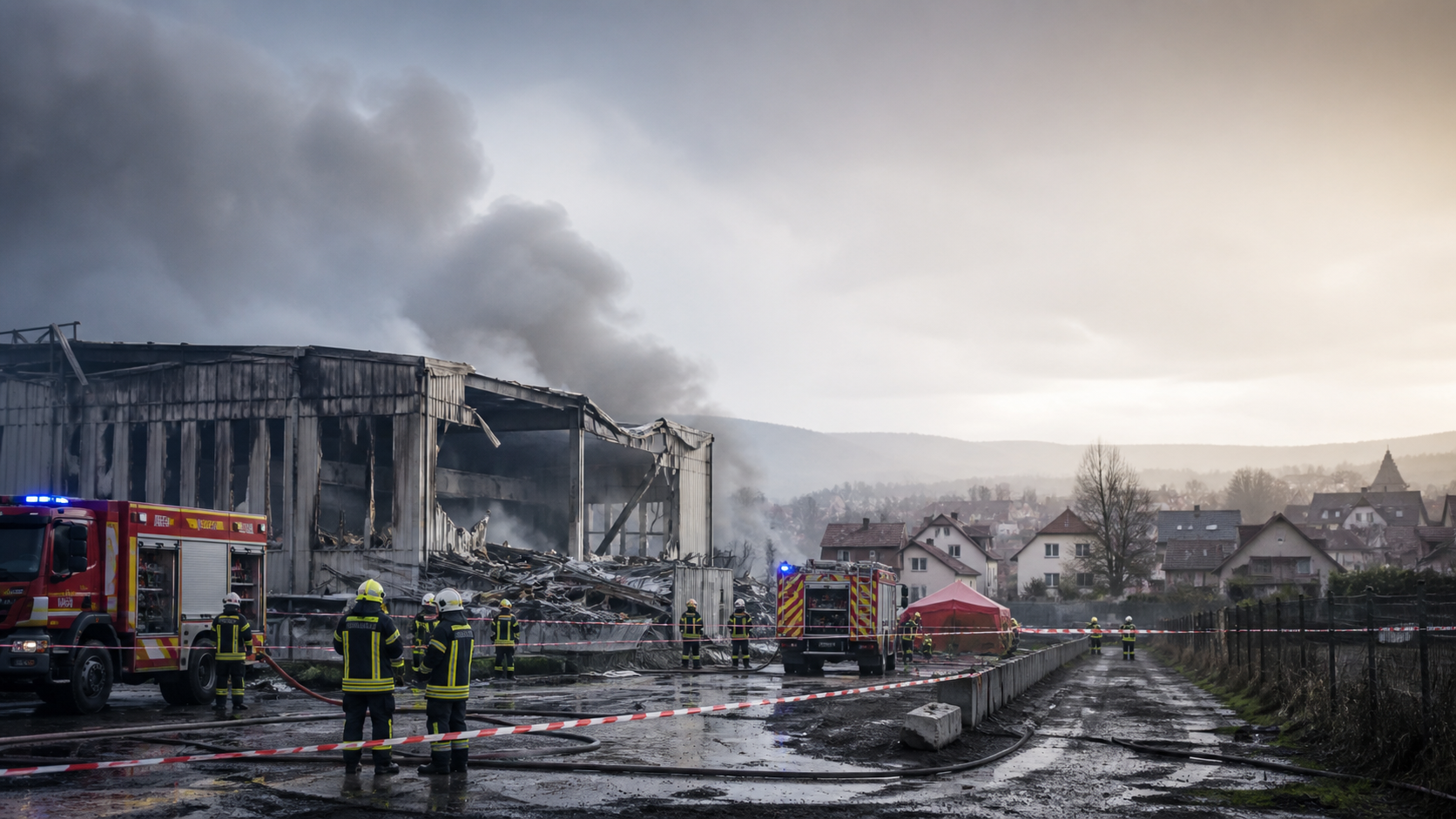
On the night of 28 August 2026, a reported drone strike hit a warehouse in Myla village, Bucha district, that was reported to hold ammunition. Secondary explosions and fires followed, damaging nearby homes and a care facility, and at least 37 deaths were officially reported.
Why did the Myla warehouse strike harm so many civilians?
Explosive material was reportedly stored near homes and a care facility for elderly and disabled residents. A warehouse boundary does not contain blast risk, so one initiating event exposed the whole community. Ukrainian authorities announced criminal proceedings over the storage decisions, and on 10 September an official who headed the unit storing the ammunition was served a notice of suspicion.
What to do during an explosion near your home?
Get down and move away from windows, exterior walls and unsecured heavy objects, and protect your head and neck. Do not rush towards the sound or smoke, and expect secondary explosions and falling debris.
Is it safe to touch debris or metal fragments after an explosion?
No. Never touch metal fragments, unfamiliar objects or damaged munitions. Follow official routes and cordons, register with evacuation staff and do not return until authorities declare the area safe.
Myla Warehouse Detonation: 37 Deaths and the Critical Explosive-Storage Safety Lessons
HowToSurvive.in | Know Before You Need to Know
📅 Date & Location
– Initial event: Night of 28 August 2026, with rescue and reporting continuing on 29–30 August
– Location: Myla village, Bucha district, Kyiv region, Ukraine
– Incident type: Drone strike on a warehouse followed by reported ammunition detonation, explosions and fires affecting nearby civilian buildings
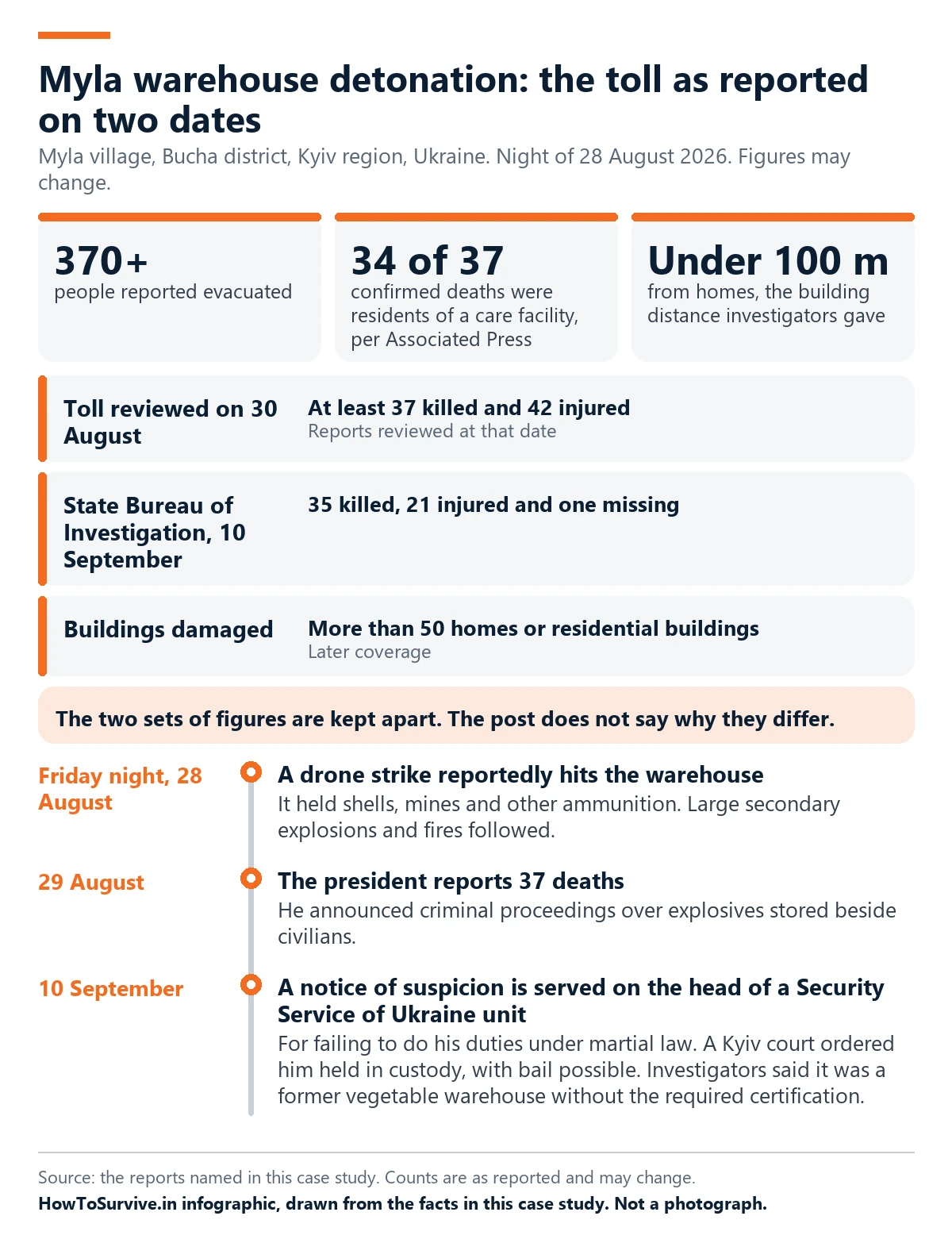
– Reported toll reviewed on 30 August: At least 37 killed and 42 injured; casualty figures may change. By 10 September, the State Bureau of Investigation put the toll at 35 killed, 21 injured and one missing
– Evacuation: More than 370 people reported evacuated
🕯️ What Happened?
Ukrainian officials and international news organisations reported that a Russian drone struck a warehouse in Myla, west of Kyiv. The warehouse was reported to contain shells, mines and other ammunition. The impact was followed by large secondary explosions and fires.
The blast effects damaged dozens of nearby homes and buildings. A care facility for elderly people and people with disabilities was severely affected; Associated Press reported that 34 of the 37 confirmed deaths were residents of that facility.
Ukraine’s president publicly described the storage of explosives beside civilians as serious negligence and said criminal proceedings had begun. Rescue teams continued clearing debris, treating casualties, evacuating residents and managing fire and explosive hazards.
This event involved two connected hazards that must not be confused:
1. the initiating strike, and
2. the secondary mass-casualty consequences of explosive storage near civilian occupancy.
📊 Incident Snapshot
| Item | Verified or carefully reported information |
|---|---|
| Initiating event | Reported Russian drone strike on a warehouse |
| Secondary event | Detonation of stored explosive/munitions material, followed by fires |
| Deaths | At least 37 as of the official update reviewed |
| Injured | 42 reported by Reuters and other coverage; official statements described dozens |
| Evacuated | More than 370 people reported |
| Buildings affected | More than 50 homes/residential buildings reported damaged in later coverage |
| Highly vulnerable occupancy | Care facility for elderly people and people with disabilities |
| Investigation | Criminal proceedings concerning official negligence announced |
⏱️ Reported Timeline
Friday night, 28 August
A drone strike reportedly hit the warehouse in Myla.
Immediately afterward
Stored material detonated, producing a series of explosions, fires and blast effects across nearby civilian areas.
Overnight into 29 August
Firefighters, emergency personnel, police and local responders carried out rescue, firefighting, evacuation and debris operations.
29 August official update
Ukraine’s president reported 37 deaths, dozens injured and continued debris clearance. He said the head of the local community died while helping the rescue operation and announced accountability proceedings over explosive storage near people.
30 August reporting
International reporting continued to document the destruction and the impact on the care facility. Figures remained subject to revision.
✅ Confirmed Facts vs ⚠️ Developing Claims
Confirmed through official statements and multiple major outlets
– A warehouse in Myla was struck.
– The strike was followed by detonation, major explosions and fires.
– At least 37 deaths were officially reported.
– Dozens were injured and hundreds evacuated.
– Nearby residential buildings and a care facility were damaged.
– Ukrainian authorities announced criminal proceedings concerning storage decisions and official negligence. On 10 September the head of the Security Service of Ukraine unit responsible for storing weapons and ammunition at the site was served a notice of suspicion for failing to perform his duties under martial law, and a Kyiv court ordered him held in custody, with bail possible. Investigators said the building was a former vegetable warehouse without the required certification, less than 100 metres from homes.
Developing or requiring final investigation
– The complete inventory, quantity and classification of material stored in the warehouse.
– Who else, beyond the one official charged, was responsible for the storage arrangement.
– The exact blast sequence and how each casualty occurred.
– The final casualty and building-damage totals.
– Every military claim about the intended target and weapon system.
🔍 What Turned One Strike into a Wider Civilian Disaster?
1. Hazardous storage near homes
Explosive materials require separation distances based on quantity, type, construction and credible blast effects. When hazardous inventory is close to homes, one initiating event can expose an entire community.
2. Vulnerable occupants nearby
Residents of an elderly and disability care facility may require assisted evacuation, mobility support, medication, medical equipment and trained staff. They cannot be protected by a plan based on rapid self-evacuation.
3. Secondary explosions
Responders may face continuing detonations, unstable structures, unexploded material and fire. These dangers delay access to victims and enlarge the exclusion zone.
4. Night-time conditions
An incident at night may find people asleep, reduce immediate situational awareness and make evacuation, accountability and family reunification harder.
5. Domino effects beyond the warehouse
Blast pressure, fragments, fire, structural failure and smoke can affect buildings outside the original site. Site-level planning is inadequate when the credible consequence area crosses the boundary.
🧯 Prevention and Loss-Reduction Layers
SEPARATE
– Never locate explosive or high-consequence hazardous storage beside homes, hospitals, schools or care facilities.
– Establish legally compliant quantity-distance and buffer zones.
– Reassess separation whenever inventory type or quantity changes.
CONTROL INVENTORY
– Maintain accurate, real-time stock records.
– Limit quantities to authorised levels.
– Segregate incompatible materials.
– Prevent undeclared or temporary overflow storage.
PROTECT VULNERABLE OCCUPANCIES
– Map care facilities and other dependent populations within credible impact zones.
– Maintain transport, staffing, medication and receiving-site plans.
– Practise assisted evacuation and shelter procedures.
INFORM RESPONDERS
– Provide secure, current hazard plans to emergency services.
– Identify blast zones, access routes, water supplies and safe command locations.
– Establish procedures for unexploded material and secondary-device hazards.
AUDIT AND ENFORCE
– Independent inspections must verify actual—not declared—inventory and separation.
– Serious deficiencies require immediate risk reduction, not paperwork closure.
– Investigations must lead to corrective action across similar sites.
🛡️ How Civilians Can Respond to an Explosion and Secondary-Fire Threat
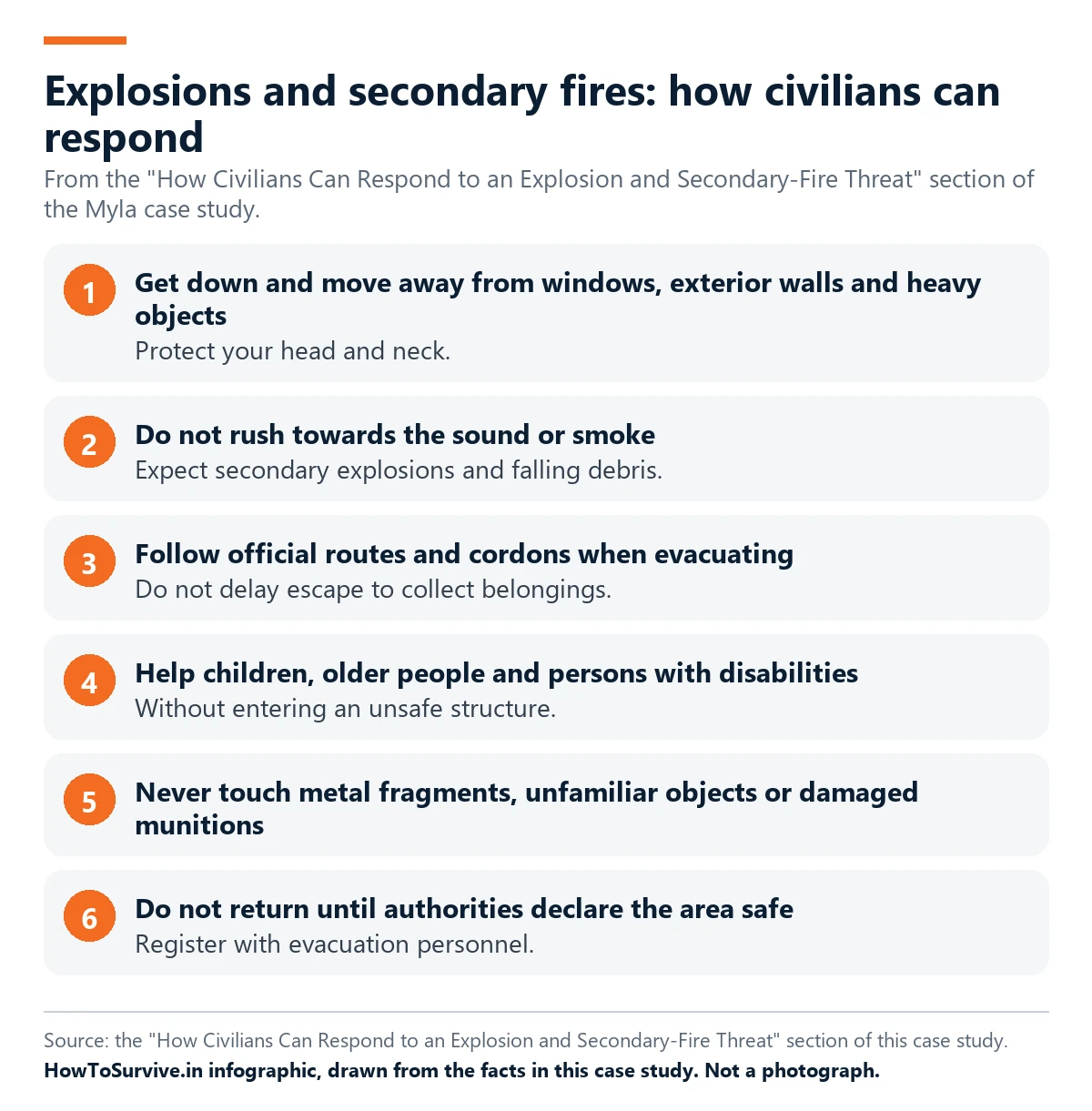
During explosions
– Get down and move away from windows, exterior walls and unsecured heavy objects.
– Protect your head and neck.
– Do not rush towards the sound or smoke.
– Expect secondary explosions and falling debris.
When evacuating
– Follow official routes and cordons.
– Wear sturdy footwear if debris is present.
– Help children, older people and persons with disabilities without entering an unsafe structure.
– Take essential medication only if immediately accessible; do not delay escape to collect belongings.
– Never touch metal fragments, unfamiliar objects or damaged munitions.
After reaching safety
– Call emergency services only when needed and give an exact location.
– Register with evacuation/accountability personnel.
– Do not return until authorities declare the area safe.
– Avoid sharing unverified locations, casualty identities or operational details.
⚖️ Truth You Must Know
A warehouse boundary does not contain blast risk.
When high-energy material is stored near civilian life, the community becomes part of the hazard zone—even if residents never entered the warehouse and knew nothing about its contents.
📢 Systemic Lesson
War creates initiating threats, but storage decisions determine how far some consequences travel. Hazardous materials, ammunition and explosive inventory must be separated from civilian occupancy, independently audited and transparently controlled.
Dependent-care facilities require special protection because evacuation may take longer than the warning available.
💡 What Authorities and Communities Can Do
– Map high-consequence storage against surrounding civilian occupancy.
– Relocate illegal or unsafe inventory immediately.
– Give care facilities assisted-evacuation resources and drills.
– Establish community warning and evacuation systems.
– Protect emergency access routes from congestion.
– Publish investigation findings and verify that corrections are completed.
🔚 Closing Line
The safest distance between explosive storage and civilian life is not an administrative promise—it is a physically verified separation that still protects people when the worst event occurs.
- A reported drone strike hits a warehouse in Myla said to hold ammunition; secondary explosions and fires follow
- Firefighters, police and rescuers carry out rescue, firefighting, evacuation and debris clearance
- Ukraine's president reports 37 deaths and announces criminal proceedings over storing explosives near civilians
- International reports document damage to homes and a care facility; figures still subject to revision
- Investigators say 35 were killed, 21 injured and one is missing; the head of the Security Service of Ukraine unit storing the ammunition is served a suspicion notice and a court orders custody
Why consequences escalated
- Ammunition stored near homes turned one strike into a mass-casualty event
- Associated Press reported that 34 of the 37 confirmed deaths were residents of a nearby care facility
- More than 50 homes were reported damaged and more than 370 people evacuated
- Residents of a care home for elderly and disabled people could not escape on their own in time
- Ukrainian authorities opened criminal proceedings over the storage decision
Failures and risk multipliers
- Storing ammunition beside homes and a care facility
- Treating the warehouse boundary as if it could contain a blast
- Leaving a care home within the blast zone without an assisted-evacuation plan
- Not reassessing separation distances when stock type or quantity changed
- Touching metal fragments or unfamiliar objects after the explosions
Actions that reduce risk
- Keep explosive and high-hazard storage well away from homes, schools, hospitals and care homes
- Map every care facility and dependent population inside a credible blast zone
- Give care homes staff, transport and drills for assisted evacuation
- Keep accurate stock records and cap quantities at authorised limits
- Have independent inspectors check actual stock and distances, not paperwork


Leave a comment