
Quick answers
What happened in France and Italy on 17 and 18 October 2026?
Cost-of-living and school protests, with about 550,000 marchers in France by the interior minister, turned violent in several French cities and in Milan, Bologna and Turin. Police used tear gas and water cannon, shops were looted and vehicles burned.
Is it safe to travel to France or Italy now?
The reports describe violence in specific city centres on protest days, not whole countries. Check your embassy’s latest advice, avoid the main squares and station fronts on protest days, and be indoors before any curfew. More protests are announced for 24 October in both countries.
Has the Indian government issued an advisory?
The Embassy of India in Rome issued a caution for Indians in Italy on 19 October. We found no protest advisory on the Paris embassy’s home page on 21 October. Check both again before you travel.
What is the emergency number in France and Italy?
112, the European emergency number, is free from any phone in every EU country. For the Indian embassy in Paris, the out-of-hours number is +33 6 48 34 00 63 on its website.
What should I do if tear gas reaches me?
Get into fresh air, remove your clothes, wash your skin with soap and water, rinse your eyes with plain water for 10 to 15 minutes, take out contact lenses, and seek medical care if symptoms continue or you have trouble breathing.
What if I am detained?
Stay calm, do not resist, state that you are an Indian citizen and ask for your embassy to be informed. Under Article 36 of the Vienna Convention on Consular Relations, the authorities must inform the consular post without delay if you ask. Ask for an interpreter and a lawyer.
Where should my family and I avoid?
On protest days, avoid Place de la République, the Champs-Élysées area and government districts in Paris, Piazza Duomo in Milan and the area in front of Bologna’s station. Check curfew zones in Paris, Lyon and Marseille.
Should I carry my passport?
Carry a photocopy and a phone photo and keep the original locked in your hotel or home unless you must carry it that day. Check the local rule on carrying ID.
How many people were arrested?
In France, nearly 2,400 by 18 October (interior ministry) and roughly 2,500 by 20 October (Justice Ministry). In Italy, 28 were arrested after Saturday (Reuters) and more than 200 young people detained in Milan (ANSA); the measures differ.
On the weekend of 17 and 18 October 2026, marches against the rising cost of living and poor public services turned violent in France and in northern Italy. In France, school students, unions and activists marched in about 110 places, and in Paris police used tear gas and water cannon at Place de la République while many metro stations were closed. In Italy, clashes broke out around Piazza Duomo in Milan, near the railway station in Bologna and in Turin. Both countries have more protest days announced for this weekend and beyond. This page is for Indians who are travelling to France or Italy, studying or working there, or have family there. It says briefly what happened, then spends most of its space on what to do: how to check advice from our own government, how to plan your day around closures, tear gas first aid, what to do in a crowd surge, if you get separated or detained, and how to look after your documents. It takes no side in the argument behind the protests. Last checked: 21 October 2026, around 12.30 pm IST. Figures are still moving, and we say whose figure each one is.
In short
- Officials in both countries blamed small organised groups for the violence. The danger for everyone nearby came from those groups, from police use of tear gas, water cannon and grenades, and from looting and fires in city centres.
- Check what the Indian embassy says before you move. The Embassy of India in Rome issued a caution for Indians in Italy on 19 October. We found no protest advisory for France on the Paris embassy home page on 21 October.
- Stay away from the main squares and station fronts on protest days, and especially after dark. Curfews are in force in parts of Paris, Lyon and Marseille.
- If tear gas reaches you, get out of the cloud, wash your skin and rinse your eyes with plain water for 10 to 15 minutes.
- Fix a meeting point with your group, keep a paper copy of your key numbers, and keep your passport safe.
- Next protest days announced so far are Saturday 24 October in France and 24 and 30 October in Italy.
What happened, briefly
France
On Saturday 17 October the interior minister, Laurent Nuñez, counted about 550,000 people in 110 marches; the organisers, including the CGT union and student groups, said about 800,000 (Al Jazeera, AP). Masked groups set cars alight, smashed shopfronts and looted businesses in Paris, Marseille, Lyon, Bordeaux and other cities. Masked groups set fire to the city hall in Limoges, and a tourist office in Lyon was set alight (AP, AFP). In Paris, police used tear gas and water cannon at Place de la République, and many metro stations were closed at police request, including near the Champs-Élysées, the presidential palace and parliament (Al Jazeera). Police used tear gas again on Sunday evening at the same square (AP, FRANCE 24).
The numbers differ by source and by hour. The interior ministry gave at least 272 arrests on Saturday afternoon (PA Media/dpa), the authorities about 1,200 later that day (Al Jazeera), and then nearly 2,400 arrests and almost 1,000 police and gendarmes hurt, seven of them seriously, by 18 October (AFP). On 20 October the Justice Ministry spoke of roughly 2,500 people arrested since Saturday, with more than 800 sent before prosecutors, and the justice minister said 149 people were in jail (AP). The first police-injury figure given on Saturday was about 150 (Al Jazeera). Protesters were hurt too. A 17-year-old lost his right hand to a crowd-control grenade in Saint-Étienne and a 17-year-old girl lost an eye in Mulhouse, and inquiries have been opened (AFP, AP). Paris police said one man died on the march route, of a heart attack, and the prosecutor’s office is looking into it (AP). Counts of dead and injured may be revised.
Authorities have since imposed curfews. In Paris, two zones, around Place de la République and the Les Halles shopping district, are closed at night (the hours reported are 11 pm to 6 am), Lyon’s city centre has a curfew from 9 pm to 6 am, and Marseille has one for unaccompanied minors (FRANCE 24, AP). Gatherings are banned on the Champs-Élysées, near several public buildings and at railway stations (FRANCE 24, photo captions of 21 October). The prime minister has promised a “massive” police deployment for Saturday 24 October, when yellow-vest groups have asked for a march from Place de la Bastille to the Opéra and high-school students plan to protest; the unions have called theirs for 5 November (FRANCE 24, AP). For the full French story, the numbers and the school-student background, see our explainer on the France Gen Z protests of October 2026.
Italy
On Saturday 17 October marches under the banner “Italia in piazza” against the cost of living and weak public services took place in several cities. In Milan, protesters threw stones in the square in front of the cathedral and police fired tear gas; in Bologna, police used a water cannon and tear gas near the central railway station, and the main entrance of the station stayed closed for hours; Turin, Brescia and Bergamo also saw clashes (Reuters, US News, Open, Giornale di Brescia). On Sunday several hundred hooded protesters broke shop windows and set bins on fire near Piazza Duomo in Milan, and police again used tear gas and water cannon (Reuters).
Italian figures conflict even more than the French ones, because the outlets count different things. Reuters reported 28 people arrested after Saturday’s clashes, citing a police report, and more than 60 taken to a police station for checks on Sunday. ANSA and Il Sole 24 Ore wrote on 19 October that more than 200 young people had been detained after the Milan riots, about 80 per cent of them under 18. Detained, identified and arrested are not the same thing. For injuries, the regional emergency service reported about 10 officers and 15 protesters hurt in Milan alone, and other reports give higher numbers for other cities; we do not give one total. Damage estimates also differ by a factor of about a thousand between two Italian reports, so we give none. On 19 October the prime minister, Giorgia Meloni, chaired a security meeting; Il Sole 24 Ore reports that a decree adding 500 soldiers to the “Strade Sicure” street-patrol operation, starting in Milan, was under discussion. Demonstrations are already planned for 24 and 30 October in major Italian cities (Il Sole 24 Ore).
Step 1: check official advice before you move
- Indian embassy and consulates. On Monday 19 October the Embassy of India in Rome posted a caution for Indian nationals in Italy: exercise caution, avoid crowded areas and places where protests are taking place, and follow local news (reported by India TV, Daily Jagran and Daijiworld from the embassy’s post on X). The Consulate General of India in Milan covers northern Italy. We could not open the embassy’s own website for the contact numbers, so we do not print them here. Take them from the embassy’s post or its website.
- Paris. The Embassy of India in Paris lists an emergency number for Indians in distress outside office hours, +33 6 48 34 00 63, and a general number, +33 1 40 50 70 70, open Monday to Friday, 9 am to 5.30 pm (embassy website, read on 21 October). Its home page that day carried no protest advisory; the latest two notices were dated July 2025. We did not find a protest advisory from the Ministry of External Affairs either. Look again before you travel, because this can change within hours.
- Register. The Paris embassy site has a registration page for Indian nationals, and points Indian students to the Madad portal of the Ministry of External Affairs. Registration is voluntary and is meant to help the mission reach you in a crisis. For Italy, ask the embassy or consulate which registration it uses.
- Local rules. Curfews and gathering bans come from local prefects in France and local authorities in Italy, and they change day by day. Check the announcements of the city or prefecture and the transport operator, not social media clips. Old videos are often shared again as if new.
- Insurance and bookings. If you hold travel insurance, read what it says about riots and civil unrest, and keep your hotel or booking contact handy in case you must change plans.
Step 2: plan your day around squares, stations and closures
- On a protest day, treat the big squares and station fronts as places to avoid: Place de la République and the Champs-Élysées area in Paris, Piazza Duomo in Milan, and the area in front of Bologna’s central station. These are where marches end and where the clashes happened.
- Before you leave the hotel, check which metro and train stations are open. In Paris, stations near the Champs-Élysées, the presidential palace and parliament were shut at police request on 17 October. In Bologna, the station’s main entrance was closed for hours. If you have a train or flight, leave early and have a second route.
- Be indoors before curfew hours, and remember that a curfew can be announced the same afternoon.
- Do not go to “see what is happening” or to film. Police lines, burning vehicles, and the paths of looters change in minutes. Keep two streets away from a march, and never stand in front of shop windows when a crowd is moving.
- If you are on the street when trouble starts, walk away calmly towards a wide, well-lit street, not into a narrow lane and not towards the shouting. Go into a hotel, a station or a large shop if staff will let you in.
- Do not pick up or approach a canister, a grenade or a smoking object. A 17-year-old in France lost a hand to a crowd-control grenade, and AP says police use of grenades has drawn sharp scrutiny.
- If you are a student or work in a city centre, check with your school, university or employer whether classes or offices are closed on protest days and whether remote work is allowed.
Step 3: tear gas first aid
This follows the US Centers for Disease Control and Prevention’s page on riot control agents. Effects usually last 15 to 30 minutes after you leave the source and clean off.
- Get away from the cloud and into fresh air. Outdoors, move away from the release and go to higher ground; do not stay in a low, enclosed spot where the gas settles. Indoors, leave the building.
- Remove your clothes quickly, by cutting them off if you can, rather than pulling them over your head.
- Wash your skin with plenty of soap and water.
- If your eyes burn or your vision is blurred, rinse them with plain water for 10 to 15 minutes. Take out contact lenses and do not put them back in. Glasses can be washed with soap and water.
- Put the clothes you took off in a sealed plastic bag and then in a second bag, and avoid touching them. Do not touch the contaminated parts of clothing on someone you are helping.
- Get medical care if symptoms do not settle, if your eyes are still painful or blurred, or if you have trouble breathing. Call 112 in France and Italy.
Step 4: if the crowd surges
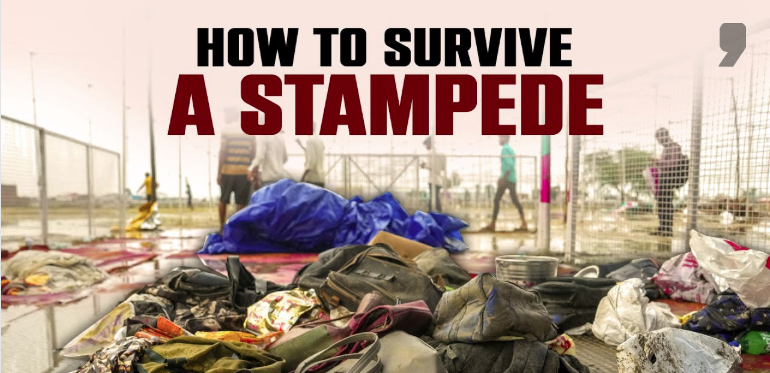
A crowd that is running away from police, tear gas or a fire can crush people at a narrow street, a stairway or a metro entrance. The steps below are the same as in our guide on how to survive a stampede or crowd crush, and our guide on crowd-crush warning signs helps you notice the danger earlier.
- Leave early, while you can still walk freely. If you cannot see an exit, or your arms are pinned, it is already late.
- Stay on your feet, with your feet apart and knees slightly bent. Do not bend down to pick up a phone or a bag.
- Do not push against the flow. Between surges, move sideways, at an angle, towards the edge of the crowd.
- Hold your arms up in front of your chest to keep some space to breathe.
- Keep away from walls, glass shopfronts, railings, barriers and poles.
- If you fall, get up at once if you can. If not, curl on your side with your knees to your chest and your arms around your head.
- Help others only if you are steady yourself. Once out, call 112 and tell the police where people are trapped.
Step 5: if you are separated from your group
- Fix the meeting point before you go out, somewhere outside the protest zone and easy to name, such as your hotel lobby. Agree a second place and a time limit for waiting.
- Everyone should carry the hotel name and address, a family contact and the embassy number written on paper. Phone batteries die and networks jam when crowds gather.
- Share your live location with one person at home. Send a short “I am safe” message as soon as you reach a safe place, so family in India do not worry.
- Children should have a phone number written inside a pocket or on a wristband, and they should know to go to a shop or a uniformed officer, not to keep looking for you in the crowd.
- Do not go back into the crowd to look for someone. Call 112, give the place and a description, and wait at the agreed point.
Step 6: if you are stopped, questioned or detained
France has run fast-track trials over the past days, and the justice minister said 149 people were in jail by noon on 20 October. The Justice Ministry said most of those arrested were tried immediately or ordered to appear at a later hearing (AP). Police custody is not a conviction, but it is serious, so stay clear of any scene of violence. This is general information and not legal advice. We have not checked the French or Italian procedure rules in detail.
- Stay calm and do not resist or run, even if you think the stop is unfair. Keep your hands visible.
- Give your name and show your ID or a copy of your passport and visa.
- Say clearly that you are an Indian citizen and that you want the Indian embassy or consulate to be told. Article 36 of the Vienna Convention on Consular Relations says that, if the detained person so requests, the authorities must inform the consular post without delay and tell the person of this right.
- Ask for an interpreter if you do not follow the language, and ask to speak to a lawyer. Do not sign any paper you cannot read or understand.
- Ask a friend or family member to call the embassy’s emergency number and tell them where you are held.
Step 7: protect your documents and money
- Keep a colour photocopy and a phone photo of your passport photo page, visa or residence permit and return ticket. Keep another copy in your email or a cloud folder.
- Leave the original passport locked in your hotel or home unless you have to carry it that day for travel or an official check. Check the local rule about carrying ID before you go out without it.
- Carry only the cash and cards you need, split between two pockets, and keep your phone in a front pocket. Crowds attract pickpockets.
- If your passport is lost or stolen, call the embassy. The Paris embassy’s out-of-hours number is meant for lost passports and Indians in distress.
- Keep a list of your bank’s international helpline, your insurance policy number and your hotel’s number somewhere other than your phone.
If you live in France or Italy
Tell your family how you are doing every day while the protests last, and give them the numbers above. Check on neighbours and friends who are students, shop owners or late-shift workers. If you run a shop in a city centre, ask your landlord and insurer about shutters and cover. If you wish to take part in a demonstration, learn the local rules on notice, masks and routes first; our guide to staying safe at a protest in India sets out the same habits of planning an exit, carrying water, and leaving early, though the laws are different abroad. If you read about the unrest in other places, our Manipur safety guide shows how curfew orders can be read.
Who to call
112 is the European emergency number, free and open day and night in every EU country, and it works from mobile phones, so it works in both France and Italy (EENA). For your own embassy, use the numbers on the embassy’s website or its latest post.
What is still not known
- The final French counts of arrests, injured police and injured protesters, and the cause of the man’s death on the march route. Also how this weekend’s protests will go.
- The real Italian totals of injured and of damage, which differ widely between reports.
- Whether Italy will pass the security decree under discussion, and whether the new curfews will be extended in France.
- Whether the Ministry of External Affairs or the Paris embassy will issue a protest advisory for France.
- We found no report of an Indian national hurt in the unrest in either country. This does not mean none was.
We will update this page if the picture changes. Last checked: 21 October 2026, around 12.30 pm IST, using reports published up to about midday.
What needs attention
- In both countries a mostly peaceful march became dangerous when small hooded groups attacked police, shops and public buildings, and police answered with tear gas, water cannon and grenades. Bystanders and tourists in the centres were exposed to both.
- Closures changed fast. Paris metro stations near government buildings were shut at police request, Bologna’s main station entrance was closed for hours, and curfews were announced day by day, so yesterday’s route can be shut today.
- Official figures are not comparable across countries. France counts arrests and injured police; Italy’s reports mix arrested, detained, identified and taken in for checks.
- A young protester lost a hand to a crowd-control grenade in France, so staying far back from police lines matters as much as avoiding the violent groups.
- India’s mission in Rome acted within two days of the first clashes, while we found no equivalent notice on the Paris embassy page. Do not assume that no advisory means no risk.
Controls that reduce risk
- Traveller: check the Indian embassy’s latest post or website and the local authority’s notices each morning, and write the embassy’s number on paper.
- Traveller: avoid the main squares, station fronts and government districts on protest days, and be indoors before curfew.
- Student or resident: register with the embassy, tell family every day, and check with your school or employer about closures.
- Group or family: fix a meeting point and a second one, share live location, and give each child a number to carry.
- Anyone exposed to tear gas: leave the cloud, remove clothes, wash skin with soap and water, rinse eyes for 10 to 15 minutes, take out contact lenses.
- Anyone detained: stay calm, state your nationality, ask for the embassy to be informed, ask for an interpreter and a lawyer.
- Keep copies of passport, visa and ticket on your phone and on paper, and leave originals secure unless you must carry them.
Common unsafe practices
- Going to the main square or the station front to watch or film.
- Leaving the hotel without checking which stations are open or whether a curfew starts that evening.
- Trusting social-media clips without checking their date.
- Carrying the original passport into a crowd, or having no copy at all.
- Rubbing the eyes or putting contact lenses back in after tear gas.
- Running into a narrow lane or a station entrance with a surging crowd.
- Having no meeting point or paper number when the phone dies or the network jams.
- Signing a paper in custody that you cannot read, or not asking for the embassy to be told.
Leave a comment