
Quick answers
What are the Gen Z protests in France?
Since about 21 September 2026, high-school students in France have blockaded schools and marched over teacher shortages, overcrowded classes and run-down buildings. AFP and AP called it a Gen Z movement. On 17 October it joined a wider cost-of-living protest with unions, farmers and others.
Did anyone die in the French protests?
The prime minister said on 19 October that no one was killed by the violence. On 20 October the Paris police prefecture confirmed two deaths on the margins of the protests, both after collapses. A 59-year-old man collapsed on Boulevard Magenta on 17 October and died at a fire station; the prefecture says it had no link to the violence or to police action. A 48-year-old man died at about 1.10 am on 19 October in the Châtelet area; no third-party responsibility is suspected so far. Inquiries are open, the causes are not known and neither man has been named. Some early reports (AP) mentioned only one death; the second was confirmed later by the prefecture. A rumour about a street medic was denied by the man himself, who is alive; he says police hit him, and an inquiry has been opened.
How many people were arrested?
By 11 October, AP reported more than 6,600 arrests in the school phase, mostly minors. After 17 October the authorities reported nearly 2,400 arrests over the weekend, including 855 in Paris on Saturday according to the Paris prosecutor. By the evening of 19 October the justice minister put the number placed in police custody at 2,513, with 67 jailed, and 123 were in jail by the morning of 20 October; France 2 reported 149 by midday. Custody is not a charge or a conviction. Counts keep changing, so check the date of any figure. On 22 October the justice minister said at least 2,700 people had been in custody, 217 convicted and jailed and about 1,000 more were being prosecuted. On 24 October a further 1,314 people were arrested across France, according to the interior ministry's provisional count of 25 October.
How many people were injured?
After the 17 October weekend, the interior ministry counted almost 1,000 police and gendarmes injured; NBC News says firefighters are included. In the school phase, the prime minister said 215 students and 85 education staff had been hurt by 6 October. We found no national figure for injured civilians over the 17 October weekend.
Why did the protests turn violent on 17 October?
The reports say looting and attacks on public buildings followed the big marches. The prime minister and interior minister blamed organised disorder by the ultra-left and offenders; opposition leaders blamed the government. Macron acknowledged failures of anticipation and intelligence. We could not find a final official finding.
What happened in Limoges?
AP reported that fire engulfed the 19th-century city hall in Limoges, its roof collapsed and the building was nearly destroyed. The mayor said an attack on it was an attack on the republic. On 24 October the two men arrested, aged 34 and 66, were placed under formal investigation and in pre-trial detention, and the prosecutor's judicial inquiry includes attempted homicide of a person holding public authority (BFMTV).
Has France declared a state of emergency or a curfew?
A state of emergency has not been declared; the prime minister said it could be used if necessary. On 19 October he asked prefects for partial, very local curfews, mainly to protect shops, and ruled out a curfew for all of Paris. The curfews took effect that night in parts of Paris (Place de la République and Les Halles, 11 pm to 6 am), Lyon, Lille, Nice and other places, and the night was calm. Prefects and mayors are setting more day by day: Paris repeated its central curfew on Tuesday night, Marseille added one for minors in several districts, and Toulouse starts one on Thursday evening. Marseille banned all gatherings from noon to 8 pm.
Is the interior minister still in his job?
Yes. Laurent Nuñez offered to resign on 18 October. Macron refused on 19 October, citing the need for continued command of the police.
Is it safe for Indians to travel to France now?
The UK Foreign Office advice says demonstrations can happen with little or no warning, particularly in cities, and advises following police and local advice. On 20, 21 and 22 October the Indian embassy’s website carried no protest advisory (Business Today paraphrased embassy advice on 19 October without dating a notice) for France and we found none from India’s external affairs ministry; the embassy in Rome did issue one for Italy. News18 reported on 24 October that the Embassy of India in Paris has since issued an advisory urging nationals to stay vigilant, avoid protest sites and follow local authorities; we have not seen the notice itself. Several European governments and China have told their citizens to avoid crowds in France. Check news and the prefecture for the city you are in.
What should I do if I am caught near a protest?
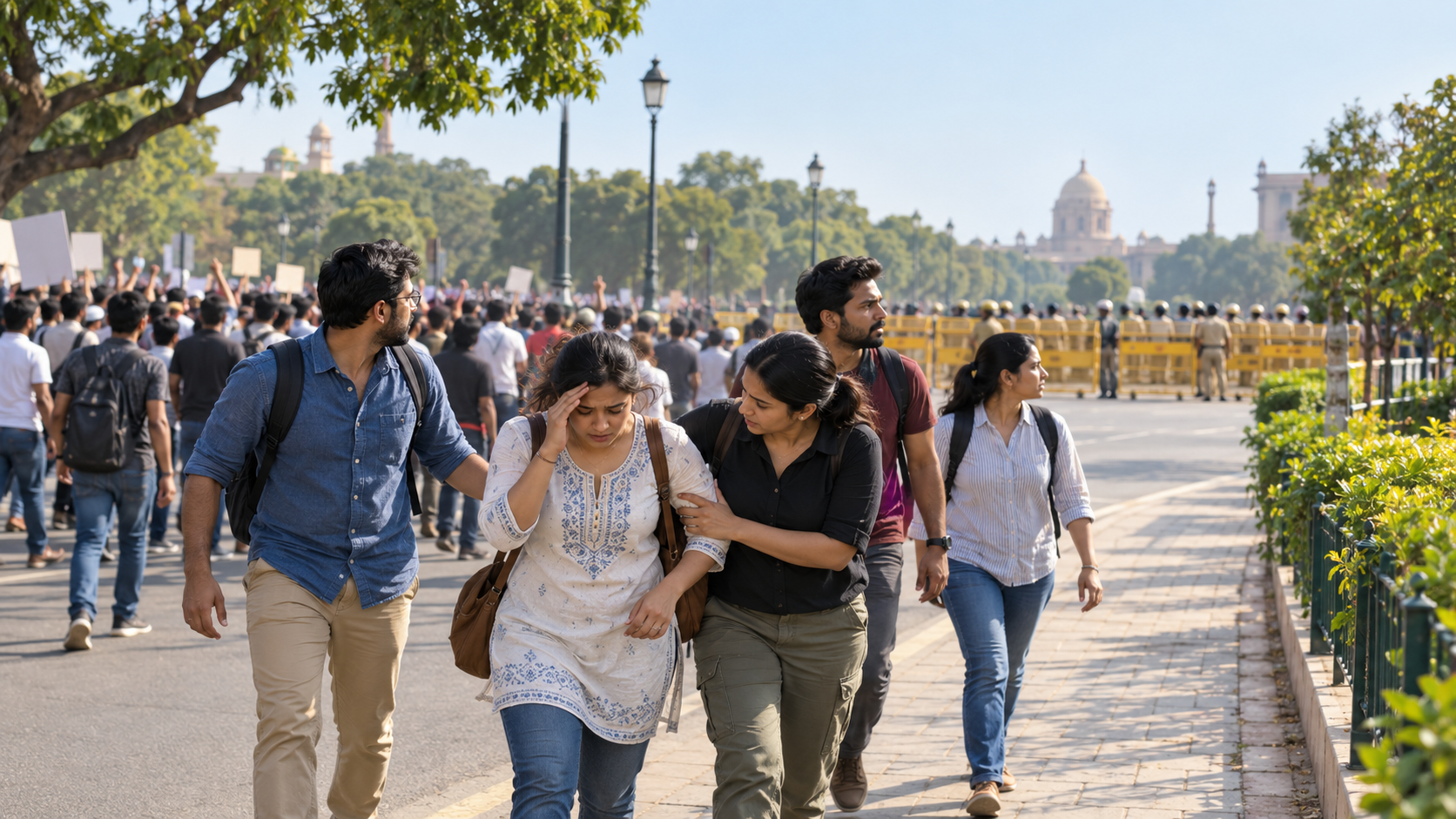
Leave early by a wide, open street, avoid barricades, burning vehicles and narrow gates, and keep children out. Call 112 in India or France for serious injury. Our protest guide has more steps.
What is the first aid for tear gas?
The MSD Manual says to get out of the cloud, wash exposed skin and flush the eyes with plenty of plain water. Most effects are short-lasting. See a doctor if breathing trouble does not settle or skin blisters.
What is planned next in France?
The yellow vests have called another protest day for Saturday 31 October; the 24 October day has passed. Prime Minister Lecornu receives school and student organisations at Matignon at 2.30 pm on Monday 26 October, and ministers are due to speak at the end of the day. The CGT backs a national mobilisation on 5 November, and the Senate is due to examine a bill on damage liability on 27 October. The prime minister met the unions at Matignon on 21 October; the CGT said no measures came out of it and called strikes for 5 November. He was due to meet the parties on 22 October and the mayors of some of the worst-hit cities that day. He has promised a massive police deployment for 24 October, and Toulon, Rouen and Le Havre have banned protests that day. Parts of Paris and Lyon had protest bans on 22 October. Prefects can ban gatherings or set curfews at short notice, so check local orders.
What happened in France on Saturday 24 October 2026?
The second national day brought about 410,000 marchers by the interior ministry's count and 800,000 by the CGT's, with clashes and tear gas in several cities. The ministry's provisional count of 25 October was 1,314 arrests, 53 police and gendarmes injured and 24 shops looted, and it gave no figure for injured protesters. Two people were seriously injured, in Toulouse and Clermont-Ferrand. We found no report of a death. About 70,000 police and gendarmes were deployed, protests were banned in Lyon and Marseille and parts of other cities, and the authorised Paris march ran from Bastille to Nation.
For about four weeks, school students across France have been blocking their lycées, marching in the streets and, on some days, clashing with police. On Saturday 17 October 2026 the movement met a wider cost-of-living protest, and the day ended in looting, fires and attacks on town halls that Reuters headlined as the worst riots in years. This explainer sets out what happened, which numbers are firm and which are not, and what an Indian reader can take from it for crowd safety. Updated 26 October 2026, about 10.30 am IST. The latest reports we used are timed up to Sunday evening, 25 October, in Paris, and the situation is still moving.
What changed from 22 to 26 October
- Saturday 24 October: the second national day. The interior ministry counted about 410,000 marchers in 289 actions, against 550,000 in 430 actions on 17 October; the CGT said 800,000, the same as for 17 October. In Paris the authorities counted 110,000 and the CGT 250,000 (Le JDD, Euronews). The interior ministry said the authorised marches went off well, and its provisional count of Sunday 25 October was 1,314 arrests across France, 53 police and gendarmes injured and 24 shops looted. It gave no figure for injured protesters (Euronews, citing the ministry). Interior minister Laurent Nuñez said two people were seriously injured, in Toulouse and Clermont-Ferrand, and La Nouvelle République reports a person hurt in the eye in Poitiers (Le JDD); the Clermont-Ferrand prosecutor has opened an inquiry. Nuñez blamed far-left individuals for attacks on the security forces, naming Paris, Marseille, Lyon, Grenoble, Nantes, Angers and Lille (Euronews). Euronews saw riot police use tear gas, a water cannon and charges near Porte de Vincennes and Place de la Nation in Paris, while groups fired fireworks at them. The Saturday-evening figure was nearly 1,000 arrests, so the total rose overnight; Paris had 142 arrests, of which reports give 120 to 126 in police custody (Libération and others). About 70,000 police and gendarmes were deployed, with GIGN, BRI and RAID units and Sentinelle soldiers guarding public buildings (Euronews). We found no report of a death on 24 or 25 October.
- How the Thursday march went. An administrative court overturned the Paris police ban on the Interfac student march. Thousands gathered on 22 October in the south-east of the city, peacefully and under heavy police presence; the organisers signed a police document saying the march would stay stationary because of the risk of violence. Bans on Thursday demonstrations had also been announced in Lyon, Lille and Grenoble, and we saw no report of them being lifted (AP, via The Hindu; Al Jazeera; franceinfo).
- Macron’s line. After a security meeting on 22 October, President Macron said protests asked for by people with no legitimate authority would be banned by prefects, while union marches would be offered alternative routes away from city centres. He blamed radical far-left groups for the 17 October violence and said the general recommendation was that there should be no demonstrations in the coming days (AP, via The Hindu; Al Jazeera). A defence council met on Friday 23 October, and the president received school-student organisations at the Élysée that afternoon; their representatives called the meeting satisfying and said the mobilisation would go on (franceinfo; La Nouvelle République). These are the government’s statements and the organisers’ reactions, and we have not seen the evidence behind the ultra-left charge.
- What was banned or changed for Saturday. Paris authorised the CGT march from Bastille to Nation and banned a second one, declared by Interfac and yellow vests, from Bastille to the Opéra. All demonstrations were banned in Lyon and in the Bouches-du-Rhône département, where Marseille’s public transport was suspended for the day; the centres of Lille, Nice, Caen and Toulon, parts of Rouen and Le Havre, and other cities had bans or limits too (franceinfo). The Louvre, Orsay and Picasso museums stayed shut on Saturday (AFP and AP, via Al Jazeera). Paris repeated its night curfew zones every night until Monday morning (France 24).
- Courts and custody. On 22 October the justice minister said at least 2,700 people had been taken into police custody since the unrest began, 217 had been convicted and jailed and about 1,000 more were being prosecuted (AFP and AP, via Al Jazeera). That is a ministerial count and is not the same as the 1,314 arrests of 24 October.
- Limoges city hall. On 24 October the two men arrested over the fire, aged 34 and 66, were placed under formal investigation and in pre-trial detention. The Limoges prosecutor has opened a judicial inquiry that includes attempted homicide of a person holding public authority (BFMTV, citing the prosecutor; 20 Minutes). The 34-year-old stayed silent in custody (BFMTV). These are the charges at this stage and neither man has been tried.
- Next steps. The yellow vests have called another day for Saturday 31 October, and the CGT strikes for 5 November still stand. Matignon said that Prime Minister Lecornu will receive the school and student organisations at 2.30 pm on Monday 26 October, with the education and higher-education ministers due to speak at the end of the day on replacement teachers, school buildings, class sizes and Parcoursup (Europe 1; Ouest-France). We have not seen what was announced.
- India and travel. News18 reported on 24 October that the Embassy of India in Paris has issued a safety advisory urging Indians in France to stay vigilant, avoid protest sites and follow local authorities. We have not seen the notice itself.
Earlier, on 22 October
- The unions left Matignon with nothing. The prime minister, Sébastien Lecornu, met union leaders for about two and a half hours on 21 October. The CGT leader, Sophie Binet, said the government announced no measures and did not take the unions’ demands into account, and she called for strikes on 5 November (France 24). That is the CGT’s account; we have not seen the government’s.
- Bans for Thursday 22 October. Paris police banned demonstrations from 8 am to 8 pm around the presidential palace, parliament, the prime minister’s office, the Louvre and the Champs-Élysées, and also at the railway stations, Place de la République, Place d’Italie and Les Halles. The Paris police also banned a school students’ protest called by the Interfac IDF group, saying the organiser could not prevent violence and vandalism. In Lyon the prefect banned a protest by the UNEF student union and the NPA party, citing a serious risk of public disorder (France 24). Updated 22 October 2026, about 4.30 pm IST: the school students’ organisers did not call the march off. It was still listed for 2 pm Paris time, from the Pitié-Salpêtrière hospital to Bastille, with several metro stations shut from 10 am (Sortiraparis, morning update). The day was started by general assemblies of school and university students, not formally by the student unions, to keep the movement alive in the school holidays (franceinfo, 22 October). The afternoon is covered under 22 to 26 October above.
- Curfew again on Wednesday night. Paris police set the central curfew once more from 11 pm on Wednesday to 6 am on Thursday, with a ban on undeclared gatherings from 8 pm around the presidential palace, the National Assembly, the Senate and the Champs-Élysées. France 24 calls this the third consecutive night of restrictions in Paris. Lyon had a city-centre curfew from 19 October and renewed it for Tuesday night (France 24, 20 October); we did not confirm a Lyon curfew for Wednesday night. The calm night the prime minister praised was Monday night (ABC News, France 24); we found no report on how Tuesday night went.
- Bans for Saturday 24 October. Toulon, Rouen and Le Havre have banned protests for the yellow vest day, and France 24 says the list of cities was still growing. Lecornu had promised a massive security operation for Saturday, with the military set to reinforce the police (France 24). Updated 22 October 2026, about 4.30 pm IST: the Lyon prefecture has now banned all demonstrations in the city on Saturday 24 October, citing the events of 17 October. An Interior Ministry official, Jean-Didier Berger, said security on Saturday will be 20 per cent higher than on 17 October, with Sentinelle soldiers, the RAID, GIGN and BRI units, helicopters and armoured vehicles; about 60,000 police and gendarmes were mobilised across the country on 17 October (France 24 live page, 22 October).
- More looting suspects in court. Police said 30 more looting suspects were brought before the courts on 21 October, identified with the help of CCTV, and goods worth tens of thousands of euros were seized. On 22 October France 24 added that police have arrested a 66-year-old man in La Creuse over the Limoges city hall fire, and that a man in his 30s, arrested earlier, has been charged with attempted murder of the officers who were in the building; we cannot tell whether he is the suspect described next. Separately, a suspect in the Limoges city hall arson was arrested three days after the unrest and, according to the report, was on a national security watch list (France 24).
- What ministers say. Lecornu accused ultra-left groups of an insurrectionary plan behind the weekend riots, and the interior minister, Laurent Nuñez, said the radical ultra-left is watched very closely, including its contacts with groups in Italy and Spain (France 24). These are ministers’ statements, and we have not seen the evidence. France 24 also reports that the government admitted law enforcement officers lost control on the weekend. Lecornu was to meet the mayors of Paris, Marseille and Lyon on Thursday afternoon and the mayor of Limoges on Friday (France 24 live page, 22 October). The leaders of La France Insoumise said they would attend the Thursday meeting with party leaders to demand an apology and explanations.
- Schools: a meeting on Monday. The education minister, Édouard Geffray, told the National Assembly on 21 October that he will meet school-student and teacher unions and the regions on Monday morning, 26 October, to present a first set of decisions on class sizes, replacement of absent teachers and Parcoursup, the university admission platform (franceinfo, 21 October). The students leading Thursday’s protest said they would not wait for it and want the detained students cleared, classes capped below 25 pupils and Parcoursup repealed (franceinfo, 22 October). These are the organisers’ demands as reported, not a government response. Matignon has since moved the Monday meeting to the prime minister’s office at 2.30 pm (see above).
- Money and travel. The government spokeswoman said France will release 10 million barrels of diesel from 1 November at a price three to four times below the market price (France 24, as reported). Fnac Darty says about 12 of its stores were hit, some looted, in Paris and Marseille, and the tourism body Protourisme estimates about a 1 per cent rise in hotel cancellations in the days after the riots (France 24, as reported).
- The number of deaths: one or two? Some early reports, including AP, mentioned only one man who died on the march route. That was before the Paris police prefecture confirmed, on 20 October, a second death: a 48-year-old man who collapsed in the Châtelet area and died on 19 October (franceinfo, 20 October, opened and read by us). Both deaths follow collapses and neither is tied by the police to the violence, so two is the later and fuller count. We found no report of any further death.
- India and travel. Business Today (19 October) says the Embassy of India in Paris advises Indians to look after their belongings in crowded places and to keep copies of their documents, but it does not date or quote any embassy notice. The advisories archive on the embassy website, which showed an update date of 21 October, listed no 2026 protest advisory when we opened it, and we found none from the External Affairs Ministry. The embassy’s after-hours number for Indians in distress is +33 648340063.
Earlier, on 21 October
- Two deaths confirmed on the margins of the protests. On 20 October the Paris police prefecture confirmed two deaths, both after collapses, and said inquiries are open (franceinfo). A 59-year-old man collapsed on 17 October on the march route near Rue Lancry and Boulevard Magenta and died at the Château-d’Eau fire station; the prosecutor spoke of a probable malaise, and the prefecture says it had no link to the violence or to any police action. A 48-year-old man died at about 1.10 am on 19 October after a collapse in the Châtelet area; no third-party responsibility is suspected so far, and his circumstances are not established. Neither man has been named, and the medical causes are not yet known. The prosecutor sees no link so far between the protests and the fatal fall of a 22-year-old from the Arc de Triomphe, so we have not counted that death. The prime minister’s statement that no one was killed by the violence is a separate claim, and we repeat it as his.
- The street medic. The man filmed on the ground at République, who gives his name as Antoine, says he is alive. He says police hit him and that he has a head injury, and an inquiry into violence has been opened even though he has not filed a complaint (franceinfo). The police oversight body, the IGPN, has opened four inquiries after the violence of 17 and 18 October (franceinfo).
- More people jailed. France 2 reported on the evening of 20 October that 149 people had been jailed so far, up from the justice minister’s 123 that morning, as fast-track trials ran in four courtrooms in Paris and in other cities. Examples given: eight months in prison with immediate detention for a 19-year-old in Grenoble; four months for a student arrested with firework mortars in Perpignan, who left court free because the sentence can be adjusted; and 14 months suspended plus a fine for a 19-year-old in Paris (franceinfo). Jailed means sentenced or held in prison, which is not the same as the 2,513 held in police custody.
- Curfews on Tuesday night. Paris repeated its central curfew, barring presence around Place de la République and Les Halles from 11 pm to 6 am (France 24). Marseille added a curfew for minors in several districts, and Toulouse will start one on Thursday evening (franceinfo, late on 20 October). We found no report on how Tuesday night went; for Wednesday night see 22 October above. Prefects still decide day by day.
- Government. On 20 October the prime minister, Sébastien Lecornu, told the National Assembly that the police set-up on 17 October was too static and not mobile enough, and promised a massive deployment for the protests on Saturday 24 October. The interior minister, Laurent Nuñez, said the doctrine would be revised on means, numbers, reaction time and mobility (franceinfo). The unions were invited to Matignon on 21 October; for what came out of that meeting see 22 October above.
- Senate. On 21 October a Senate fact-finding mission presented 30 recommendations on policing demonstrations, among them better intelligence before protests, more specialised officers, more drones, and raising the maximum sentence for joining a violent group from one to three years (franceinfo). These are recommendations, not law.
- Next days. The school students’ day on Thursday 22 October came after this check, and demonstrations were banned in parts of Paris and Lyon that day (see above). Dates still called: 24 and 31 October and 5 November.
- India and travel. The home page of the Embassy of India in Paris carried no protest advisory on 21 October, and we found none from the External Affairs Ministry. The only Indian advisory we know of is the Rome embassy’s for Italy; see the note under 22 October above about a press report on the Paris embassy.
Earlier, on 20 October
- Curfews took effect. The curfews asked for on 19 October were in force on Monday night. In Paris the police prefect barred all presence in a small zone around Place de la République and Les Halles from 11 pm to 6 am, and banned demonstrations in wider parts of the centre from 8 pm. Reports also name the Presqu’île shopping area of Lyon (9 pm to 6 am), Douai and Wattignies in the north (from 8 pm), and curfews for minors only in parts of Lille, in Nice and in Coulaines. Bordeaux and Nice were reported to run for several days (BBC; Al Jazeera; Le Nouvel Obs; AFP via Midi Libre).
- A calm night. The prime minister said the targeted curfews had helped keep the night calm, and police, gendarmes and the Paris fire brigade told AFP that it passed without major incidents. Prefects, with mayors, will decide on new curfews for Tuesday night where needed (Euronews; DW). The mayor of Paris, Emmanuel Grégoire, said the curfew should stay exceptional and not become a lasting answer (AFP via Midi Libre).
- Arrests and jail. The justice minister, Gérald Darmanin, said on 19 October that 2,513 people had been placed in police custody since the violence began and 67 were in jail. On 20 October he put the number jailed at 123 (TF1 and CNews, via 20 Minutes and Les Echos). He has told prosecutors to treat the cases as organised crime, which lets custody run to 72 hours instead of 48, and said about 95 per cent of those held for looting or attacking police were men and about 70 per cent adults. Police custody is not a charge or a conviction.
- Limoges. A 40-year-old man suspected of links to the arson of the Limoges city hall was arrested in Haute-Vienne, according to AFP and BFMTV via Les Echos. The report describes him as known to the authorities for ultra-left ties. The justice minister said the national anti-terrorism prosecutor’s office was looking at whether to take the case. These are suspicions, not findings.
- The Paris death. A rumour that the man who died on 17 October was a street medic filmed unconscious at République has been denied: the medic said he is alive with a head injury, and Libération and Le Parisien reported the same. The dead man’s identity and medical cause were still not public that day (Paris Match). The prefecture later confirmed a second death; see the 21 October update above.
- Damage. Euronews reports that the count of damaged shops has doubled to at least 3,000, from about 1,500 estimated a day earlier by the head of Carrefour. Insurers have no loss estimate yet. The head of the employers’ group Medef said the state had failed, and a special meeting with businesses was due at the finance ministry on Tuesday.
- Next dates. The yellow vest groups have called a second day of action on Saturday 24 October and a third on 31 October (Le Figaro). Student organisations have called for protests on 24 October, and a national school students’ coordination has called pupils out on Thursday 22 and Saturday 24 October (Les Echos). The prime minister met the unions on Wednesday 21 October (the CGT said nothing came of it) and was to meet the political parties on Thursday. A prefecture in Rennes banned a school students’ gathering planned for Tuesday, citing the risk of fresh violence.
- India and travel. The Embassy of India in Rome issued an advisory for Indians in Italy, where cost-of-living protests also turned violent (Moneycontrol). We found no advisory for France from the embassy in Paris or the external affairs ministry. Several European governments and China told their citizens to avoid crowds in France (Reuters via ThePrint).
In short
- The protests began around 21 September 2026 at a lycée in Créteil, near Paris, over teacher shortages, overcrowded classes and run-down school buildings.
- AFP and AP called it a Gen Z movement in their headlines. Within weeks it spread to hundreds of schools and to unions, teachers and parents.
- The first big national march was on 6 October. The interior ministry counted about 256,000 people; the organisers said 450,000.
- On 17 October a cost-of-living day drew 550,000 people by the interior minister’s count (800,000 by the organisers). Violence that evening and on 18 October hit city halls and shops. The government says at least 3,000 shops and businesses were damaged or looted.
- By 19 October the justice minister counted 2,513 people taken into police custody, and the interior ministry counted nearly 1,000 police and gendarmes injured over the weekend. The prime minister says no one was killed by the violence. Two men died after collapsing near the protests, one on 17 October and one on 19 October, according to the Paris police prefecture on 20 October; police say the first was unrelated to the violence, and the causes are still being determined.
- On 19 October the prime minister asked prefects for partial, local curfews, and they took effect that night in parts of Paris, Lyon, Lille, Nice and other places, with more decided day by day. A state of emergency has not been declared, and the interior minister is still in his post.
What the movement is, and why it is called Gen Z
Gen Z means people born from the late 1990s to early 2010s. The label has been used since 2024 for youth-led protests in several countries, among them Kenya, Nepal, Madagascar, Morocco, Peru and Indonesia, according to a Wikipedia overview of the wave. In France, AFP put “Gen Z has risen up” in a headline on 6 October, and AP wrote about “Gen Z school protests” on 11 October. The pupils are mostly 15 to 17 years old.
Their complaints were practical. AFP reported missing teachers, overloaded timetables, dilapidated classrooms and buildings that cannot cope with rising temperatures. A student quoted by AFP spoke of classrooms short of desks and chairs and toilets without doors or soap. It is worth saying plainly that the later violence is a different matter. By 17 October the marches included unions, farmers, retirees and others, and the Prime Minister said those arrested were almost all men, often already known to the police. Nothing we read ties the looting to school students as a group.
How it unfolded
A short timeline, from reports by AFP, AP, Euronews, Amnesty International, franceinfo and other French outlets:
- About 21 September: students at a Créteil lycée begin blockades. Other reports say mid-September.
- 28 September: a 14-year-old is hospitalised after being hit in the face by a projectile fired by a police officer at a blockade in Saint-Ouen-l’Aumône, north of Paris. The police oversight body IGPN opens an inquiry.
- 29 September: the interior minister reports 440 arrests, mostly minors.
- 5 October: a 15-year-old loses a hand to a police stun grenade in Lens. Amnesty France says the police response has been disproportionate.
- 6 October: first big national day. About 256,000 marchers by the interior ministry count, 56,000 of them in Paris.
- 7 October: the interior minister suspends stun grenades at school protests. An officer is charged over the 14-year-old’s injury.
- 11 October: AP reports more than 6,600 arrests since the start. The government orders urgent hiring of substitute teachers.
- 13 October: fifth national day. About 161,500 by the ministry, 480,000 by unions. Clashes near the Invalides in Paris.
- 17 October: cost-of-living day, 550,000 by the interior minister. Looting in Paris; fire destroys most of the 19th-century city hall in Limoges; a tourist office in Lyon is set on fire.
- 18 October: looting and fires continue in the evening in Paris, Lyon, Marseille and other cities. The interior minister offers his resignation. Macron addresses the nation, says the country feels “anger and shame” and blames far-left fringe groups and criminals.
- 19 October: Macron’s office says he has refused the resignation, asked for full transparency about failures in planning and intelligence, and asked for new policing tactics. Macron leaves on a three-day Gulf tour. The prime minister announces partial, local curfews and a firm judicial response. Marseille bans all gatherings from noon to 8 pm. Student protesters block access to the Louvre in Paris, according to France 24. Curfews begin that night in parts of Paris, Lyon, Lille, Nice and other places.
- 20 October: the prime minister says the night was calm and that prefects will decide on new curfews for Tuesday night. The justice minister puts the number jailed at 123. A man suspected of links to the Limoges city hall fire is arrested. A prefecture in Rennes bans a school students’ rally.
The numbers, and where they disagree
Crowd counts and arrest totals differ by source, and some are updated every few hours. We give each figure with its source and date. If you see a different number elsewhere, check who gave it and when.
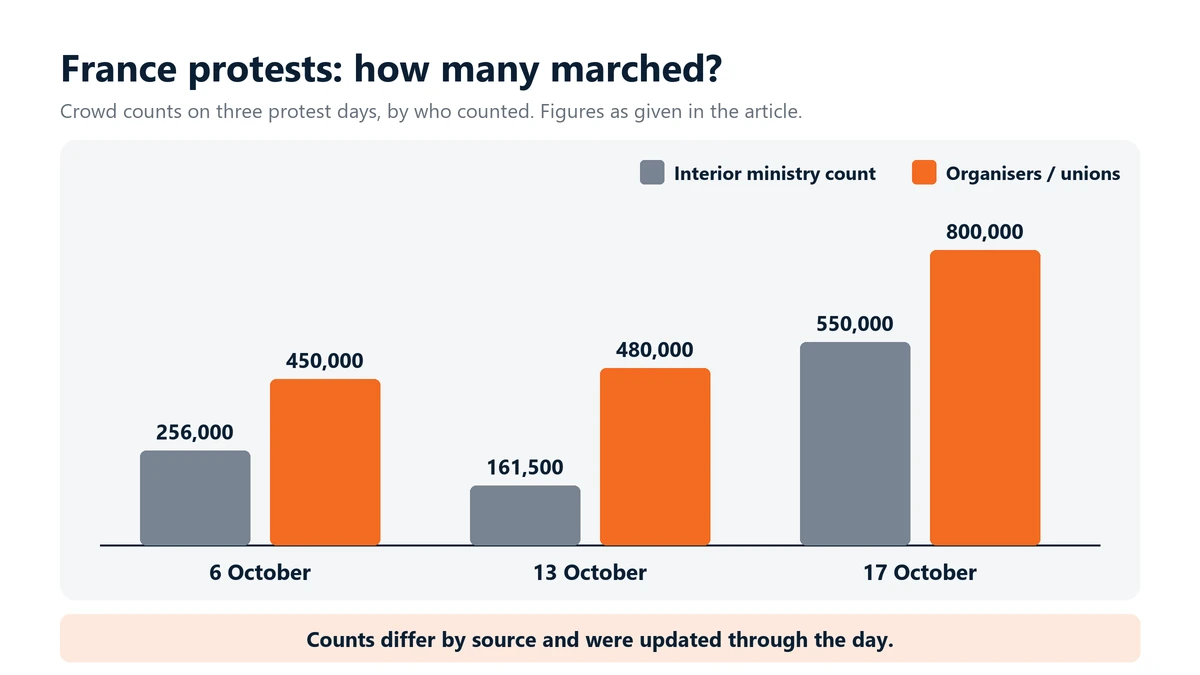
- Turnout. 6 October: 256,000 (interior ministry), 450,000 (student and pupil organisations), reported by AFP. 13 October: about 161,500 (ministry), 480,000 (unions), reported by Euronews. 17 October: 550,000 (interior minister), 800,000 (organisers).
- Arrests. School phase: more than 5,000 by 5 October (interior ministry, via Amnesty), 6,100 by 6 October (government figures, via the Guardian), more than 6,600 by 11 October (AP), more than 6,800 by 14 October, about 86 per cent minors (Euronews, source not named). The 17 October weekend: 1,200 on Saturday night, 1,800 on Sunday, nearly 2,400 by Monday morning (interior ministry and prime minister), then 2,513 people placed in police custody by Monday evening, 67 of them jailed, according to the justice minister; the BBC says more than 2,500 have been arrested. The jailed figure was 123 on Tuesday morning (Les Echos) and 149 by midday (France 2, via franceinfo). Police custody (garde à vue) is not the same as a charge or a conviction. In Paris, the prosecutor counted 855 arrests on Saturday, 557 of them taken into custody, and 208 more on Sunday. In Marseille, 101 people were arrested over the weekend, according to franceinfo.
- Injured, police. By 6 October, the prime minister said more than 715 police and gendarmes had been hurt in the school phase. After 17 October, the interior ministry counted almost 1,000 police and gendarmes injured; NBC News says the count includes firefighters. Early counts of about 150 and 500 reflect the time of reporting.
- Injured, civilians. By 6 October, the prime minister said 215 students and 85 education staff had been hurt. We found no national civilian injury figure for 17 and 18 October. Individual cases reported include a young protester who lost a hand in Saint-Étienne (cause under investigation) and a shop manager kicked while trying to stop looters in Nice.
- Deaths. On Saturday 17 October a man had a collapse on Boulevard Magenta in Paris and died outside the Château-d’Eau fire station. The Paris police prefecture reported a cardiorespiratory arrest, and franceinfo reports a probable heart attack that police say was not linked to the violence. His identity has still not been published as of 20 October. A rumour that he was a street medic filmed unconscious at République was denied by the medic himself, who said he is alive, and Libération and Le Parisien reported the same. The prime minister’s statement that “no one was killed” refers to the violence, so the two reports do not contradict each other. On 20 October the Paris police prefecture confirmed a second death on the margins of the protests: a 48-year-old man who collapsed in the Châtelet area and died at about 1.10 am on 19 October, with no third-party responsibility suspected so far (franceinfo). Both deaths are being investigated, and we count these two. The prosecutor sees no link so far between the protests and the fatal fall of a 22-year-old from the Arc de Triomphe, so we have not counted that one.
- Damage. The education ministry said 24 schools were burned or ransacked by 6 October. After 17 October the government said at least 3,000 shops and businesses were hit (AP, franceinfo); Euronews notes that this is double the 1,500 estimated a day earlier by the head of Carrefour. The head of the French chambers of commerce spoke of damage in the “hundreds of millions of euros”, and gave over 2,000 businesses as an earlier tally (France 24). Ynet, citing AFP, reported more than 1,500 fires involving vehicles and public equipment. There is no official cost yet.
Police response and the criticism of it
Police used batons, tear gas and riot-control rounds at school protests. Amnesty International and several unions called the force disproportionate. AFP reported that the interior minister said 10 internal investigations were open on 6 October, and 18 by 7 October; Euronews later gave 36 inquiries by the police oversight body. The government rejects the claim that police were ordered to repress students; the prime minister called it a lie in the National Assembly. After 17 October the interior minister admitted authorities had “lost control” in some cities and that police tactics must adapt to very mobile groups. The justice minister told France 2 that the state had failed, according to franceinfo. A shopkeeper told AP that police asked him not to step in during looting.
What the government and courts have done
- Schools: the government announced 3,000 replacement teachers for hardest-hit schools, and rearranged school timetables. Students say this is not enough.
- Leadership: Macron refused the interior minister’s resignation, citing the need for continued command of the police, and acknowledged failures of anticipation and intelligence. No state of emergency has been declared; the prime minister called it a “heavy” measure but possible “if necessary”.
- Shops: the prime minister announced partial unemployment support from Tuesday and a special support fund for affected shops, according to franceinfo and France 24.
- Courts and justice: the prime minister promised a “massive penal response”. Fast-track hearings began in Paris, and Marseille added them for 20 and 21 October (franceinfo). Hearings held on 19 October in Paris, Bobigny and Toulouse produced prison terms, one man arrested at République was acquitted, and the justice minister told prosecutors to appeal sentences they judge too light (20 Minutes).
- Europe: the European Commission called the looting and fires “unacceptable” and urged France to protect the right to peaceful protest.
- Next dates: the yellow vest groups have called a second day of action for Saturday 24 October and a third for 31 October (Le Figaro), and student organisations and a national school students’ coordination are also calling for protests on 22 and 24 October (Les Echos). The CGT backs a national strike and protest day on 5 November, according to Sud Radio. The Senate is due to examine a bill on 27 October that would make participants in a gathering that causes damage financially liable up to €10,000, as Amnesty described it.
- Politics: the movement comes six months before the 2027 presidential election. Ministers blame the radical left; opposition leaders blame the government for failing to see it coming. We do not take a side.
Why youth-led protests spread so fast
No single cause explains it, and we are wary of simple stories. The reporting points to a few things at once: a concrete grievance that every pupil can see in their own classroom; a harsh policing response that angered others when children were badly hurt; a build-up of wider anger over prices and fuel; and an election year in which every party wants a say. The same pattern shows up in other Gen Z protests since 2024, which often start with an everyday grievance and grow when the state’s reaction becomes the story. Protests also travel: NBC reported that weekend protests in Italy led to hundreds of arrests, according to the authorities.
What this means for crowd safety
Indian readers are not going to be in a French lycée blockade, but the safety points travel well. We have a full guide for Indian protests, how to stay safe at a protest in India, so we keep this short.
- Leave early. In France the worst violence came in the evening, after the marches had ended.
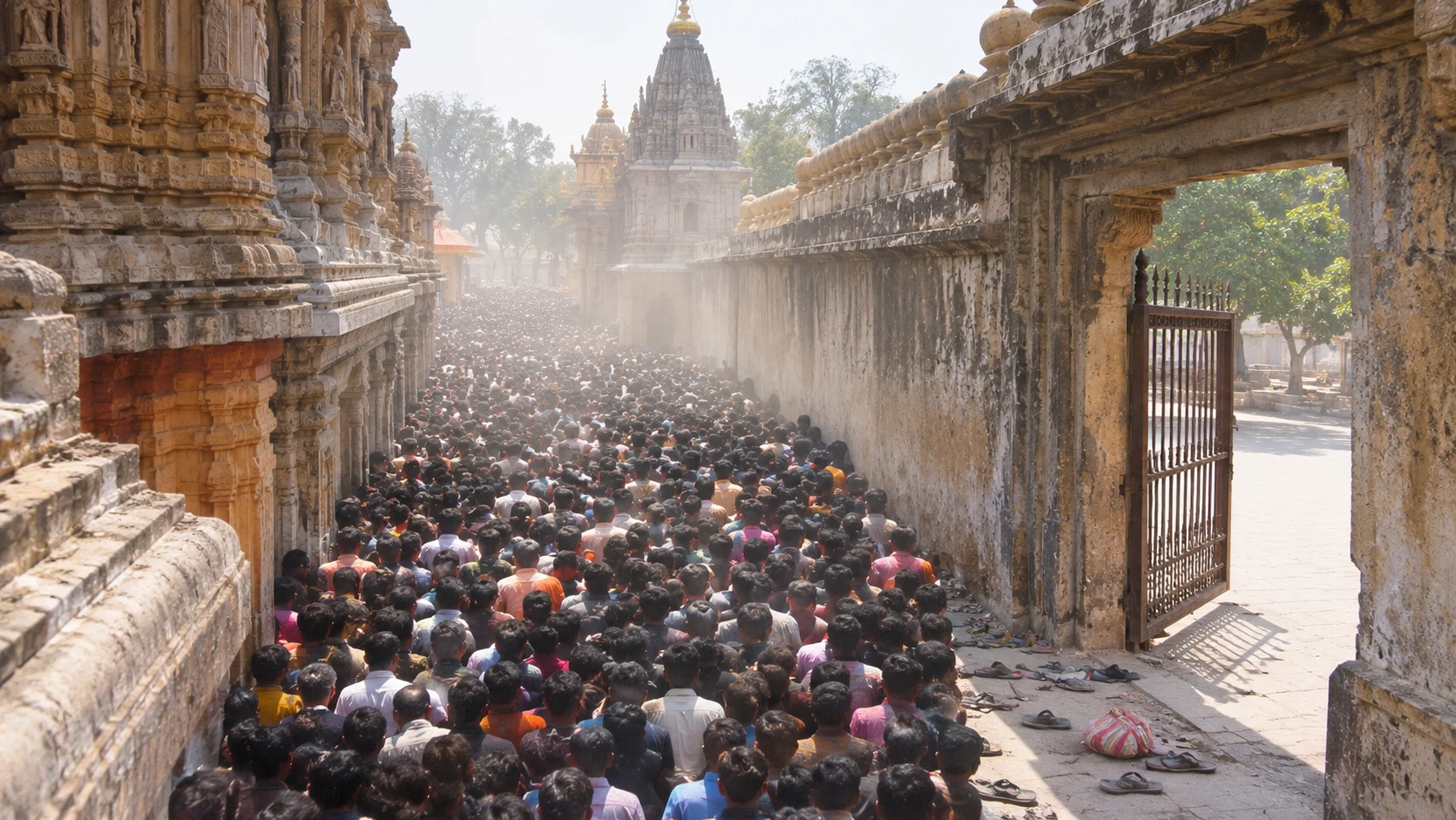
- Know your exit before you need it. Pick a route that does not pass a barricade or a narrow gate. The warning signs are the same as in a festival lane; see crowd-crush warning signs and how to survive a crowd crush.
- Keep away from burning vehicles and buildings. They are dangerous and the fire crews need room to work. Do not stop to film.
- Keep children out. Several of the worst injuries in France were to teenagers. If you have a child in a crowd, agree a meeting point outside it, as we explain for pandals and festival crowds.
- Peaceful assembly and its limits. In India, Article 19(1)(b) of the Constitution protects the right to assemble peaceably and without arms, and Article 19(3) allows reasonable restrictions in the interest of public order. This is general information, not legal advice; if you are detained, ask for a lawyer and see our protest guide.
If tear gas or pepper spray reaches you
The MSD Manual, reviewed in September 2026, says most effects of riot-control agents are short-lasting and most people do not need hospital care. The basics: get out of the cloud, wash exposed skin (soap helps with pepper spray, and water still works even if it stings at first), and flush the eyes with plenty of plain water. See a doctor if you have breathing trouble that does not settle, or if skin blisters. Our protest guide has a longer step-by-step.
If you or your family are in France
- The UK Foreign Office advice for France says demonstrations can happen with little or no warning, particularly in cities. It advises staying aware near them and following police and local authority advice.
- Check local news and the prefecture of your city for curfew and gathering bans. The prime minister asked prefects for partial curfews from the evening of 19 October and ruled out a curfew for all of Paris. Areas reported: in Paris, a small zone around Place de la République and Les Halles, 11 pm to 6 am, with demonstrations banned in wider parts of the centre from 8 pm; the Presqu’île of Lyon, 9 pm to 6 am; Douai and Wattignies; curfews for minors in parts of Lille, in Nice and in Coulaines; Bordeaux; and Denain in the north, where the curfew now covers unaccompanied minors from 10.30 pm until 6 am on Sunday 25 October. The Marseille prefect banned all gatherings from noon to 8 pm on 19 October. Marseille added a curfew for minors in several districts on 20 October, and Toulouse will start one on Thursday evening, 22 October (franceinfo). Prefects and mayors set more from day to day, so look at the prefecture’s website or X account for your city that day. Guadeloupe has a separate curfew for minors in Pointe-à-Pitre and Les Abymes after violence there.
- Keep your passport copy and the Embassy of India, Paris, emergency number on your phone: +33 648340063, as listed on the embassy website for Indians in distress. On 20, 21 and 22 October the embassy’s home page and advisories archive carried no protest advisory, and we found none from India’s external affairs ministry either. A Business Today article of 19 October paraphrases embassy advice to watch belongings in crowds and keep document copies, without dating or quoting a notice. The Indian embassy in Rome did issue an advisory for Italy on 19 October.
- Calls to the French emergency numbers are free: 112 (all EU countries), 15 for medical emergencies, 17 for police and 18 for fire. In India the numbers are 112, 101 for fire and 108 for an ambulance; see our emergency numbers guide for India.
What is still not known
- The final arrest, injury and damage totals, and who is among those held. Official figures are being revised daily, and there is no national figure for injured civilians.
- Which areas will be under curfew after Monday morning, from what hour and until when; prefects are deciding day by day, and Paris set its curfew zones every night until Monday 26 October.
- The identity of the two men who died in Paris, on 17 and 19 October, and the medical causes.
- How a Saint-Étienne protester lost a hand on 17 October. The reports we read say it is under investigation and do not confirm the cause.
- What the government announced on Monday 26 October, the number of protesters injured on 24 October, whether the school movement will carry on after the school holidays, and whether the protest days of 31 October and 5 November will pass peacefully.
We will update this page if the picture changes. Updated 26 October 2026, about 10.30 am IST.
What needs attention
- The movement began with school conditions and was labelled Gen Z by AFP and AP; by 17 October it also carried cost-of-living and fuel-price grievances and many adult marchers.
- The prime minister said those arrested after 17 October were nearly all men, often known to police; the reports we read do not tie the looting to school students as a group.
- Official and organiser counts differ widely, as they did on 6, 13 and 17 October; arrest and injury totals were revised several times in a few days.
- Amnesty International and unions called police force disproportionate; the government rejects the idea that police were ordered to repress students and has suspended stun grenades at school protests.
- The prime minister says no one was killed by the violence. The Paris police prefecture confirmed on 20 October two deaths on the margins of the protests, both after collapses (17 and 19 October); the causes are under investigation. No national figure for injured civilians was found.
- Macron acknowledged failures of anticipation and intelligence and asked for new policing tactics; the interior minister stays in post.
- Curfews that took effect on 19 October covered small zones: in Paris the area around Place de la République and Les Halles, 11 pm to 6 am. The prime minister said they helped keep the night calm; the mayor of Paris said curfews should stay exceptional.
- The justice minister’s count of 2,513 is people placed in police custody, not people charged or convicted; 123 were in jail by the morning of 20 October, and France 2 reported 149 by midday. He said about 95 per cent were men and about 70 per cent adults.
- The prime minister accepted on 20 October that the police set-up on 17 October was too static; he promised a massive, more mobile deployment for 24 October, and the interior minister said the doctrine will be revised.
- The man filmed on the ground at République is alive; he says police hit him, and an inquiry into violence has been opened (franceinfo).
- The CGT said on 21 October that the prime minister announced no measures at their meeting and ignored the unions’ demands, and it called strikes for 5 November (France 24); this is the union’s account.
- Prefects and police are banning protests in advance: parts of Paris and Lyon on 22 October, and Toulon, Rouen and Le Havre for 24 October (France 24).
- On the count of deaths, the Paris police prefecture’s two (17 and 19 October) is the later and fuller figure; early reports that mentioned one death (AP) were written before the second was confirmed.
Controls that reduce risk
- Check local news and the city prefecture for curfews and gathering bans before going out in France.
- Keep a passport copy and the Embassy of India, Paris, emergency number on your phone.
- Walk away early from any crowd with thrown objects or fire; use a wide, open street.
- If tear gas reaches you, get out of the cloud, wash skin and flush eyes with plain water.
- Call 112 in France or India for emergencies.
Common unsafe practices
- Staying in a protest after dark once thrown objects, fireworks or masked groups appear.
- Taking children or teenagers into a crowd where clashes are likely.
- Standing next to burning cars, bins or buildings to film.
- Picking up an unexploded stun grenade or canister.
- Sharing an old or unverified clip as footage of a new event.

Leave a comment