
Quick answers
How can families plan evacuation for a person with a disability?
Identify who needs help, assign a trained buddy helper, keep emergency contact cards with health and mobility details, and keep wheelchairs, canes and hearing aids accessible rather than stored away.
How should I help a visually impaired or hearing-impaired person evacuate?
For a visually impaired person, offer arm support and describe the surroundings aloud. For a hearing-impaired person, make eye contact and use hand signals or written notes instead of shouting.
Can a person with a disability use the lift during a fire?
Do not rely on lifts during a fire unless they are fire-rated evacuation lifts. Use evacuation chairs on staircases and designated, clearly marked refuge areas.
What should first responders keep in mind when helping people with disabilities?
Approach calmly, never pull or push without consent, speak directly to the person, describe each action before doing it, and never separate the person from their assistive device.
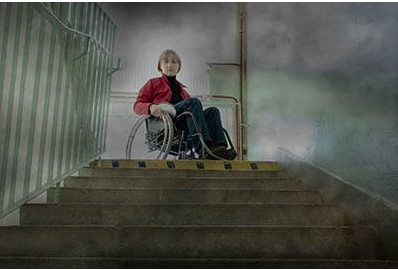
When the fire alarm goes off in a building, most people head for the stairs. For someone who uses a wheelchair, cannot hear the alarm or cannot see the exit sign, the same alarm can be the start of a long, frightening wait. Whether they get out depends on whether someone planned for them before the emergency.
The United Nations Office for Disaster Risk Reduction (UNDRR) says persons with disabilities die in disasters two to four times more often than the rest of the population. Its 2023 global survey of about 6,000 persons with disabilities in 132 countries found that 84% had no personal preparedness plan, and only 11% knew of a disaster management plan for their area (UNDRR 2023, as reported by Down To Earth, 13 October 2023).
In India, the Rights of Persons with Disabilities Act, 2016 (Section 8) gives persons with disabilities equal protection and safety in disasters and emergencies. It asks the national and state disaster management authorities to include them in disaster management, and district authorities to keep a record of persons with disabilities and warn them of risks.
Why this matters
The problem is usually not the disability. It is the building and the plan:
- No ramp, a narrow door or a lift that stops working in a fire.
- An alarm that only makes a sound, with no flashing light.
- Nobody assigned to help, so everyone assumes someone else will.
Safe evacuation for everyone has to be designed and practised, not improvised on the day.
Different needs, different help
| Need | What helps in an emergency |
|---|---|
| Uses a wheelchair or has difficulty walking | A named helper, an evacuation chair for stairs, ramps and wide doors |
| Blind or low vision | Clear spoken directions, an arm to hold, tactile markings and a clear route |
| Deaf or hard of hearing | Flashing-light alarms, a tap on the shoulder, hand signals and written notes |
| Intellectual disability, autism or memory problems | A calm voice, short simple instructions and a familiar person |
A step-by-step plan
1. Prepare in advance
- Find out who in your family, society or office may need help to get out.
- Give each of them a buddy: a named person who knows what help is needed, with a second person as backup.
- Keep an emergency card with medical details, medicines, mobility needs and contact numbers.
- Keep the wheelchair, walker, white cane and hearing aid within reach, not stored away.
- Ask the person what help they want. They know their own needs best.
2. Make the building easier to leave
- Ramps with handrails and doors wide enough for a wheelchair.
- Glow tape or tactile strips along the route to the exit.
- Alarms with flashing lights as well as sound.
- Exit signs in Braille or raised letters where possible.
Small changes like these make the biggest difference.
3. During the emergency
- Stay calm and speak clearly. Use short sentences, gestures or written notes.
- For a deaf person, get their attention with a tap or a wave, face them and use hand signals.
- For a blind person, offer your arm and describe what is ahead: “Five steps down, then turn left.”
- Move steadily. Do not drag or lift someone unless you know how to do it safely.
- Keep the wheelchair, cane or walker with the person.
4. In a multi-storey building
- Keep an evacuation chair on the floors where it is needed, and train people to use it on stairs.
- Know the building’s refuge area or protected staircase lobby, where a person can wait safely for the fire brigade.
- Keep these areas clearly marked, lit and unlocked.
- Do not use the lift in a fire unless it is a fire lift and the fire brigade is directing its use.
- Tell the fire brigade on arrival exactly where anyone is waiting.
In drills, use the real routes, not the convenient shortcuts.
5. After you are out
- Check that mobility aids, hearing aids and medicines came too.
- Find a quiet, steady place for anyone upset by noise and crowds.
- Keep the person with their carer or guide dog.
- Tell doctors and rescuers about any medical needs straight away.
Who does what
| Who | What to do |
|---|---|
| Families | Plan a route that works for everyone at home, and a backup. |
| Schools | Train teachers to guide children with different needs calmly in drills. |
| Housing societies | Keep a confidential list of residents who may need help, and include them in every drill. |
| Employers | Make workplace drills accessible and appoint safety buddies. |
Tips for anyone helping
- Ask before you touch, push or lift anyone.
- Speak to the person, not to the person with them.
- Say what you are going to do before you do it.
- Never separate someone from their wheelchair, cane or hearing aid.
- Public spaces need warnings people can hear, see and feel.
Common mistakes
- Using an ordinary lift in a fire.
- Leaving wheelchairs and other aids behind.
- Shouting instructions at someone who cannot hear them.
- Treating persons with disabilities as helpless instead of asking what they need.
- Running drills that leave them out.
What needs to change
- Accessibility provisions of the National Building Code 2016 followed in every new building, and older ones upgraded.
- Fire and disaster audits that check whether evacuation works for persons with disabilities.
- Training for police, fire and rescue staff on helping persons with disabilities.
- Disability-inclusive planning by every district disaster management authority, as the 2016 Act requires.
Do this this week
If someone at home, in your society or at work needs help to get out, sit down with them and agree a plan: who helps, which route, where they wait if the stairs are a problem, and what goes with them. Then practise it once.
What needs attention
- Persons with disabilities face a much higher risk of dying in disasters
- Most have no personal evacuation plan and do not know of a local plan
- Barriers are usually in the building and the plan, not the person
- A named buddy with a backup is the simplest life-saving step
- Alarms must be visible as well as audible
- In tall buildings, refuge areas and evacuation chairs need to be known and practised
Controls that reduce risk
- Make a list of people at home, in the society or at work who may need help
- Agree a plan with each person and name a buddy and a backup
- Fit flashing-light alarms and glow tape along exit routes
- Keep mobility aids, hearing aids and medicines within reach
- Find the refuge area or protected lobby in your building
- Train helpers to use an evacuation chair
- Include everyone in the next drill
Common unsafe practices
- Planning for persons with disabilities without asking them
- No named helper, so everyone assumes someone else will help
- Using an ordinary lift in a fire
- Leaving wheelchairs, canes or hearing aids behind
- Shouting at someone who cannot hear
- Drills that leave persons with disabilities out

Leave a comment