
Quick answers
Is the ISI mark compulsory on pressure cookers?
Yes. Since 1 February 2021, every domestic pressure cooker sold in India must meet IS 2347 and carry the ISI mark under a BIS licence, under the Domestic Pressure Cooker (Quality Control) Order. This applies to online and offline sales.
How full can I fill a pressure cooker?
Never more than two-thirds of its capacity. Keep liquids, soups, dal and rice to half, and dals that froth a lot, like tuvar and moong, to one-third (Hawkins).
Why does the safety valve blow?
Usually because the cooker boiled dry, the vent tube was blocked, the flame was larger than the base, or the flame was kept high after full pressure. Replace a blown valve with a genuine one before using the cooker again.
When should I change the gasket?
When it is cracked, cut, hard or stretched, or steam leaks from the edge of the lid. Check it before every use.
Can I lift the whistle to release pressure quickly?
Not when the cooker has liquid or frothing food, because hot food can spray out of the vent. Let it cool naturally, or follow your manual; Hawkins suggests standing the cooker in about 10 cm of cold water for 2 minutes.
What is the first aid for a steam burn?
Switch off the gas first. Cool the burn under cool, clean running water for 20 minutes. Even 10 minutes helps if that's all you can manage. No ice, toothpaste, oil or butter. Do not apply haldi either, and do not break blisters. Cover it loosely with a clean cloth and get medical help. Call 112 in an emergency.
Almost every Indian kitchen has a pressure cooker, and most of us were taught to use it by counting whistles. It is a safe appliance when it is in good shape and used the right way. But it works at about 121°C and 15 psi, according to Hawkins, so a blocked vent, a worn gasket or a lid forced open too early can cause serious scalds. The habits below prevent most of the trouble.
Buy only an ISI-marked cooker
Since 1 February 2021, the Domestic Pressure Cooker (Quality Control) Order has made it compulsory for every domestic pressure cooker sold in India to meet IS 2347 and carry the ISI mark under a BIS licence. This applies online and offline. In 2022 the Central Consumer Protection Authority (CCPA) ordered Amazon to recall 2,265 and Flipkart to recall 598 pressure cookers that did not meet the standard, and fined each platform ₹1 lakh.
Before you buy, look for the ISI mark and the licence number (CM/L-) on the cooker. Be careful with very cheap cookers from unknown sellers. Use genuine gaskets and safety valves from the same brand when you replace them.
Check these three parts every time
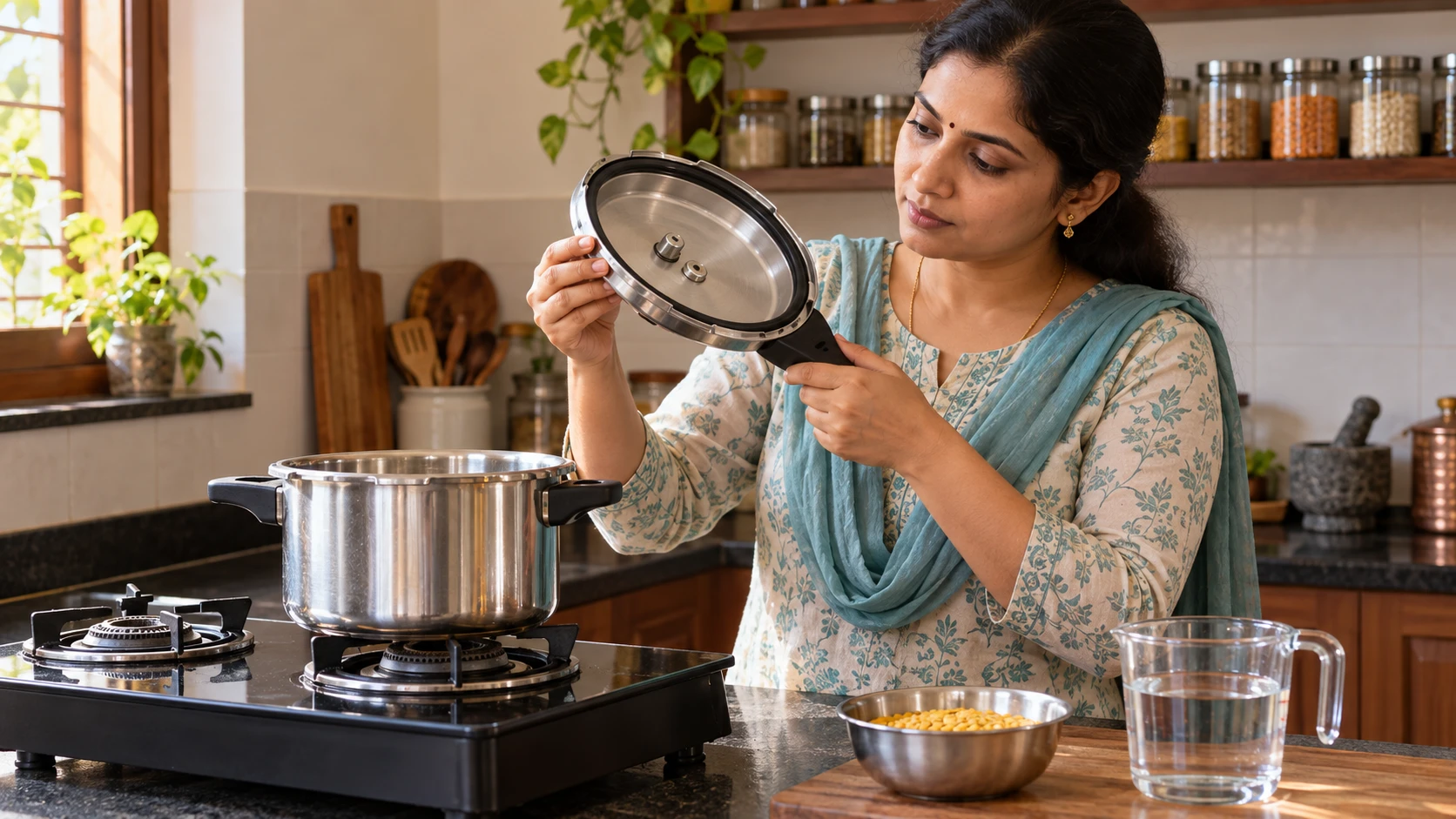
- Vent tube. Hold the lid up to the light and look through the vent tube. It must be clear. A blocked vent is one of the main reasons the safety valve blows.
- Gasket (rubber ring). It should sit properly in place and have no cracks, cuts or hardness. If steam leaks from the edge of the lid, or the gasket feels hard or stretched, replace it.
- Safety valve. It should be intact and clean. If it has ever blown, switch off the gas, let the cooker cool and fit a genuine replacement before using it again.
Do not overfill
Hawkins says a cooker should never be filled more than two-thirds of its capacity. Soups and other liquid foods, and foods that swell, like dal and rice, should not go above half. Dals that froth a lot, like tuvar and moong, should stay below one-third. The empty space lets steam circulate and keeps froth away from the vent.
Foods that foam and sputter, like oats, noodles, pasta and split peas, can clog the vent, and Hawkins advises against pressure-cooking them.
Use enough water and the right flame
- Add at least 1 cup (240 ml) of water for the first 10 minutes of cooking and half a cup for every 10 minutes after that (Hawkins). A cooker that boils dry overheats and the safety valve blows.
- Once full pressure is reached, turn the flame down. Cooking on high flame throughout is a common cause of a blown safety valve.
- Match the cooker to the burner. A small cooker on a large burner lets flames lick the sides and overheat it.
- Time your cooking with a clock from full pressure rather than only counting whistles. If water dries up while you wait for the next whistle, the food burns and the valve can blow.
- Never deep-fry with a lot of oil in an aluminium cooker body, and never use it to bake or dry-heat. High heat weakens the metal (Hawkins).
Open it the safe way
Never force the lid open. If it is stiff, there is still pressure inside. Let the cooker cool naturally for 10 to 20 minutes, or follow your manual. For liquid or frothing foods do not lift the weight to let steam out quickly, because hot liquid can spray from the vent. Hawkins suggests placing the cooker in about 10 cm of cold water in a basin or sink for 2 minutes instead, without running water over the lid.
When you open it, tilt the lid away from your face so steam escapes away from you. Keep children away from the stove while the cooker is on and while it is being opened.
If steam or hot food burns someone
- Make sure you are safe, then switch off the gas.
- Remove clothing and jewellery from the burnt area unless it is stuck to the skin.
- Cool the burn under cool, clean running water for 20 minutes. Even 10 minutes helps if that’s all you can manage. No ice, toothpaste, oil or butter.
- Do not put ghee, haldi or raw cotton on it either, and do not break blisters.
- Cover loosely with a clean cloth and get medical help. Go to hospital for burns on the face, hands, genitals or joints, burns larger than the person’s palm, or any burn on a child or elderly person. In an emergency call 112.
The World Health Organization says more than 10 lakh people in India suffer moderate or severe burns every year. Most kitchen burns are preventable.
Quick checklist
- ISI mark on the cooker, and genuine spare parts.
- Clear vent, healthy gasket and an intact safety valve before every use.
- Never more than two-thirds full; half for dal, rice and liquids.
- Enough water, low flame after full pressure.
- Never force the lid; open away from your face.
What needs attention
- A blocked vent, too little water and a high flame are the main reasons safety valves blow, according to Hawkins.
- Overfilling, especially with dal and rice, lets froth reach and clog the vent.
- Forcing the lid or releasing steam fast with liquid food inside can spray scalding food.
- Sub-standard cookers without a valid ISI licence were sold online until regulators ordered recalls.
Controls that reduce risk
- Check the ISI mark and licence number before buying a cooker.
- Look through the vent tube and check the gasket and safety valve before every use.
- Keep to the fill limits and add enough water.
- Turn the flame down at full pressure and time the cooking.
- Let the cooker cool before opening, and open the lid away from your face.
Common unsafe practices
- Filling the cooker to the brim with dal or rice.
- Counting whistles on high flame instead of timing from full pressure.
- Lifting the weight or forcing the lid open while there is still pressure.
- Using a hard, cracked gasket or a non-genuine safety valve.
- Putting toothpaste, oil or haldi on a steam burn.

Leave a comment