
What happened here
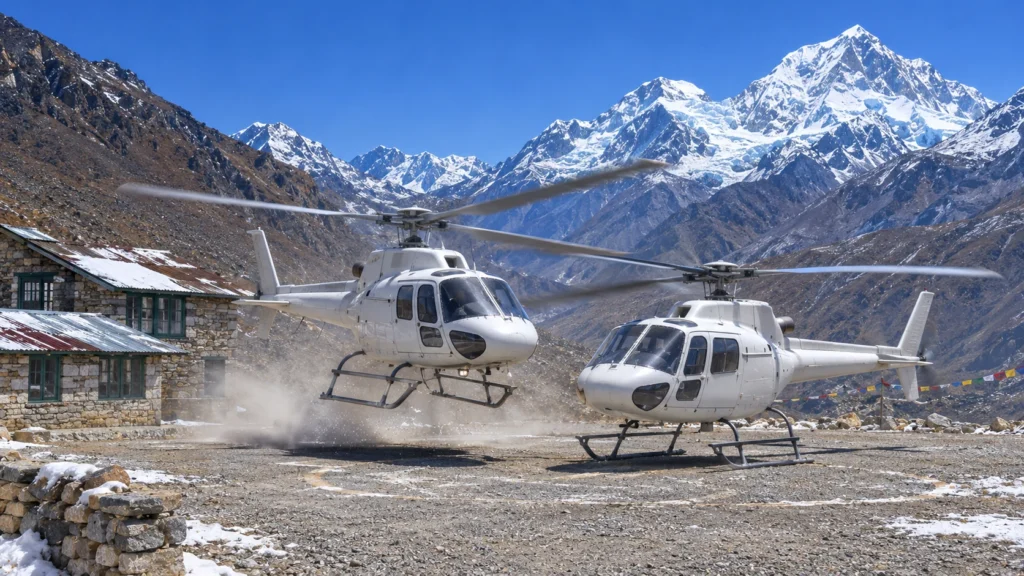
On Tuesday, 3 November 2026, at about 8.11 am, two helicopters, one of Fishtail Air and one of Air Dynasty, collided as they landed at the Pheriche helipad (about 4,200 m) in Solukhumbu district, Nepal, on the trekking route to Everest Base Camp. A 47-year-old Indian tourist travelling on the Fishtail Air helicopter, which carried people rescued from the Everest region, died; his body was taken to Lukla. PTI reports three injured: a New Zealand citizen of Indian origin and the two pilots, the pilots with minor injuries. Reuters reports one injured. CAAN says the rotor blades struck each other during landing. Preliminary information, which CAAN's deputy spokesperson called unconfirmed, is that the aircraft approached from different directions for the same spot and snow on one pad may have played a part. CAAN and police are investigating. The cause is not established.
Quick answers
What happened at Pheriche on 3 November 2026?
Two helicopters, of Fishtail Air and Air Dynasty, collided as they landed at the Pheriche helipad in Nepal's Everest region at about 8.11 am. An Indian tourist was killed and up to three people were injured.
How many people were injured in the Nepal helicopter collision?
PTI and India.com report three injured: a New Zealand citizen of Indian origin and the two pilots. Reuters reports one injured. The figures have not been reconciled.
Who was killed?
A 47-year-old Indian tourist who was a passenger on the Fishtail Air helicopter, reported to be from Tamil Nadu. We do not name him.
What caused the collision?
The cause is not established. CAAN says the rotor blades struck each other during landing. Its deputy spokesperson told BBC Nepali that the two helicopters may have come from different directions to land at the same spot and that snow on one pad may have played a part, but called this unconfirmed.
Was it a mid-air collision?
Some headlines say so, but the police, CAAN and PTI describe a collision during landing at the helipad.
Where is Pheriche?
A trekkers' halt at about 4,200 metres in Solukhumbu district on the trail to Everest Base Camp, in Khumbu Pasang Lhamu Rural Municipality.
Is the Pheriche accident linked to the Joshimath crash in India?
No link has been reported. Joshimath was a separate accident on 30 October in Uttarakhand, where six people died.
What should I do before taking a helicopter flight on a trek?
Use a registered operator, carry insurance covering helicopter rescue, follow ground-staff signals, stay clear of the tail rotor and rotor wash, and share your plan with family.
What happened
On Tuesday, 3 November 2026, two helicopters collided while landing at the Pheriche helipad in the Everest (Khumbu) region of Solukhumbu district, Nepal. An Indian tourist travelling on one of the helicopters was killed. The District Police Office put the time at about 8.11 am, and the Press Trust of India (PTI) said about 8.15 am; we treat the time as approximate Nepal time. Pheriche is a trekkers’ halt on the route to Everest Base Camp, at about 4,200 metres. The two aircraft belonged to private operators Fishtail Air and Air Dynasty. Fishtail Air’s helicopter was carrying tourists who had been rescued from the Everest region, and an Air Dynasty official told Reuters that its helicopter carried only cargo. The rotor blades of the two aircraft struck each other as they came in to land, according to the Civil Aviation Authority of Nepal (CAAN), as reported by PTI. A video of the moment of impact has been widely shared online. Checked on 3 November 2026; reports were still coming in and numbers may change.
Who was hurt
- Dead: one Indian tourist, a 47-year-old passenger on the Fishtail Air helicopter, identified by Nepal Police. Indian outlets reported that he was from Tamil Nadu (Chennai). His body was taken to a hospital in Lukla. We do not name him.
- Injured: PTI and India.com report three injured: a passenger who is a New Zealand citizen of Indian origin, and the pilots of the two helicopters, whose injuries were described as minor. The passenger was airlifted by a Prabhu Air helicopter, first to Lukla for initial treatment according to one report and to Mediciti Hospital in Kathmandu according to another. Reuters reports only one injured person, a New Zealander who has been rescued.
- Others on board: police were still confirming how many people were aboard both helicopters. Nobody else has been reported dead.
Where the reports differ
- Injured count: one (Reuters) against three (PTI, India.com, Daily Jagran); another headline says two injured. We use up to three and name the source.
- Which pilot was in which helicopter: reports swap the two captains between Fishtail Air and Air Dynasty. We name neither pilot.
- The passenger’s age: given as 49 and as 53 in different reports.
- Place: Reuters and several Indian outlets say near Everest Base Camp. PTI and India.com give the Pheriche helipad in Khumbu Pasang Lhamu Rural Municipality, which is on the trekking route and well below base camp. We use Pheriche.
- Mid-air or on landing: some headlines say mid-air; the police, CAAN and PTI describe the collision as happening during landing.
What is known about the cause
The cause is not established. CAAN and the local police have begun an investigation, and no formal inquiry committee or finding had been published when we checked. India.com, quoting CAAN’s deputy spokesperson to BBC Nepali, reports preliminary information that one helicopter came from Lukla and the other from the Gorakhpur area near Everest Base Camp, that they approached from different directions and tried to land at the same spot, and that snow covering one helipad may have led a pilot to choose another landing spot. The official described this as unconfirmed. We take no side: it is a preliminary lead, not a finding.
What is not known
- Exactly how many people were on each helicopter.
- Whether the helicopters were in radio contact with each other, and how landing slots at the helipad are managed.
- Whether snow on one pad really changed anyone’s landing plan.
- The condition of the injured after treatment in Kathmandu.
- What CAAN’s investigation finds, and when it will report.
Why it matters beyond Nepal
Thousands of Indian pilgrims and tourists take helicopter rides to remote places, in Nepal and at home. Just days earlier, on 30 October, six people died in the Joshimath helicopter crash in Uttarakhand, where the cause is still under investigation. The two accidents are unrelated and nothing links their causes. But both show the same point: helicopters fly in thin air, near mountains, from small pads, and a busy helipad in peak season has no margin for confusion. Our guide to what to check before you book and board a pilgrimage helicopter flight applies equally on a trek abroad.
Safety steps for travellers who fly by helicopter
These are general practices, not findings about this accident.
- Check the operator. Book only with a company registered with the aviation authority of that country, and ask your trek agency which company it uses. Do not pressure a pilot to fly in marginal weather or to take extra passengers.
- Buy proper travel insurance before you go. Check that it covers high-altitude trekking, helicopter rescue and medical evacuation, and carry the policy number and the insurer’s emergency number.
- Follow ground staff at the helipad. Wait well away from a landing helicopter until the crew signals you. Approach only when the pilot waves you in, from the direction shown, bent low and in sight of the pilot. Never walk behind the tail rotor.
- Secure everything. Hats, poles, jackets and bags can be thrown by the rotor wash. Keep trekking poles flat and low, and keep children and bystanders back.
- Know the emergency numbers. In Nepal, call the Nepal Police on 100 or the Tourist Police on 1144, and contact your embassy. Tell your family where you are before you set out and when you expect to reach a connection. Back home, see our guide to emergency numbers in India.
- Trekking in general: our outdoor survival skills guide covers kit, weather and what to do if a group is separated.
- Nepal’s mountain risks: for another danger on Nepal’s high routes, read how a flash flood hit the Budhi Gandaki valley in Gorkha.
- Two helicopters collide as they land at the Pheriche helipad; rotor blades strike each other
- An Indian tourist on the Fishtail Air helicopter is declared dead; his body is taken to a hospital in Lukla
- The injured New Zealand citizen of Indian origin is airlifted by a Prabhu Air helicopter, to Lukla and then Kathmandu per reports; both pilots reported with minor injuries
- A video of the collision is shared widely online
- CAAN and Nepal Police begin an investigation; CAAN's deputy spokesperson tells BBC Nepali of preliminary leads, which he calls unconfirmed
- Reuters, PTI and Indian outlets report; the injured count differs (one against three)
Why consequences escalated
- Two helicopters collided while landing at the Pheriche helipad in Nepal's Everest region on 3 November 2026.
- An Indian tourist died; up to three people were injured.
- CAAN says the rotor blades struck each other during landing.
- The cause is not established; CAAN and police are investigating.
- Reports differ on the injured count, the pilots' helicopters and the place name.
Failures and risk multipliers
- No finding of fault has been made and none is stated here.
- A preliminary suggestion that the helicopters came from different directions for the same landing spot and that snow covered a pad is described by CAAN's own spokesperson as unconfirmed.
- How the landing order at a busy pad is coordinated, and whether the pilots were in contact, has not been reported.
- The cause is not established.
Actions that reduce risk
- Book helicopter flights only with companies registered with the country's aviation authority, and do not push a pilot to fly in marginal weather.
- Buy travel insurance covering high-altitude trekking and helicopter rescue.
- Wait away from a landing helicopter until the crew signals; approach bent low, in the pilot's view, never behind the tail.
- Secure hats, poles and bags against rotor wash and keep bystanders back.
- In Nepal call Police 100 or Tourist Police 1144 and contact your embassy; tell family your plan.

Leave a comment