
What happened here
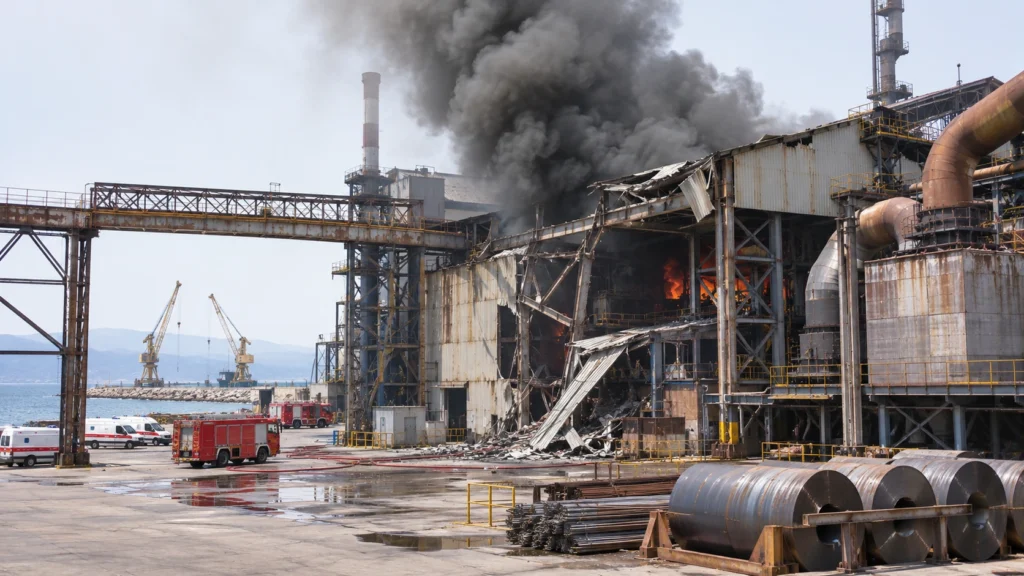
Cause not yet confirmed; no final cause has been given. The governor says a crane fell into a furnace during a boiler replacement, while the company says the blast came during planned maintenance on an electric arc furnace. Lesson: treat a maintenance shutdown as the most dangerous period, with a written lifting and isolation plan for every furnace, crane and boiler job. At about noon on Monday 9 November 2026 a huge explosion and fire struck the HABAS iron and steel works in Aliaga, Izmir province, western Turkey. The plant was established in 1987 and can make 4.5 million tonnes of steel a year, AP reports from the company website. President Erdogan told the nation after a Cabinet meeting that 16 people had died and 13 were injured, two critically; earlier figures were three, six and ten. Health Minister Kemal Memisoglu then announced that a seriously injured person had died in hospital, bringing the toll to 17. Ekoturk, Posta and DHA, all opened in full, carry 17, and so do the BBC headline and many Turkish headlines, so we now use 17 and show the President's 16 as the earlier figure. The injured are put at 12 (Izmir Governorship, as carried by Posta), 13 (Erdogan, Ekoturk) or 14 (the Health Minister, who said three were seriously hurt); no report reconciles the counts. Governor Suleyman Elban said a crane fell into a furnace while a boiler was being replaced and that about 200 workers were present instead of the usual 300 because production had stopped for the work. The Governorship's written statement and DW say an overhead crane toppled into an electric arc furnace during casting of liquid steel, which does not match the boiler wording. The company says the accident happened during planned maintenance on one of its electric arc furnaces, and the Labour Minister said material fell during maintenance; DHA quotes him saying the falling material ruptured natural gas and oxygen pipes. Four public prosecutors were assigned, the Menemen chief prosecutor's office is leading the case, a Social Security Institution chief inspector was appointed and five people, later six, were detained; no court arrest was reported in the pages we opened. A court banned publication of reports on the case until the investigation ends. Figures are from the reports opened on 10 November 2026 (IST) and may change.
Quick answers
What happened at the HABAS plant in Aliaga?
An explosion and fire at the iron and steel works at about noon on 9 November 2026 killed 17 people according to the Health Minister's later count; President Erdogan had said 16 on the evening of 9 November. The injured are put at 12 (Izmir Governorship), 13 or 14 depending on the report.
What caused the explosion?
It is not established. The governor says a crane fell into a furnace during a boiler replacement; the company says it happened during planned maintenance on an electric arc furnace.
Has anyone been detained?
Five people were reported detained by Demiroren News Agency and six by the Justice Minister; no court arrest was reported in the pages we opened, and no charges or names are given here.
Why are details limited?
A court in Aliaga banned publication of news about the case until the investigation ends, according to Ekoturk.
Why are maintenance shutdowns risky in a steel plant?
More people, unusual lifts and opened equipment share the same area. See: Tandem Crane Lifts: The Critical-Lift Plan That Must Exist…
Is there a city safety guide for Aliaga?
No; our guides cover Indian cities, and this is a world case.
What happened
At about noon on Monday 9 November 2026 a huge explosion and fire struck the HABAS iron and steel plant in Aliaga, in Izmir province on Turkey’s Aegean coast. The plant was established in 1987 and can make 4.5 million tonnes of steel a year, according to the company’s own website, which AP quotes.
President Recep Tayyip Erdogan said that evening that 16 people were dead and 13 injured, two of them critically. Earlier counts had been three, six and then ten. Health Minister Kemal Memisoglu then announced that a seriously injured person had died in hospital, making 17. Ekoturk, Posta and DHA, all opened in full, carry 17, and so do the BBC headline and many Turkish headlines, so we now use 17.
What the reports say
- Dead: 17 per the Health Minister (Ekoturk, Posta, DHA); President Erdogan had said 16 on the evening of 9 November (AP, DW).
- Injured: 12 per the Izmir Governorship (Posta), 13 per Erdogan, two critically (AP, DW), or 14 per the Health Minister, three seriously (Posta, DHA).
- Workers on site: about 200 instead of the usual 300, because production had stopped for a boiler switch (Governor Suleyman Elban, via AP).
- What the officials say: the governor says a crane fell into a furnace as a boiler was being replaced, causing an explosion in a nearby steel mill. The company says the accident came during planned maintenance on an electric arc furnace. The Labour Minister said material fell during the maintenance work and, in DHA’s account, that the falling material ruptured natural gas and oxygen pipes.
- Investigation: four public prosecutors, a Social Security Institution chief inspector, and judicial and administrative probes; five people were reported detained by Demiroren News Agency and six by the Justice Minister; no court arrest was reported in the pages we opened.
- Reporting limits: a court in Aliaga has banned publication of news about the case until the investigation ends.
Where reports differ and what we do not know
- The toll: 16 from the President on the evening of 9 November; 17 from the Health Minister later, in Ekoturk, Posta and DHA, and in the BBC and many Turkish headlines. We now use 17 and show the President’s 16 as the earlier figure.
- The sequence: AP’s governor quote says the crane fell as a boiler was being replaced; DW says an overhead crane toppled into a furnace during casting of liquid steel. These are different descriptions, and none is a finding.
- The injured: 12 (Izmir Governorship, as carried by Posta), 13 (AP, DW, Ekoturk) or 14 (Health Minister, DHA); the Governor at the hospital had said 15 earlier. Ekoturk says one remains in serious condition, Posta says three, and no report reconciles the counts.
- Not known: the cause, the number of workers inside the danger area, the permit and inspection record, and the names and roles of those detained.
What this case teaches
Maintenance days look quiet, but they put the most people near the most dangerous equipment. A crane, a furnace and a boiler in one bay leave no margin for a lift that goes wrong. This is not a finding about HABAS; it is a reason for every steel, foundry and power plant to plan shutdown work task by task, empty the danger zone and give workers the right to stop a job. See our tandem crane lift guide, the boiler explosion guide and the Douala steel plant explosion, Ramgarh steel plant furnace blast and Durg steel plant molten iron accident cases.
- The explosion and fire at the HABAS plant; first calls reach the emergency services (Ekoturk; AP says about noon)
- The toll rises from three to six and then ten as search and rescue continues; the Izmir mayor warns it may rise further (Ekoturk; DW)
- Five people are reported detained (Demiroren, via AP); four prosecutors are assigned; the Health Minister makes the first statement at 1.50 pm (Ekoturk)
- President Erdogan announces 16 dead and 13 injured, two critically, after a Cabinet meeting (AP, DW)
- The Health Minister reports a 17th death; the Justice Minister says six are detained; a publication ban is imposed (Ekoturk)
- AP copy (8.39 am IST) and DW copy (6.12 am Oman time) still carry the earlier 16 figure; Ekoturk (6.34 am local time), Posta (updated 12.37 am) and DHA (updated 11.56 pm on 9 November) carry 17, the detentions and, in Posta and DHA, the differing injured counts
Why consequences escalated
- An explosion and fire at the HABAS steel plant in Aliaga, Izmir, on 9 November 2026 has killed 17 people according to the Health Minister's later count (Ekoturk, Posta, DHA); President Erdogan had said 16 on the evening of 9 November.
- The governor says a crane fell into a furnace during a boiler replacement; the company says the blast came during planned maintenance on an electric arc furnace. No cause has been confirmed.
- Five to six people have been detained, four prosecutors and a Social Security Institution inspector are on the case, and a court has banned publication of reports until the inquiry ends.
- Opposition parties and unions called the deaths workplace homicide and blamed weak safety enforcement; these are political claims, not findings.
Failures and risk multipliers
- No official finding exists. What the reports raise as questions:
- Whether lifting or hoisting work near an energised or hot furnace had a written plan, an exclusion zone and a stop-work authority, since the governor describes a crane falling during replacement work.
- Why about 200 workers were on site, and in which areas, while production was halted for maintenance.
- Whether maintenance on a hot-metal furnace needs the furnace to be fully drained, cooled and isolated first, and who checked that it was.
- What the plant's earlier safety record shows; Turkish labour outlets recall earlier accidents there, which we did not open and do not use.
- These are open questions, not findings of fault.
Actions that reduce risk
- Plant owners: treat a maintenance shutdown as the most dangerous period, not the safest. Write a task-specific lifting and isolation plan for every furnace, crane and boiler job, and keep the number of workers inside the danger area to the minimum.
- Before any hot-metal or furnace-adjacent work: drain, cool and isolate the equipment, check for trapped water or moisture, and get a signed permit from the person who controls the furnace.
- Crane and gantry work: inspect the structure and hooks before a lift, set a clear exclusion zone below, and stop the job if the load, the rail or the crane behaves unexpectedly.
- Contractors and shift workers: ask what the plan is, where the danger zone is and who can stop the job; you have the right to step back.
- Regulators and boards: publish the cause and the permit and inspection record, and protect workers who report unsafe conditions.
- Indian plants: the same risks apply in steel, foundry and power units; compare with the Durg, Ramgarh and Douala cases linked below.

Leave a comment