
The guide
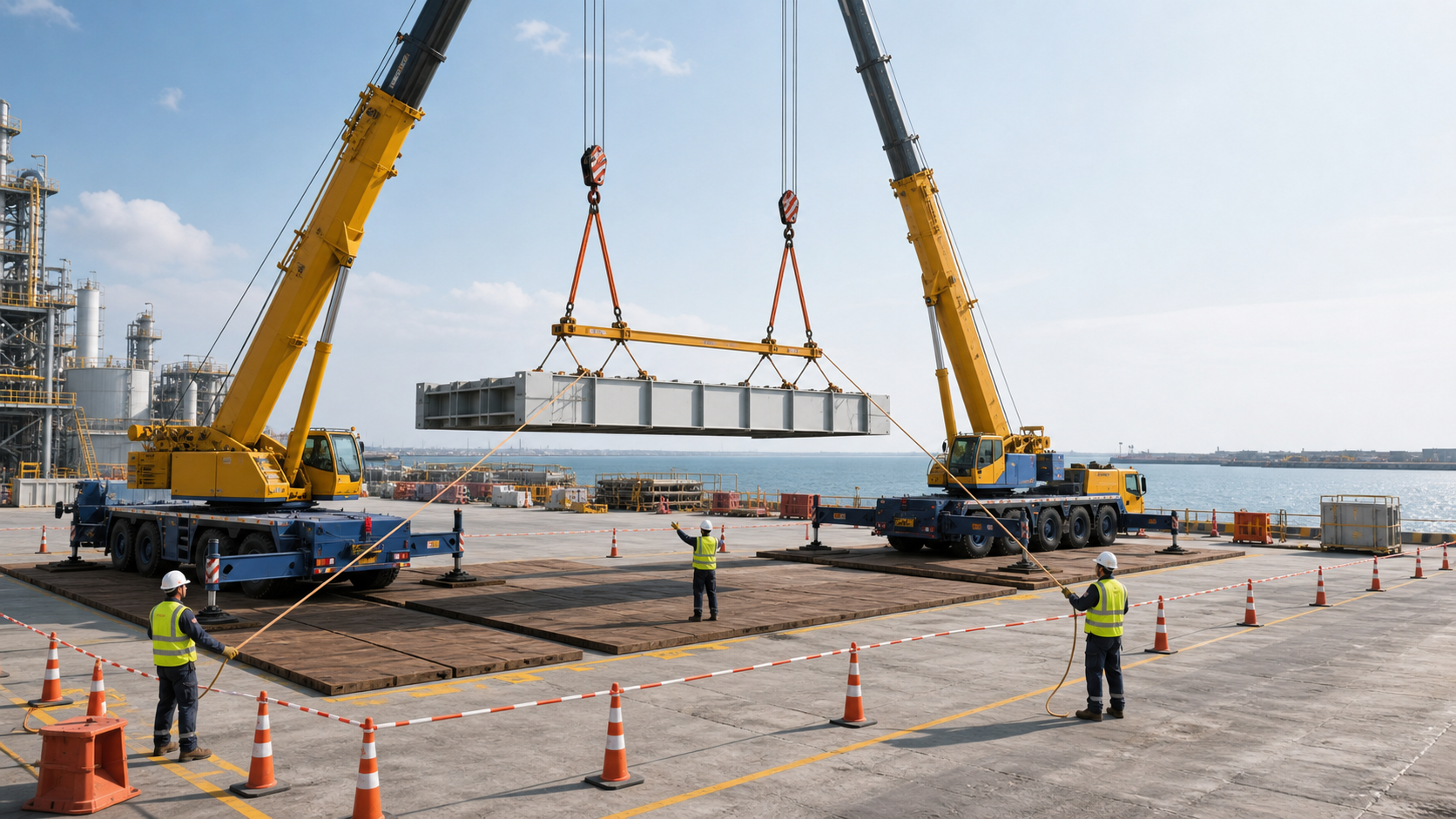
Tandem Crane Lift Safety: 12 Essentials for a Critical-Lift Plan
**HowToSurvive.in | Practical Industrial and Life Safety**
Using two cranes to lift one load may solve a capacity, geometry or access problem—but it also connects two machines, two operators and one changing centre of gravity into a single high-consequence system.
The UK Health and Safety Executive identifies tandem lifts using multiple cranes as complex operations that require extensive planning by a person with suitable competence. ILO dock-work guidance says such lifts should be used only when other means are unavailable and should be directly supervised and carefully planned.
## Why Tandem Lifts Are Different
In a single-crane lift, one hook carries the load. In a tandem lift, the force at each hook changes when the load:
– tilts;
– rotates;
– moves horizontally;
– passes through different radii;
– encounters unequal hoist speed;
– is affected by wind;
– shifts internally;
– loses one rigging connection.
A load described as 100 tonnes does not automatically place 50 tonnes on each crane. Real load share depends on centre of gravity and geometry at that instant.
## The 12-Part Critical-Lift Plan
### 1. Verify the load
Confirm certified weight, dimensions, lifting points, internal movement risk and centre of gravity. “Approximately” is not adequate for a high-capacity engineered lift.
### 2. Define the complete movement
Plan pickup, clearance, slewing, travel, transfer, landing and rigging removal. Capacity must remain adequate through the entire path.
### 3. Calculate each crane’s load share
Calculate static and foreseeable dynamic loads at every critical position. Include rigging weight, hook blocks and accessories.
### 4. Select compatible cranes
Consider capacity, load charts, boom configuration, hoist speed, controls, reeving and operating characteristics. Similar response helps coordination but does not replace engineering.
### 5. Engineer the rigging
Specify slings, straps, shackles, spreader beams, attachment angles and edge protection. Check every component against its applied force.
### 6. Verify ground and support
Calculate outrigger reactions and ground-bearing pressure. Use correctly sized mats or engineered support. Reassess quay edges, underground services and voids.
### 7. Name one lift director
One competent person must control the operation and have unquestioned authority to stop it. Conflicting commands are a hazard.
### 8. Establish communication
Use a tested radio channel and agreed signals. Decide what every operator does immediately if communication fails.
### 9. Create an exclusion zone
Include the suspended-load area, possible load swing, boom-fall radius and crane overturn zone. Keep all non-essential people out.
### 10. Define weather limits
Set maximum wind and visibility conditions based on load area, crane configuration and manufacturer guidance. Stop before the limit is exceeded.
### 11. Conduct a controlled pre-lift check
Confirm rigging seating, brake response, communication and load balance through a carefully controlled initial lift when permitted by the plan.
### 12. Plan abnormal events
Specify actions for sling movement, unequal hoisting, overload alarm, hydraulic leak, crane movement, vessel movement, power loss, fire or sudden weather change.
## The Most Important Scenario: Loss of Load Share
Every tandem-lift plan should examine what happens if one crane suddenly carries less—or none—of its planned load.
The remaining crane may experience:
– abrupt overload;
– boom deflection;
– outrigger uplift;
– instability;
– unexpected load swing;
– structural contact;
– rigging failure.
If the plan cannot show a tolerable outcome or safe control strategy, the method must be redesigned.
## Roles That Must Be Clear
### Lift planner
Develops the engineered method and identifies resources, limits and contingencies.
### Lift director/crane supervisor
Controls execution and stops the operation when the plan is not being followed.
### Crane operators
Operate within load charts and agreed commands; stop when signals, conditions or loads are unsafe.
### Rigger/slinger
Selects and attaches rigging according to the plan and verifies secure seating.
### Signaler/banksman
Provides clear, recognised directions from a safe position.
Everyone must understand who may issue normal commands and who may issue an emergency stop. Anyone who sees immediate danger should be able to call stop.
## Red Flags: Do Not Start the Lift
– Cargo weight or centre of gravity is uncertain.
– The written method does not calculate individual crane loads.
– Rigging certificates or inspection status cannot be verified.
– Crane setup differs from the plan.
– Ground or quay capacity is unknown.
– Wind exceeds or approaches the planned limit.
– Radios or signals are unclear.
– People remain inside the exclusion zone.
– The crew has not reviewed abnormal-event actions.
– Commercial pressure is being used to override stop-work concerns.
## If Something Changes Mid-Lift
– Stop movement smoothly if conditions permit.
– Do not make an improvised corrective movement.
– Keep the exclusion zone clear.
– Confirm actual loads and crane stability.
– Lower to the planned safe position when authorised.
– Recalculate and rebrief before resuming.
– Treat a shifted sling, changed load orientation or unexpected alarm as a changed lift—not a minor inconvenience.
## Emergency and Fire Readiness
– Keep fire-service access clear.
– Identify fuel, hydraulic oil, batteries and cargo hazards.
– Provide suitable extinguishers without expecting operators to fight a developed fire.
– Establish shutdown and operator-escape procedures.
– Share manifests and hazardous-cargo information with responders.
– Never approach a burning crane without specialist control; tyres and pressurised systems can fail violently.
## Practical Audit Questions
1. Who engineered and approved the lift?
2. What is the verified load and centre of gravity?
3. What load will each crane carry at every stage?
4. What prevents a sling from moving?
5. What happens if one crane stops carrying its share?
6. Are ground and outrigger forces verified?
7. Who gives commands?
8. What is the stop signal?
9. Is the exclusion zone physically controlled?
10. Where can the load be placed safely if the lift is aborted?
## Closing Line
Two cranes do not provide twice the safety. Without one engineered plan and one coordinated command, they create twice the opportunity for forces to move somewhere nobody expected.
## References
– [UK HSE — Planning and organising lifting operations](https://www.hse.gov.uk/work-equipment-machinery/planning-organising-lifting-operations.htm)
– [UK HSE — Construction lifting operations](https://www.hse.gov.uk/construction/safetytopics/lifting-operations.htm)
– [ILO — Safety and health in dock work](https://www.ilo.org/sites/default/files/wcmsp5/groups/public/%40ed_protect/%40protrav/%40safework/documents/normativeinstrument/wcms_107876.pdf)
– [ILO — Machinery, plant and equipment safety](https://www.ilo.org/topics-and-sectors/occupational-safety-and-health-guide-labour-inspectors-and-other/machinery-plant-and-equipment)
– [OSHA — Hoisting and rigging requirements](https://www.osha.gov/laws-regs/regulations/standardnumber/1926/1926.753)
## SEO Publishing Package
– **Category:** Blog; Industrial Safety; Workplace Safety
– **SEO title:** Tandem Crane Lift Safety: 12 Essentials for a Critical-Lift Plan
– **Slug:** `tandem-crane-lift-safety-critical-lift-plan`
– **Focus keyphrase:** tandem crane lift safety
– **Meta description:** Learn the 12 essentials of a safe tandem crane lift: load-share calculations, rigging, ground support, communication, exclusion zones and emergency planning.
– **Tags:** Tandem Lift, Crane Safety, Critical Lift Plan, Rigging Safety, Port Safety, Lifting Operations, Industrial Safety, Workplace Safety, HowToSurvive
– **Generated cover:** `assets/daily/2026-08-31/tandem-crane-lift-safety-cover-ai.png` — 1672×941, approximately 16:9
What needs attention
- Why a tandem lift is different: When two hooks support one load, the share carried by each crane depends on the centre of gravity, hook positions, rigging geometry and the load's orientation. It should not be assumed to remain 50/50 while the load is hoisted, slewed, travelled or tilted. A small change in geometry can transfer load from one crane to the other.
- Plan it as a complex lift: UK HSE guidance identifies tandem and multiple-crane lifts as complex operations that may require a written plan created by a person with the necessary competence. OSHA 1926.1432 likewise requires a multiple-crane lift to be planned by a qualified person, with engineering expertise involved when the qualified planner determines it is necessary.
- Verify the load and the complete movement: The plan should use a verified load weight, centre of gravity, approved lifting points, rigging arrangement and the actual crane configurations. Capacity must be checked through the whole intended path, not only at the pickup position. Boom length, radius, counterweight, outrigger arrangement, reeving, hook block and below-the-hook equipment all affect the calculation.
- Treat the ground and surroundings as part of the lifting system: Crane position, outrigger reactions, bearing support, underground services, nearby structures, power lines, access routes and the interaction between the two cranes must be assessed before setup. The exclusion zone should cover the load path and credible movement if control is lost.
- Use one command structure: OSHA requires the operation to be directed by a lift director who meets the applicable competent-and-qualified-person criteria, and the plan must be reviewed with the workers involved. The team should know who may give normal commands, how an emergency stop is communicated and what happens if radio contact, visibility or synchronisation is lost.
Controls that reduce risk
- Confirm the exact load weight, centre of gravity and approved lifting points.
- Draw the pickup, complete travel path, final position and planned safe-landing position.
- Calculate the expected and worst credible load share for each crane; include hooks, blocks, rigging and any lifting beam.
- Check each crane's capacity for its actual configuration at every relevant radius and stage.
- Have the rigging and temporary lifting arrangement designed or verified by competent people.
- Assess ground bearing capacity, outrigger loads, underground services and required mats or foundations.
- Nominate one lift director and record the responsibilities of operators, riggers, signalers and supervisors.
- Agree and test the radio channel, standard signals and emergency-stop signal before taking load.
- Barricade the exclusion zone and keep everyone out from beneath or within the swing path of the suspended load.
- Set site-specific limits for wind, visibility, lighting and other changing conditions.
- Conduct a pre-lift briefing and a controlled trial lift just clear of the supports to confirm balance and communication.
- Define stop-work triggers and the authorised response to loss of communication, unexpected load shift, equipment alarm or weather change.
Common unsafe practices
- Assuming both cranes will always carry half of the load.
- Using an estimated weight or centre of gravity when verified information is required.
- Checking crane capacity only at the starting radius.
- Changing boom, outrigger, counterweight, rigging or route details without rechecking the plan.
- Allowing two people to issue competing movement commands.
- Continuing after loss of radio contact, visibility, synchronisation or stable load control.
- Trying to correct an unexpected load shift through improvised crane movement.
- Allowing workers beneath the suspended load or inside an inadequately controlled swing area.
