
What happened here
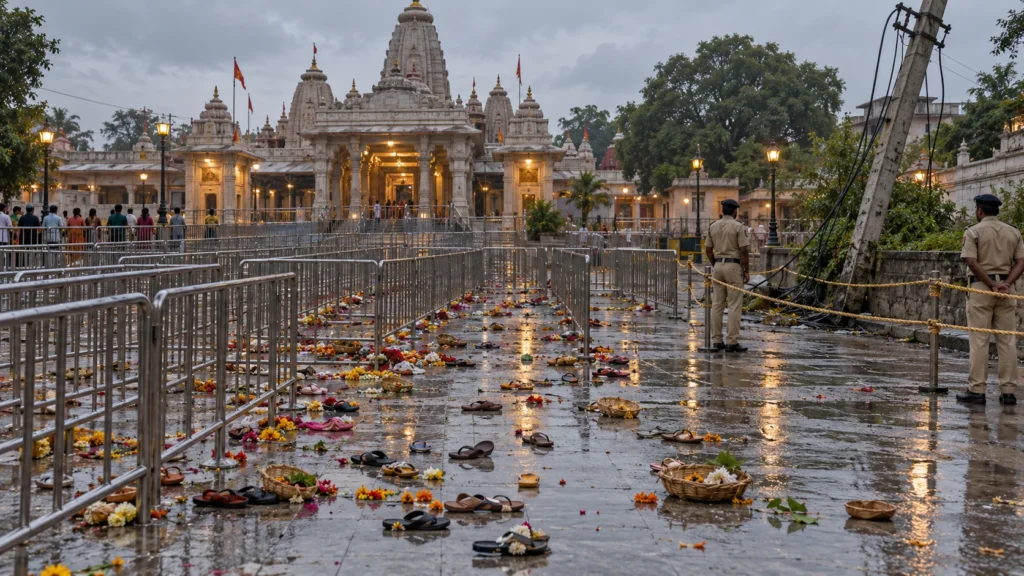
A crowd crush near the Ashok Dham temple in Lakhisarai, Bihar, at about 6:40 a.m. on 17 August 2026, the third Monday of Sawan, killed seven women devotees and injured 25, according to the district list. Officials said a barricade broke under the crowd's pressure and a fallen electricity pole set off a false rumour of electric current. The administration says the deaths were from the crush, not electrocution.
Quick answers
How many people died in the Ashok Dham stampede?
Seven women, according to the list released by the Lakhisarai district administration. The district list named 25 injured; early reports said 12 to 14.
When did the Ashok Dham stampede happen?
At about 6:40 a.m. on Monday, 17 August 2026, the third Monday of Sawan. Some international outlets dated it 16 August because of the time difference.
Were people electrocuted at Ashok Dham?
No, according to the district administration. It said the deaths were caused by the crush, that the power supply was off and that the fallen line was a cable wire. A rumour of electric current caused the panic.
What caused the stampede?
Officials said the crowd surged after two trains arrived, a barricade broke and an electricity pole fell, setting off a rumour of live current. No official inquiry finding has been published.
What compensation was given?
Rs 4 lakh to the family of each person who died, announced by Chief Minister Samrat Choudhary. ETV Bharat reported Rs 50,000 for each injured person.
Has anyone been held responsible?
Not as of 17 October 2026. Inquiries were ordered, but we found no FIR, arrest or suspension.
What happened
Early on Monday, 17 August 2026, the third Monday of Sawan, a crowd crush near the Ashok Dham temple in Lakhisarai, Bihar, killed seven women devotees. The temple, also known as Shri Indradamneshwar Mahadev Mandir, draws huge crowds for jalabhishek on Sawan Mondays. Outlook and ETV Bharat put the crowd at around 50,000, and an officer told Outlook that the queues stretched for more than 6 km.
Lakhisarai Sub-Divisional Police Officer Shivam Kumar put the time at about 6:40 a.m. District Magistrate Shailendra Kumar said the crowd swelled suddenly between 6:30 and 6:45 a.m., when two trains full of pilgrims arrived at the nearby Ashok Dham halt within a short gap. PTI reported that the crush happened near the halt, a short walk from the temple. Amar Ujala reported that it was on a narrow, partly unpaved approach road about 1 km from the temple.
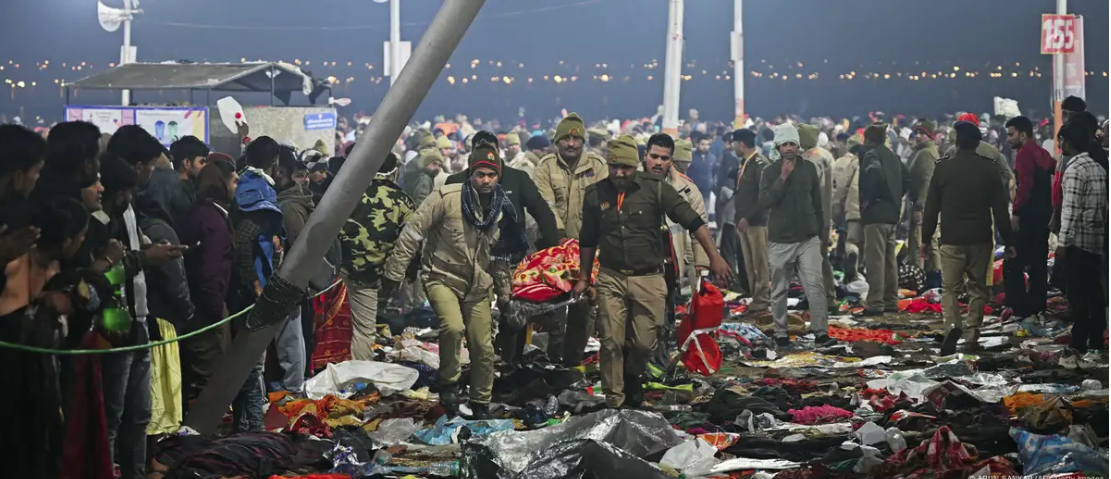
Accounts of the next two minutes agree on the main points but differ on the order. The DM told reporters that the barricading broke on one side under the pressure of the crowd. A concrete electricity pole carrying a cable fell near the queue, and a rumour spread that a live wire had come down on people. Panic pushed the crowd onto the women’s queue, and women fell on top of each other. Some ran towards fields made slippery by rain. The SDPO also told Outlook that some young men had pushed through and broken the barricades.
Electrocution or crush?
The first reports said people were electrocuted. The SDPO told ANI that it was being said a pole fell and people were electrocuted, but that the exact reason would be known only after checking everything. Within hours, the district administration said the deaths were caused by the crush, not by electric current. Patrika quoted the DM as saying that the power supply was off and the wire was covered. He told ANI and other outlets that the fallen line was a cable wire, not a live wire. Bihar minister Vijay Kumar Sinha told IANS that the pole and wires fell outside the temple premises and that people spread a rumour about electric current.
Amar Ujala raised questions about the pole itself. The Junior Engineer of the electricity department, Naveen Kewat, told the paper that he knew the pole was already leaning. He said a lineman had been sent after the crowd built up and that the line to the pole had been cut. The paper also reported that 2 to 3 feet of soil had been dug out of a field near the entrance gate about 20 days earlier, and that rain the day before had softened the ground. These points have not been answered in any official finding we could find.
The people who died
All seven who died were women. IANS reported the names from the list released by the district administration: Manmala Devi, Rinku Devi, Hemlata Devi, Lalita Devi, Savita Devi, Saroj Devi and Savitri Devi. IANS reported that three of them were from Pratappur village in Halsi block, where Jan Suraaj leader Prashant Kishor met their families on 18 August.
The injury count changed through the day. Early reports said about 12 to 14 people were hurt. The district list reported by IANS named 25 injured, almost all women and girls. Three were said to be critical and were referred from Lakhisarai Sadar Hospital to Patna Medical College and Hospital. We found no later report of a death among the injured.
Some early Hindi reports gave eight or nine deaths, based on local information before the official count. The district administration’s list has seven names, and this page uses seven.
Response and investigation
Chief Minister Samrat Choudhary announced Rs 4 lakh ex gratia for the family of each person who died. IANS reported that the district handed over the cheques the same day. ETV Bharat reported on 22 August that each injured person also received Rs 50,000. Prime Minister Narendra Modi posted his condolences.
Several inquiries were set up. The district formed an inquiry team, and ETV Bharat reported that ADM Neeraj Kumar was asked to report within 24 hours. IANS reported that the Commissioner and the DIG visited and ordered an inquiry. A three-member team from the Bihar State Religious Trust Board visited on 19 August and, according to ETV Bharat, submitted its report to the state government. Deshaj Times reported that this team found the rumour was the main cause and found no serious lapse by the administration or the temple committee. We could not find that report published, or any official statement of its findings.
Opposition leaders, the BJP’s Lakhisarai district president Deepak Singh, and Prashant Kishor questioned the arrangements and asked for responsibility to be fixed. Kishor said compensation could not take the place of accountability. Up to 17 October 2026 we found no report of an FIR, an arrest, a suspension, or any action against the electricity department, district officials or the temple trust.
For the fourth Sawan Monday, ETV Bharat reported that the district put up more barricading, installed CCTV cameras linked to a control room, repaired electric poles, widened the road near the halt, made separate routes for devotees, posted magistrates at sensitive points and asked the railways to change special train timings.
Why this matters
This is how many Indian crowd disasters unfold. A crowd far bigger than planned for, a sudden surge when trains or buses arrive together, a weak barricade, and one frightening shout. Once people in a packed queue start to run, those in front cannot move, and the pressure is enough to crush and suffocate. The SDPO himself said some of the injured had fallen ill from humidity and suffocation.
It was not the first warning at Ashok Dham. ETV Bharat and Outlook recalled a 2019 stampede at the same temple in which one person died. ETV Bharat also noted that nine people died in a stampede at the Sheetla Mata temple in Nalanda district on 31 March this year.
Women carry most of the risk. NCRB recorded 147 stampede deaths in India in 2024, and 128 of them were women. Every one of the seven who died at Ashok Dham was a woman.
Lessons for organisers and devotees
- Plan for the real crowd. Sawan Mondays at a big Shiva temple are predictable peaks. Organisers should count arrivals by train and road and hold people back in safe holding areas before the queue becomes dangerous.
- Talk to the railways. When two special trains empty onto one narrow road within minutes, the surge is built in. Staggering trains is cheaper than any compensation.
- Strong barricades, with breaks. Barricades must hold, but they also need exit gaps every few metres so people can step out when pressure builds.
- Check every pole, wire and transformer on the route. Before the festival, the electricity department should straighten or remove leaning poles, switch off or insulate lines along queues, and put a lineman on duty.
- Kill rumours fast. Public address systems along the whole queue let officials say, within seconds, that there is no current and nobody should run.
- If you are in the crowd, keep your arms up in front of your chest, move diagonally towards the edge, and do not push back against the flow. If you fall, get up at once or curl on your side with your hands protecting your head.
What is still not known
Whether the barricade gave way first or the pole fell first, why a pole known to be leaning stood next to a queue, and whether the power was switched off before the pole fell have not been settled in any published official finding. The ADM’s report and the Religious Trust Board’s report have not been made public. No one has been held responsible. We will update this page when official findings are published.
If you see someone hurt in a crowd, call 112 or the ambulance on 108 and give a landmark, such as the queue point or the nearest gate.
- Devotees begin queuing for jalabhishek; queues stretch over 6 km, an officer told Outlook
- Two trains of pilgrims arrive at Ashok Dham halt within a short gap; the crowd surges (DM)
- Barricade breaks, an electricity pole falls, a rumour of live current spreads and women in the queue are crushed
- Injured taken to Lakhisarai Sadar Hospital; three critical referred to PMCH; officials rule out electrocution
- CM announces Rs 4 lakh ex gratia; district releases names of seven dead and 25 injured and pays cheques (IANS)
- Commissioner and DIG visit and order an inquiry; Prashant Kishor meets families in Pratappur, Halsi (IANS)
- Bihar State Religious Trust Board team visits; ADM Neeraj Kumar asked to report within 24 hours (ETV Bharat)
- Trust Board team's report submitted to the state government; tighter arrangements for the fourth Monday (ETV Bharat)
- No published official finding, FIR, arrest or suspension located
Why consequences escalated
- Seven women devotees died in a crush on the approach to the temple, not inside it.
- The crowd surged after two trains of pilgrims arrived close together at Ashok Dham halt.
- A barricade broke and a concrete electricity pole fell; a rumour of live current caused the panic.
- The district administration says nobody was electrocuted and the deaths were from the crush.
- An electricity department engineer said he knew the pole was already leaning (Amar Ujala).
- A Religious Trust Board team reportedly blamed the rumour and found no serious lapse; this report is not public.
Failures and risk multipliers
- Crowd planning that did not match a predictable Sawan Monday peak, according to critics and analysts.
- Two trains of pilgrims arriving close together onto one narrow approach road.
- A barricade that gave way under the pressure of the crowd.
- A leaning electricity pole left standing beside a packed queue.
- No CCTV cameras at the site, according to Amar Ujala, which makes the sequence harder to establish.
Actions that reduce risk
- Plan crowd capacity for the real peak and hold arrivals in safe holding areas.
- Coordinate special train timings with the railways so arrivals are staggered.
- Use strong barricades with exit gaps, and keep queues for men and women apart but both with escape routes.
- Have the electricity department inspect, straighten or remove poles and switch off lines along queues.
- Put public address speakers and CCTV along the whole queue to stop rumours quickly.



Leave a comment