
The guide
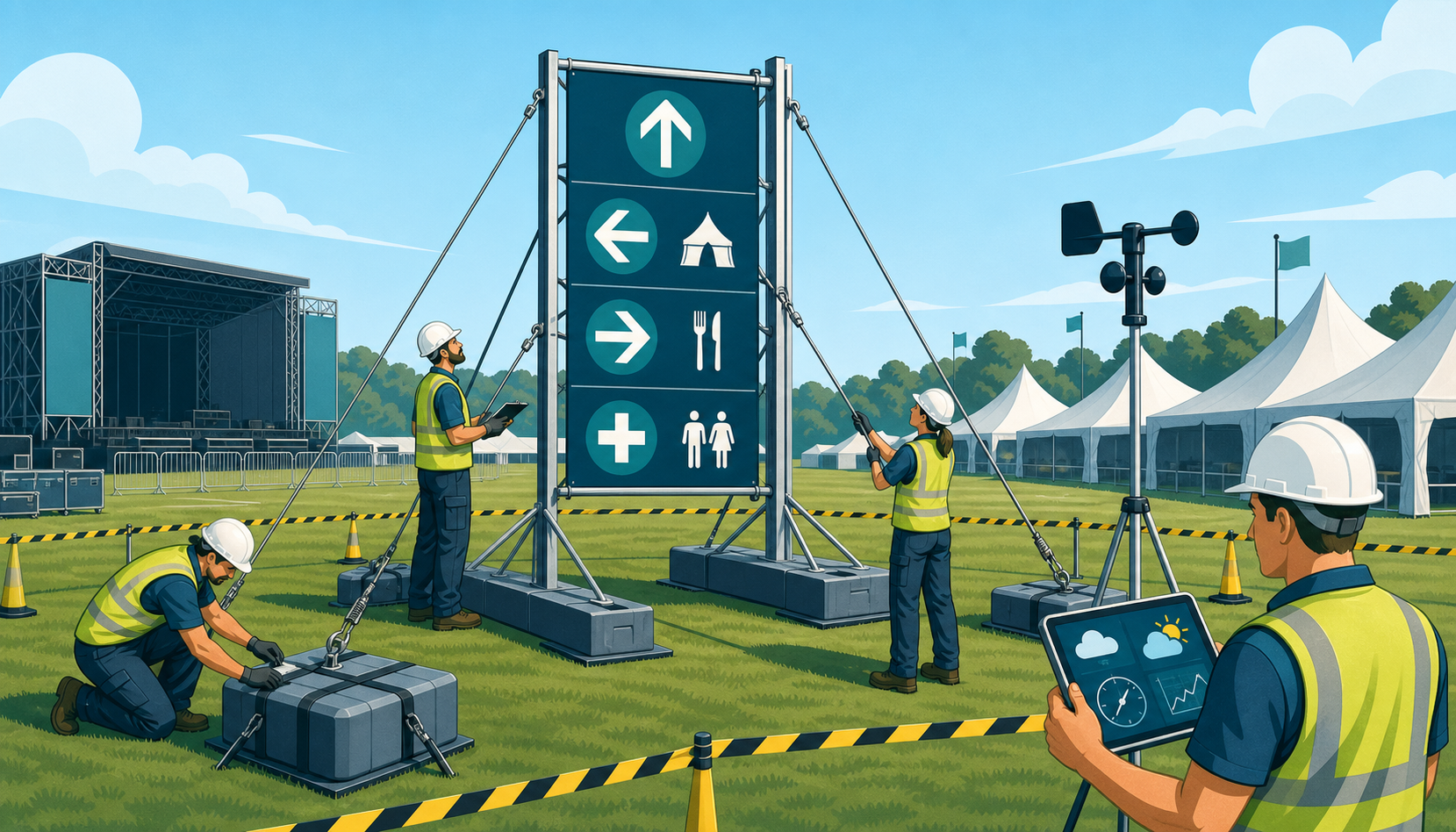
Temporary Event Sign Safety: Wind, Ballast and Exclusion Zones
Temporary signs can look harmless, yet wind acts on a solid sign face like a sail. The taller and wider the panel, the greater the overturning demand on its base, anchors and connections. Safe installation therefore starts with an engineered system, not an improvised stack of weights.
## 1. Treat the sign as a temporary structure
Record its height, face area, weight, centre of gravity, support frame, connection details and approved ballast or ground anchors. Follow the supplier’s design limits and installation instructions. Larger or elevated signs need a competent temporary-works designer and a site-specific check.
## 2. Check the actual site
Wind exposure differs beside buildings, at hilltops, in gateways and between tents. Confirm ground bearing capacity and locate underground services before stakes or anchors are installed. Keep signs away from exits, queues, accessible routes, play areas, roads and places where a fall could trigger crowd movement.
## 3. Use the specified ballast and anchors
Ballast must be secured to the frame so it cannot slide or be removed casually. Water tanks are only useful when filled to the specified level and protected from puncture or draining. Never hang extra banners from a structure unless their wind area was included in the design.
## 4. Establish a wind action plan
Set written trigger levels based on the manufacturer’s or engineer’s limits. Monitor local forecasts and on-site wind, including gusts. Define who has authority to remove fabric, lower the sign, close an area or evacuate. Act before the limit is reached; dismantling becomes more dangerous as wind rises.
## 5. Inspect through the event
Complete a documented handover before opening and recheck after high winds, heavy rain, vehicle contact, crowd pressure or any movement. Look for loose pins, distorted frames, slack guys, displaced ballast, soft ground and torn fabric. Isolate the area immediately if stability is uncertain.
## 6. Protect people with an exclusion zone
Where possible, keep the fall radius out of occupied space. Barriers should prevent access without creating a new trip or evacuation hazard. Do not rely on a steward standing beside an unstable structure.
## If a sign starts moving
– Move away sideways and warn others; do not try to hold a large sign upright.
– Keep clear of guy lines, falling panels and electrical cables.
– Tell event control or emergency services the exact location.
– Organisers should stop access, expand the exclusion area and use trained crews only when conditions permit.
– After a collapse, do not lift heavy components without stabilisation and rescue equipment.
## A seven-point organiser check
1. Is there an approved design and wind limit?
2. Has the site and ground been checked?
3. Are every anchor, connection and ballast unit installed as specified?
4. Is the fall zone separated from people and exits?
5. Is live weather monitoring active?
6. Are named people authorised to stop or dismantle the installation?
7. Are inspections and decisions recorded?
## Why this matters
Temporary structures change during an event: soil softens, water ballast leaks, people move barriers and weather strengthens. Safety is therefore a continuous control loop—design, inspect, monitor, act and document—not a one-time setup task.
**Closing line:** If wind can reach it, stability must be designed, checked and actively managed.
What needs attention
- A solid sign face behaves like a sail. Increasing height, width and elevation changes overturning demand on the frame, connections, anchors and ground. An improvised stack of weights is not an engineered design.
- Site exposure matters. Gateways, corners, gaps between buildings, hilltops and open ground can experience different wind effects. Ground bearing, softening after rain and underground services affect whether anchoring is safe and effective.
- The supplier or competent designer should define configuration, ballast or anchors and operating wind limits. Adding banners or changing the face area changes the load and requires review.
- The action plan must name the person watching forecasts and on-site conditions, the trigger for closing the area or lowering/removing the sign and who has stop-work authority. Dismantling becomes more hazardous as wind strengthens.
- An exclusion zone reduces consequence but does not make an unstable structure acceptable. Barriers must not block exits, accessible routes or create new crowd pressure.
Controls that reduce risk
- Record dimensions, face area, weight, centre of gravity, frame, connections and approved ballast/anchors.
- Use a competent temporary-works designer for larger, elevated or unusual signs.
- Assess wind exposure, ground capacity, drainage and underground services before installation.
- Install every connection, anchor and ballast unit exactly as specified and secure ballast against removal or leakage.
- Keep the fall zone away from queues, exits, roads, play areas and accessible routes.
- Set written forecast and on-site wind triggers with named decision authority.
- Inspect before opening and after high wind, rain, vehicle contact, crowd pressure or any movement.
- Isolate the area immediately if ballast shifts, ground softens, connections loosen or the sign moves.
Common unsafe practices
- Adding banners without including their wind area in the design.
- Using unsecured water ballast or loose weights.
- Driving stakes without checking underground services.
- Placing the fall radius across an exit or queue.
- Waiting until the wind limit is reached before starting dismantling.
- Trying to hold a large moving sign upright by hand.
- Using a steward as the only control for an unstable structure.
Leave a comment