
Quick answers
What affects how a fire spreads?
Three things: the fuel (what it is, how much there is and how dry it is), the weather (heat, humidity and wind) and the ground (slope, which way the slope faces, and barriers such as rivers, roads and firebreaks).
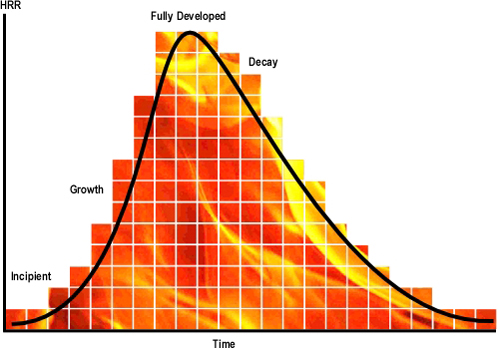
What are the four stages of a fire?
Incipient, when burning has just started; growth, when the fire spreads and smoke builds up; fully developed, when everything that can burn is burning and the heat is at its peak; and decay, when the fuel runs out.
Why does catching a fire early matter so much?
At the incipient stage a fire is small and can often be put out easily. Smoke alarms, heat detectors and sprinklers help catch it then, before it spreads and the room becomes unsurvivable.
Why does fire spread faster uphill?
The flames heat up the grass and bushes above them before they reach them, so that fuel catches fire much more quickly.
Why does one fire stay in a dustbin while another runs through a whole godown in ten minutes? Firefighters call it fire behaviour: the way a fire reacts to what it is burning, the weather around it and the ground it is on. You do not need to be a firefighter to understand the basics, and knowing them helps you decide when to act and when to get out.
What makes a fire grow
Fuel
- Type of fuel. Different materials burn at different speeds. Wood, paper, plastics and flammable liquids such as petrol all behave differently.
- Fuel load. This is simply how much there is to burn. A room packed with cartons, cloth and furniture gives a fire far more energy than a bare one.
- Moisture. Wet material burns slowly. Dry material catches easily and burns fast.
Weather
- Temperature. On a hot day, fuel is already warm and burns faster.
- Humidity. Dry air dries out grass, leaves and stored goods, so they catch fire more easily.
- Wind. Wind feeds the fire more oxygen, makes it burn harder and carries sparks and embers to new places.
The lie of the land
- Slope. Fire runs faster uphill than downhill, because the flames heat up the grass and bushes above them before they reach them.
- Which way a slope faces. In India, as everywhere in the northern hemisphere, south-facing slopes get more sun and tend to be drier, so they burn more easily.
- Barriers. Rivers, roads and cleared firebreaks can slow or stop a fire.
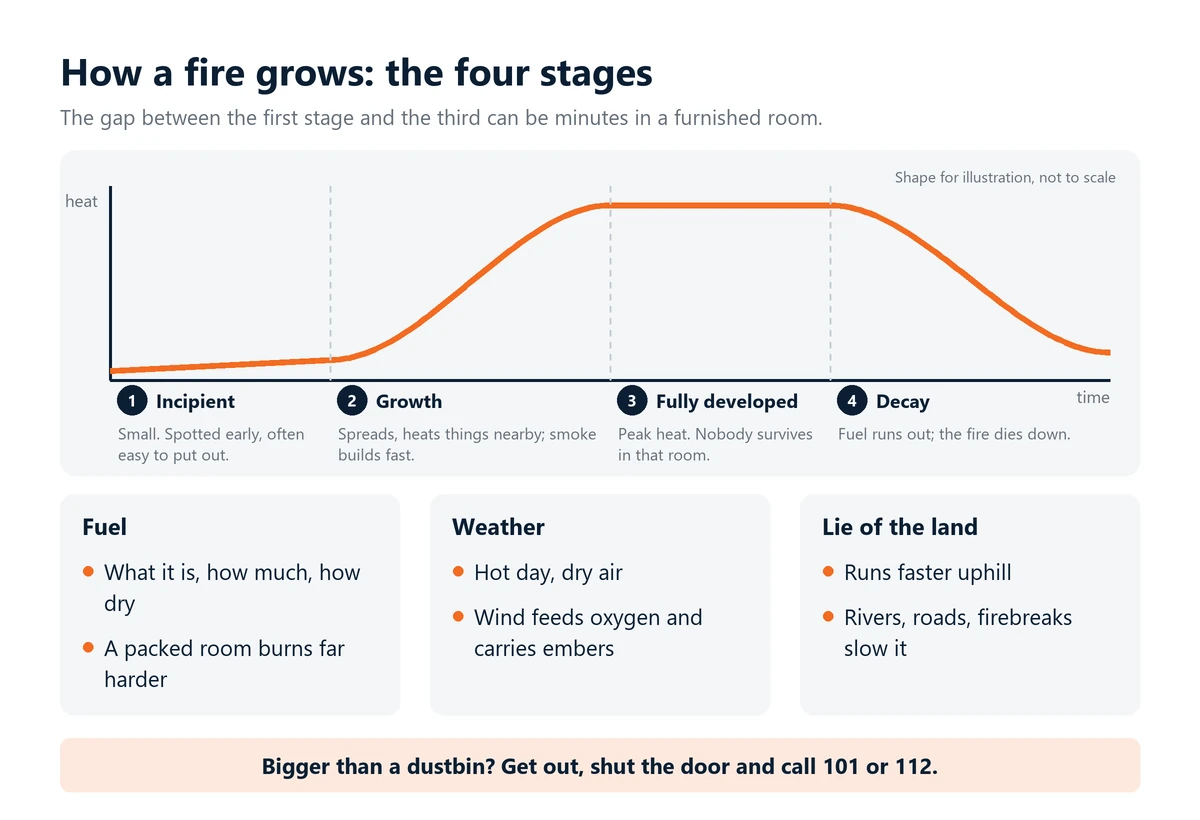
The four stages of a fire
- Incipient stage. Heat, oxygen and fuel come together and burning starts. The fire is small, and if someone spots it early it can often be put out easily.
- Growth stage. The fire spreads as it uses up fuel and oxygen. Its heat warms everything around it, so nearby things start burning too. Smoke builds up quickly and you soon cannot see.
- Fully developed stage. The fire is at its peak. Everything that can burn is burning, the heat is at its highest, and nobody can survive in that room.
- Decay stage. The fuel runs out, the heat drops and the fire dies down, until it goes out or is put out.
The gap between the first stage and the third can be a matter of minutes in an ordinary room full of furniture. That is why the only safe plan for most people, once a fire is past the small stage, is to leave.
What this means for your safety
- Catch it early. A fire found at the incipient stage can be stopped before it spreads. Smoke alarms, heat detectors and sprinklers exist to catch it then.
- Cut the fuel. Store flammable liquids properly, keep space around buildings, and clear dry grass and waste. Less fuel means a slower, smaller fire.
- Know which way it will go. Firefighters use wind and slope to decide where to stand and where to put their hoses and teams.
- Plan your way out. Knowing how fire spreads helps you choose a safe escape route. This matters most in high-rise buildings and in homes near forests or on hillsides.
- Buildings that slow fire down. Fire-resistant materials, proper ventilation, fire doors, sprinklers and clear emergency exits, built to the fire code, give people time to get out.
Try this today
Walk through your home or workplace and look at it the way a fire would. Where is the fuel piled up? Where is the heat: the stove, the heater, the switchboard? Move one pile of cartons or cloth away from a heat source, press the test button on your smoke alarm, and check that your way out is clear. If a fire does start and it is already bigger than a dustbin, get out, shut the door behind you and call 101 or 112.
What needs attention
- Every fire needs fuel, heat and oxygen; take one away and it stops
- A fire is easiest to put out in the incipient stage, while it is still small
- In the growth stage heat preheats nearby material and smoke cuts visibility fast
- Once fully developed, a room becomes unsurvivable; at that point only escape matters
- Dry fuel, low humidity and wind make fires start more easily and spread faster
- Fire runs faster uphill, because the fuel above it is already being heated
Controls that reduce risk
- Fit smoke alarms so a fire is caught in its incipient stage
- Cut the fuel load: clear waste, cartons and old furniture from stairs and corridors
- Store flammable liquids in closed containers, away from heat and sunlight
- Clear dry vegetation from around buildings, especially near hills and forests
- Keep fire doors closed and exits clear so fire and smoke spread more slowly
- Plan escape routes with the likely direction of fire spread in mind
Common unsafe practices
- Thinking a small fire will stay small while you fetch help
- Stacking cartons, cloth or plastic close to heaters, wiring or cooking
- Leaving dry grass and waste piled around buildings and godowns
- Ignoring the smell or sight of smoke until flames appear
- Opening doors and windows wide, which feeds the fire more air
- Staying to fight a fire that is already spreading

Leave a comment