
Quick answers
How to check if an urgent money request from a relative on WhatsApp is genuine?
End the suspect chat and call the person on a number already saved or independently confirmed. A familiar name, profile photo or voice does not prove who controls the message, and a callback number or link sent in that message should not be used.
What should be checked before sending money for an urgent request?
Ask who will receive the money, why the recipient or UPI ID is different and whether the amount matches the need. Check the payee name in the bank or UPI app, and never share a UPI PIN, OTP or screen with the requester.
Do I need to enter my UPI PIN to receive money?
No. A request to scan a QR code or enter a UPI PIN to receive money is a warning sign, because NPCI says that action is for making a payment, not receiving one.
What to do if money was already sent to a fraudster pretending to be a relative?
Stop further transfers and contact the bank or payment app's official fraud support with the transaction reference. Call 1930, report on the official cybercrime portal and preserve messages and payment IDs; recovery is not guaranteed.
Why a familiar request may not be genuine
An urgent money request may appear to come from a son, parent, relative, friend, colleague, customer or manager. The sender might use a copied profile photograph, a new number with a familiar name, a compromised account, an old chat thread or a voice that sounds convincing. None of those details proves the person controls the message. RBI’s fraud-awareness material specifically warns about social-media accounts impersonating friends or relatives and recommends confirming a fund request by phone or in person.
The examples are different; the safety rule is the same
In a reported Lucknow case, a company received a WhatsApp request appearing to come from an owner’s son and transferred ₹18 lakh. In a separate Indore report, a teacher said a caller sounding like her cousin persuaded her to send nearly ₹1 lakh; police described it as suspected voice-modulation fraud. These are reported cases, not evidence that every suspicious call uses AI or that their exact methods apply to another person. They show why trust in a name or voice should be followed by independent verification.
Pause and contact the person through a route you already trust
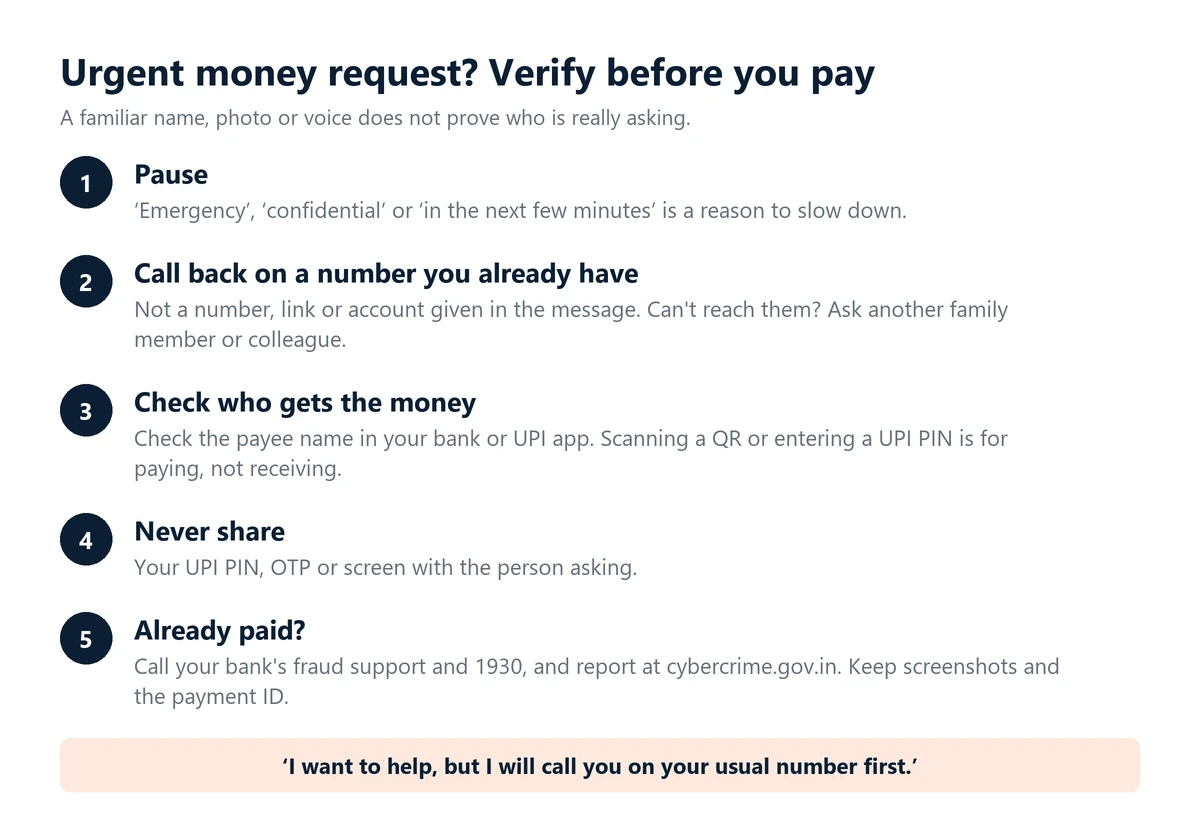
Do not reply with a payment simply because the message says it is an emergency, confidential or needed in the next few minutes. End the suspect conversation and call the person on a number you already have saved or have independently confirmed. If they cannot be reached, contact another family member, friend, colleague or the organisation through a known channel. Do not use a callback number, link or account detail supplied only in the suspicious message. If there really is an emergency, the details can be checked without rushing an unverified transfer.
Check the payment, not just the person
Ask who will receive the money, why the recipient or UPI ID is different, and whether the amount matches the stated need. Check the payee name shown in your bank or UPI app before authorising. A request to scan a QR code or enter a UPI PIN to receive money is a warning sign: NPCI says that action is for making a payment, not receiving one. Never share your UPI PIN, OTP or screen with the requester. For a business payment, use the normal approval and beneficiary-change process even when the message claims to be from a senior person.
If the person seems to be in danger
Do not ignore a plausible emergency, but separate help from an unverified payment. Try the person’s established number, contact someone near them, or contact the relevant emergency service when there is a credible immediate safety risk. Keep another trusted person involved so the caller cannot isolate you. A real emergency does not make an unknown beneficiary account trustworthy.
If you already sent money
Contact your bank or payment app’s official fraud support immediately and give the transaction reference. In India, call 1930 and report the incident at cybercrime.gov.in. Preserve the message, phone number, profile link, screenshots, payment ID and time; do not edit or forward sensitive material unnecessarily. Report the account or number to the platform. Rapid reporting may help authorities attempt to trace or hold funds, but recovery is not guaranteed.
A simple family and workplace rule
Agree in advance that nobody will be offended by a callback before a transfer. Keep trusted contact numbers current. For larger payments, ask a second person to check the request. Practise the sentence: ‘I want to help, but I will call you on your usual number first.’ That short pause protects both the person who might truly need help and the person being asked to pay.
What needs attention
- An account name, profile image or voice can be misleading.
- An unusual payment request deserves an independent callback.
- The callback route must not come from the suspect message.
- A verified identity does not remove the need to verify the beneficiary.
- Quick reporting can support an attempt to interrupt funds, but cannot promise recovery.
Controls that reduce risk
- Save independently verified numbers for family and close contacts.
- Agree on a callback rule for all urgent money requests.
- For workplaces, use two-person approval for unusual or high-value payments.
- Review beneficiary details inside the payment app before authorising.
- Keep the official bank-fraud contact and 1930 accessible.
Common unsafe practices
- Paying while still on the caller's pressured line.
- Using the callback number or payment link in the suspicious message.
- Treating a familiar voice as conclusive proof.
- Approving a QR or UPI collect request without checking who will be paid.
- Delaying a bank and 1930 report because of embarrassment.

Leave a comment