
Quick answers
Where should a vehicle stop at a red signal with a zebra crossing?
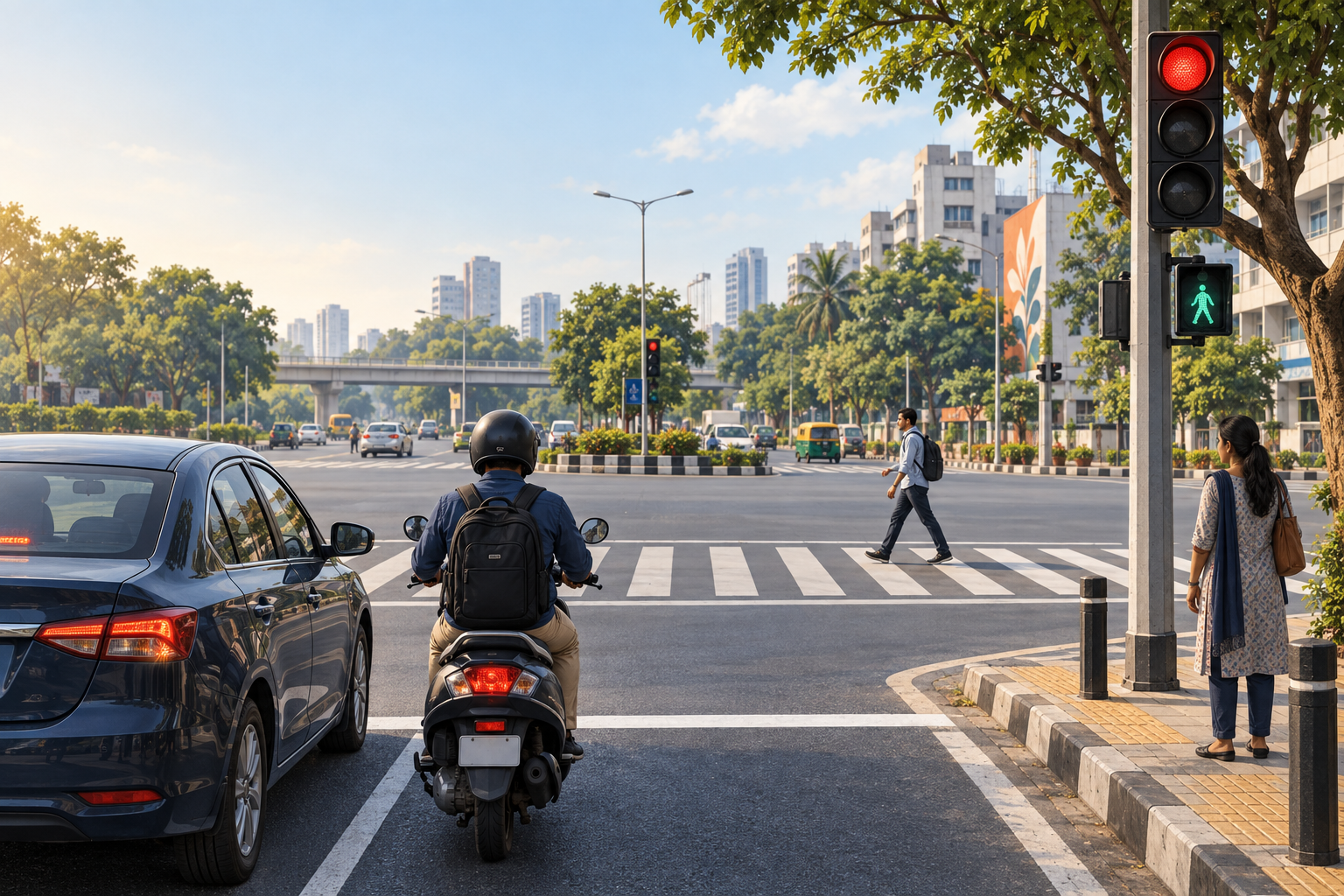
Stop before the marked stop line, not on or beyond the zebra crossing, so people on foot have a clear path. Delhi Traffic Police guidance tells drivers to stop before the stop line at red.
How should a pedestrian use a zebra crossing at a signal?
Wait at the kerb until the crossing phase and traffic allow you to move, use the marked crossing, and confirm that approaching and turning vehicles have actually stopped before you step out.
What does a flashing amber signal mean?
It is a caution signal. Slow down and give way to people and vehicles already in the crossing or junction; it does not give you the right of way.
A signal is for the person you cannot see
At a quiet junction, a red light can feel unnecessary when no police officer is present. But the signal gives crossing pedestrians, turning vehicles and traffic from another direction a predictable turn. The rule matters most when each road user cannot see the others clearly. This guide is about everyday decisions at Indian intersections, not about blaming one type of road user.
What the evidence can and cannot say
Many people see red-light jumping and stop-line violations locally. That observation is worth discussing, but it does not prove that 80% of Indians ignore traffic rules. The Ministry of Road Transport and Highways recorded 988 crashes, 304 deaths and 914 injuries under ‘jumping red light’ in million-plus cities during 2023. Those are reported crash categories in a defined set of cities; they do not measure every violation or the share of drivers who obey signals. The report also records other causes and limitations. We should not turn those figures into a nationwide compliance rate.
Approaching a signal: prepare to stop
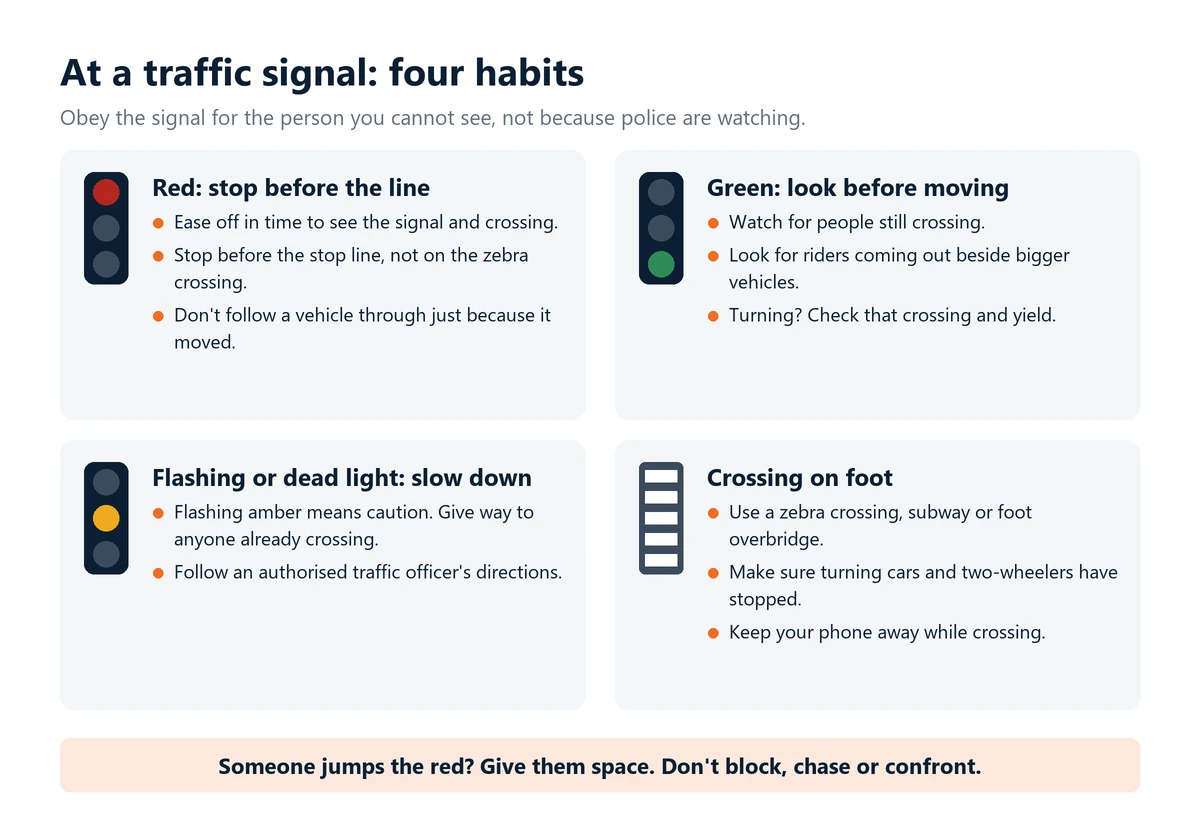
Ease off the accelerator in time to see the signal, stop line and crossing. At red, stop before the marked line rather than over the zebra crossing. Do not follow a vehicle through simply because it has moved. A changing light is not an invitation to accelerate. Keep enough space from the vehicle ahead to stop smoothly without entering the pedestrian area. Delhi Traffic Police’s road-safety guidance explicitly says to stop before the stop line at red.
On green, look before moving
Green means your movement is permitted when the path is clear; it does not mean the junction is free of people. Look for pedestrians still crossing, riders emerging beside larger vehicles and traffic left in the intersection. Start at a controlled speed. If you are turning, check the crossing in the direction of your turn and yield where required. Delhi Traffic Police advises drivers to negotiate intersections slowly and watch for pedestrians and animals even when a signal allows movement.
If the light is flashing, failed or overridden
Slow down and do not assume you have priority. A flashing amber is a caution signal: give way to people and vehicles already in the crossing or intersection. If an authorised traffic officer is directing traffic, follow that direction. Where signals are dark, unclear or damaged, treat the junction as a hazard, approach cautiously and yield as needed rather than copying the vehicle in front. The exact signal arrangement can vary, so observe local signs and markings.
Crossing on foot
Use a marked zebra crossing, pedestrian signal, subway or foot overbridge where one is available and usable. Wait at the kerb until the crossing phase and traffic conditions permit you to move. Make sure turning drivers and two-wheelers have actually stopped; do not rely only on a green pedestrian symbol. Walk without looking at a phone. Where no safe facility exists, choose a visible place, wait for a sufficient gap and cross without weaving between stopped vehicles. Children and people who need more time should be given room to cross without pressure.
When another road user breaks the rule
Do not try to block, chase or confront a red-light jumper. Give them space and keep yourself out of the path of an unexpected turn. For drivers, avoid retaliatory honking or moving into the crossing because someone behind is impatient. For pedestrians, wait for vehicles to stop even when you have the right of way. If a junction repeatedly has unsafe behaviour or a faulty signal, report the location to the local traffic authority through its official channel.
A useful habit for every trip
Choose the rule before the moment arrives: slow for junctions, stop before the line, leave the crossing clear and look again before moving. A police officer should not be the reason to obey a signal; the unseen person crossing should be.
What needs attention
- Predictability at junctions protects people who are not visible from every vehicle.
- A legal right of way does not remove the need to look for a red-light jumper.
- Stop-line encroachment can force pedestrians into moving traffic.
- Broken or flashing signals require extra caution rather than assumption.
- One local observation cannot establish a national non-compliance percentage.
Controls that reduce risk
- Teach new drivers and riders to identify the stop line before reaching a signal.
- Keep pedestrian crossings free of waiting vehicles.
- Check for turning-vehicle conflicts when designing or reviewing a junction.
- Report faulty signals and obstructed crossings through official local channels.
- Use visible, consistent enforcement and education without making safety dependent on police presence.
Common unsafe practices
- Accelerating to beat a changing signal.
- Stopping on or beyond the zebra crossing.
- Moving on green without checking for people still in the junction.
- Following another vehicle through red.
- Crossing on foot between stationary vehicles while looking at a phone.
- Confronting or chasing a rule breaker.
Leave a comment