
What happened here

 1 / 3
A 40-year-old worker from Motihari, Bihar, who had worked at a sattu factory in Tronica City, Loni, Ghaziabad, for about 15 months, died after sacks of chickpeas fell on him on the afternoon of Thursday 12 November 2026. Co-workers took him to GTB Hospital in Delhi, where doctors declared him dead. His brother alleges that the factory management was negligent about safety. The reports differ on the time and give no stack height or factory account.
Quick answers
What happened at Tronica City, Loni?
A 40-year-old worker died after sacks of chickpeas fell on him at a sattu factory in Tronica City, Loni, Ghaziabad, on the afternoon of Thursday 12 November 2026.
Who was he?
A worker from Motihari in East Champaran, Bihar, who had worked at the factory for about 15 months, according to Dainik Bhaskar.
What happened to him?
Co-workers took him to GTB Hospital in Delhi, where doctors declared him dead.
What does his brother say?
His brother told Amar Ujala that the sacks fell on him while he was working and accused the factory management of negligence about safety.
What do the police say?
The ACP for Loni told Amar Ujala that the police have been informed and that Delhi Police are doing the post-mortem at GTB Hospital. No case against the management is reported.
Did the factory respond?
We found no account from the factory in the reports we read.
How can stacked sacks be made safer?
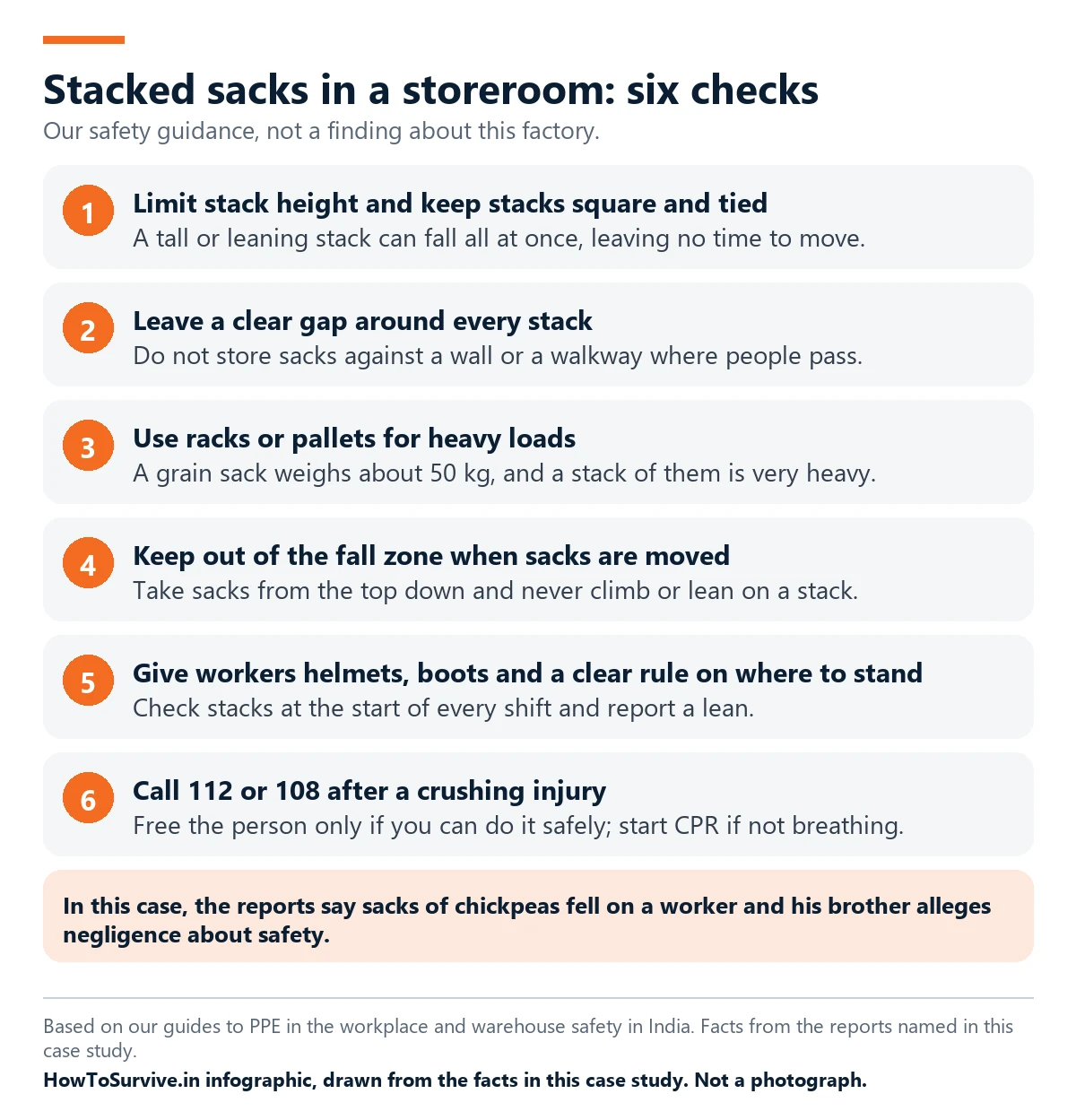
Limit stack height, keep stacks square and tied, leave a gap around them, use racks for heavy loads and check stacks at the start of every shift.
What should I do if sacks fall on someone?
Call for help and call 112 or 108, free the person only if you can do it safely, and start CPR if the person is not breathing.
What happened
The Ghaziabad factory sacks death happened on Thursday 12 November 2026 at a factory in the Tronica City industrial area of Loni, Ghaziabad, Uttar Pradesh. A 40-year-old worker from Motihari in East Champaran, Bihar, died after sacks of chickpeas fell on him. Co-workers took him to GTB Hospital in Delhi, where doctors declared him dead. Dainik Bhaskar and Amar Ujala report his death.
Amar Ujala says the factory, at Trans Delhi Signature City, makes sattu from chickpeas, and that his brother told it the sacks fell on him while he was working. The brother alleges that the factory management was careless about safety. The Assistant Commissioner of Police for Loni told Amar Ujala that the police had been told and that Delhi Police were doing the post-mortem at GTB Hospital, which is in Delhi.
This page names no one and does not name the factory. It sets out what is reported, where the reports differ and what stacked sacks teach about storeroom safety. The factory has not given its account in any report we read.
What the reports say
- When: Thursday 12 November 2026, in the afternoon (Dainik Bhaskar) or about 4 pm (his brother, in Amar Ujala)
- Where: A factory in the Tronica City industrial area, Loni, Ghaziabad, Uttar Pradesh (Dainik Bhaskar; Amar Ujala)
- The factory: A factory at Trans Delhi Signature City that makes sattu from chickpeas (Amar Ujala)
- Who died: A 40-year-old worker from Motihari, East Champaran district, Bihar, who had worked there for about 15 months (Dainik Bhaskar; Amar Ujala)
- What happened: Sacks of chickpeas fell on him while he was working and he was crushed under them (Dainik Bhaskar; Amar Ujala)
- Hospital: Co-workers took him to GTB Hospital in Delhi, where doctors declared him dead (Dainik Bhaskar; Amar Ujala)
- His family: He leaves a wife and six children, the youngest a baby of two months (Amar Ujala)
- The allegation: His brother accuses the factory management of negligence about safety (Amar Ujala)
- Police: The ACP for Loni says the police have been informed; Delhi Police are doing the post-mortem at GTB Hospital (Amar Ujala)
- Identities: Reports name the worker and his brother and the factory address; we name no one and do not name the factory
Where reports differ and what we do not know
- The time: Dainik Bhaskar says Thursday afternoon. His brother, quoted by both pages, says about 4 pm. We say the afternoon of Thursday 12 November, about 4 pm by his brother.
- What fell: Dainik Bhaskar says a heap of sacks fell on him during work. Amar Ujala says chickpea sacks fell on him while he worked. Neither says how high the stack was, whether it was a pile or a rack or whether he was moving the sacks. We do not guess.
- The place of death: Dainik Bhaskar and Amar Ujala say he was taken to GTB Hospital in Delhi, where doctors declared him dead; neither says whether he was alive on arrival.
- The police case: Amar Ujala says the police have been told and await a complaint to act on; neither page reports an FIR against the management. We say no case is reported.
- Not reported: None of the pages gives the factory’s account, the stack height, whether helmets or training were provided or whether an inspection by the labour department has begun.
What this teaches
Sacks of grain are heavy, about 50 kg each, and a stack of them can fall all at once if it is tall, leaning or not tied. Workers who move or take sacks from a stack are the ones most at risk, because a crushing weight leaves little time to move. Safe storage means limiting stack height, keeping stacks square and tied, leaving space around them and using racks or pallets for heavy loads.
We have covered similar workplace deaths, among them the Gurugram tank deaths at Bhondsi, the Tata Electronics wastewater tank deaths near Hosur, the Durg steel plant accident and, in the same area, the Loni main bazaar garment shop fire. Our guide to PPE in the Indian workplace sets out what employers must provide and train, and our guide to warehouse safety in India explains storage rules. For help after an injury, our guide to the 108 ambulance service in India and our guide to basic first aid, including CPR cover what to do next.
We do not know the stack height, how the sacks fell or whether the factory had safety measures in place. The police have not published a finding, and we will update this page if they or the labour department do.
- Sacks of chickpeas fall on a worker at a sattu factory in Tronica City, Loni (Dainik Bhaskar; Amar Ujala)
- Co-workers take him to GTB Hospital in Delhi, where doctors declare him dead (Dainik Bhaskar; Amar Ujala)
- Amar Ujala reports that Delhi Police are doing the post-mortem at GTB Hospital and that the Loni police have been informed (Amar Ujala)
- Dainik Bhaskar publishes a report at about 3.45 pm with the brother's account (Dainik Bhaskar)
- Amar Ujala publishes the family's account and the brother's allegation of negligence (Amar Ujala)
Why consequences escalated
- A 40-year-old worker died under falling sacks of chickpeas at a sattu factory in Tronica City, Loni, Ghaziabad, on 12 November 2026.
- Co-workers took him to GTB Hospital in Delhi, where doctors declared him dead.
- His brother alleges that the factory management was negligent about safety; no police case against the management is reported.
- The reports give no stack height, no account of how the sacks fell and no account from the factory.
- The reports differ slightly on the time; no finding is published.
Failures and risk multipliers
- No inquiry finding has been published. The reports leave these questions open:
- How tall and how stable the stack of sacks was.
- Whether the worker was moving the sacks or working beside the stack.
- Whether helmets, training and a safe stacking rule were in place.
- Whether the labour department has inspected the factory.
- These are open questions, not findings of fault.
Actions that reduce risk
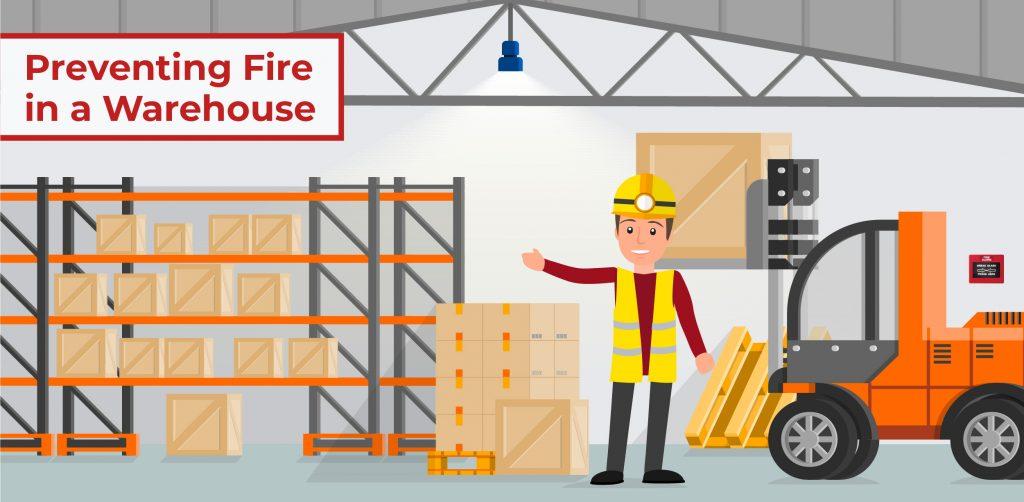
- Employers: limit the height of stacked sacks, keep stacks square and tied, leave a gap around them and use racks or pallets for heavy loads.
- Supervisors: keep workers out of the fall zone when sacks are being moved, and check stacks at the start of every shift.
- Workers: do not climb or lean on a stack, take sacks from the top down and tell a supervisor about a leaning stack.
- Call 112 or 108 straight away after a crushing injury; do not lift a person who is badly injured unless there is danger.
- Authorities: inspect factory storerooms in industrial areas and publish findings from workplace deaths.



Leave a comment