
Quick answers
How can factory workers protect themselves from industrial accidents?
Know two ways out of your shed and walk them regularly, keep solvents, oil and cartons away from boilers and electrical panels, report empty or blocked extinguishers and hydrants, and take part in every fire drill.
What should workers do about unsafe practices in a factory?
Tell your safety officer in writing. If nothing changes, report it to the state factory inspectorate, and ask for fire drills if your unit never holds them.
What kills the most factory workers in India?
In DGFASLI's 2022 cause table, machinery killed the most workers, followed by falls, fires, falling objects and electricity. Fire and explosions matter, but guarding, work at height and housekeeping matter just as much.
Why are many industrial estates high-risk for fires?
Many small and medium units handle solvents, gases and boilers side by side, often with poor chemical storage, unchecked hydrants, blocked exits and no emergency plan.
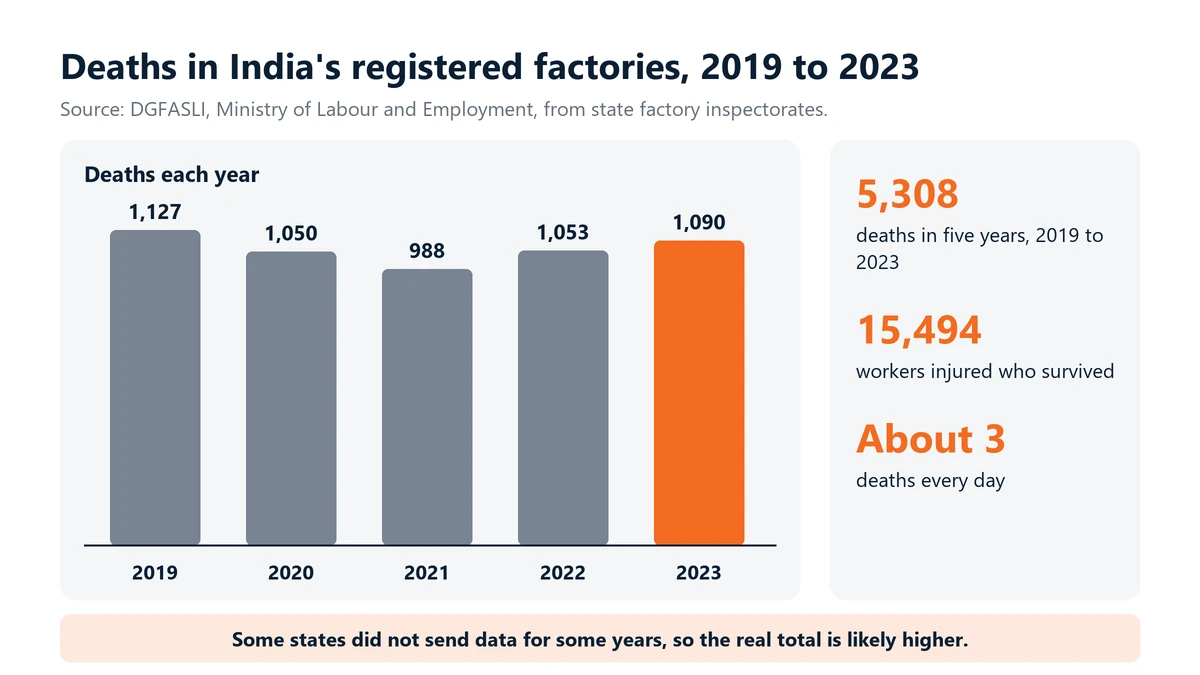
Between 2019 and 2023, 5,308 people died in accidents inside factories registered under the Factories Act, according to the government’s own records. That is roughly three deaths every day. Gujarat reported 1,124 of them, more than any other state.
These numbers come from the Directorate General Factory Advice Service and Labour Institutes (DGFASLI), in its Standard Reference Note 2024 (Table 8(b)). Some states did not send data for some years, so the real total is likely higher. In 2023 alone, the note records 1,090 deaths, and DGFASLI counted 44,309 factories carrying out hazardous processes in the states that reported.
Why industrial estates matter
Industrial estates such as Gujarat’s GIDC areas run a large part of the economy. They are also where thousands of small and medium units handle solvents, gases, boilers and heavy machinery, often side by side and close to homes. When a unit has poor fire protection, careless chemical storage or no emergency plan, the workers pay first, and nearby families can pay too.
Deaths in registered factories, 2019 to 2023
| Year | India: deaths | India: non-fatal injuries | Gujarat: deaths | Maharashtra: deaths | Tamil Nadu: deaths |
|---|---|---|---|---|---|
| 2019 | 1,127 | 3,927 | 216 | 145 | 122 |
| 2020 | 1,050 | 2,832 | 212 | 154 | 114 |
| 2021 | 988 | 2,803 | 235 | 180 | 147 |
| 2022 | 1,053 | 2,983 | 240 | 178 | 117 |
| 2023 | 1,090 | 2,949 | 221 | 190 | 184 |
Source: DGFASLI, Standard Reference Note 2024, Table 8(b), dated 16 June 2025. The figures come from state factory inspectorates. West Bengal did not provide data for these years, and Uttar Pradesh, Punjab, Himachal Pradesh and DD and DNH missed some years.
Gujarat, Maharashtra and Tamil Nadu together reported 2,655 of the 5,308 deaths, about half. All three have dense industrial clusters.
What about individual GIDC estates?
We could not find any published official audit of fire safety estate by estate in GIDC areas, so we do not show a zone-wise table. An earlier version of this page listed specific GIDC incidents, but none came with a source we could trace, so they have been taken out until each one can be checked.
The NCRB’s 2024 data does give some Gujarat figures: 14 deaths in factory fires and 14 deaths in industrial boiler or gas-cylinder explosions.
What kills factory workers
| Cause | Deaths (2022) |
|---|---|
| Machinery moved by mechanical power | 132 |
| Persons falling | 91 |
| Fires | 58 |
| Falling bodies | 41 |
| Electricity | 40 |
| Prime movers | 33 |
| Molten metal and other hot or corrosive substances | 29 |
| Explosions | 21 |
| Gassing | 17 |
| All other causes | 160 |
| Total | 622 |
Source: DGFASLI, Standard Reference Note 2024, Table 7.7, using Labour Bureau data from factories that sent returns. It covers 622 deaths in 2022, fewer than the 1,053 in the full count above, so read it as a pattern rather than a complete count.
Fire, explosions and gas are only part of the story. Machines, falls and things dropping from height kill more workers, which is why guarding, work at height and housekeeping matter as much as fire safety.
The wider cost
- 15,494 workers were injured, but survived, in registered factories between 2019 and 2023 (DGFASLI).
- 660 people died in factory or machine accidents across India in 2024, and 121 of them were in Gujarat, the highest of any state (NCRB).
- India had 3,377 fire stations against 8,559 required, the Home Ministry told the Rajya Sabha in June 2019 (as reported by Down To Earth). In an industrial fire, the nearest fire tender may be a long way off.
For workers and supervisors
- Know two ways out of your shed or floor, and walk them once a week.
- Keep solvents, oil and cartons away from boilers, ovens and electrical panels.
- Check gauges, hydrants and extinguishers on a fixed schedule, and report any that are empty, blocked or out of date.
- Take part in fire drills. If your unit never holds one, ask for it.
- Report unsafe practices to your safety officer or, if nothing changes, to the state factory inspectorate.
- Keep first-aid kits, extinguishers and fire blankets where people work, not locked in an office.
- Do not let anyone enter a tank, pit or sewer without gas testing and a permit.
What industry and government should do
- Get industrial estates audited regularly by independent, competent auditors, and publish the results.
- Link state fire services, factory inspectorates and disaster authorities so a large industrial fire gets a joined-up response.
- Set up worker safety committees in small and medium units, not just large plants.
- Teach industrial emergency response in ITI and polytechnic courses.
- Penalise poor maintenance under the Occupational Safety, Health and Working Conditions Code, 2020, which replaced the Factories Act from 21 November 2025, and follow up on every notice.
- Get all states to report factory accident data every year, so the full picture is known.
Before your next shift
Find the nearest extinguisher and the second exit from where you work. If either is blocked, locked or missing, tell your supervisor today and write it down. A checked valve, an open exit and a trained worker prevent more deaths than any report.
What needs attention
- Government records count 5,308 deaths in registered factories in five years, about three a day
- Gujarat, Maharashtra and Tamil Nadu, the states with the densest industry, account for about half
- Machinery, falls and falling objects kill more factory workers than fires, explosions and gas combined
- No official estate-by-estate fire safety audit of GIDC areas is published
- Missing state returns mean the national count is incomplete
- India had well under half the fire stations it needed in 2019, so outside help can be far away
Controls that reduce risk
- Guard every moving machine and lock it off before maintenance
- Separate flammable and incompatible materials from heat sources and panels
- Provide edge protection and harnesses for any work at height
- Inspect extinguishers, hydrants and alarms on a fixed schedule and fix defects quickly
- Hold fire and evacuation drills for every shift, contract workers included
- Use permits and gas testing for confined spaces and hot work
- Send complete accident returns to the factory inspectorate every year
Common unsafe practices
- Storing solvents, oil or cartons next to boilers, ovens and electrical panels
- Running machines with guards removed to save time
- Working at height without edge protection or a harness
- Letting extinguishers and hydrants go unchecked
- Skipping fire drills because production cannot stop
- Sending workers into tanks, pits or sewers without gas testing and a permit
- Not reporting accident data, so the problem stays hidden


Leave a comment