
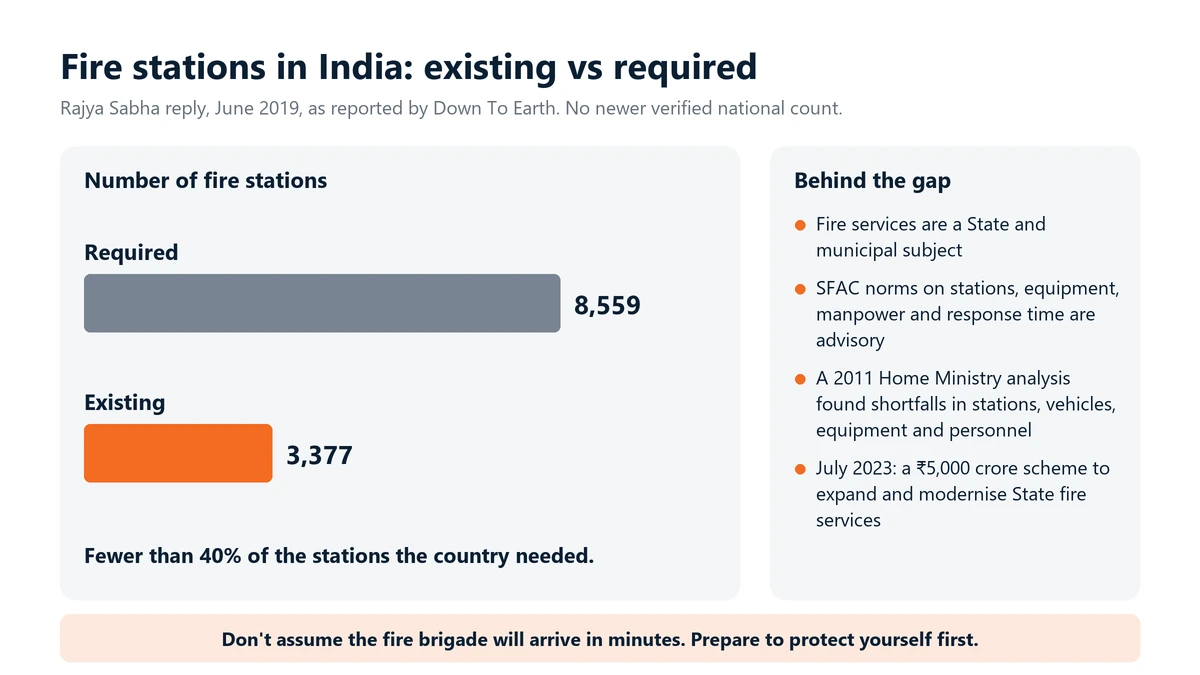
India’s fire-station gap is real, but the official figures are older than most headlines suggest. In June 2019, the Minister of State for Home told the Rajya Sabha that India had 3,377 fire stations against 8,559 required (as reported by Down To Earth). In other words, the country had fewer than 40% of the stations it needed.
Fire services are a State and municipal subject. The Union Government’s Standing Fire Advisory Council (SFAC) recommends norms for fire stations, equipment, manpower and response time, but these norms are advisory. Each State decides how far to adopt them.
Why this matters
The NCRB’s annual report Accidental Deaths & Suicides in India counts thousands of fire-accident deaths every year: 5,888 in 2024. When people call for help, the reality in many areas can be:
- no fire station close by;
- not enough fire tenders or water bowsers;
- not enough crew to send.
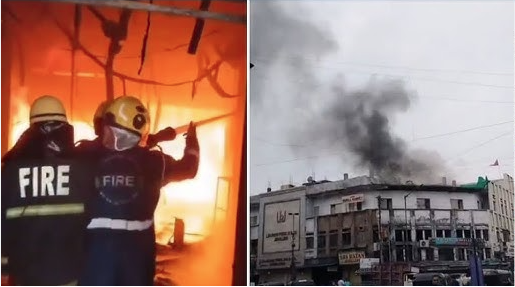
Fires such as the Takshashila coaching centre in Surat (2019), the Anaj Mandi building in Delhi (2019) and the Rajkot game zone (2024) showed how quickly a fire can outrun both escape and outside help. Without enough fire stations, every extra minute on the road is a minute the fire keeps growing.
Why there is no global ratio table here
We have not used any international table of fire stations per head, because no verified, like-for-like comparison exists. Countries count stations, volunteer and part-time crews and coverage areas differently. The often-quoted “global standard” of one fire station per 50,000 people could not be traced to any official source. In India, the SFAC’s advisory norms are built around response time rather than a single population ratio.
Why the gap exists
- Cities grew faster than fire cover. New suburbs and towns came up without fire stations.
- Budgets went elsewhere. Fire services have often been low on the list for spending.
- No land set aside. City plans frequently do not reserve plots for fire stations.
- Too few people. A Fire and Risk Hazard Analysis commissioned by the Home Ministry in 2011 reported shortfalls in fire personnel as well as fire stations and equipment.
Key facts
- Fire stations: 3,377 existing against 8,559 required (Rajya Sabha reply, June 2019, as reported by Down To Earth).
- A 2011 Fire and Risk Hazard Analysis commissioned by the Home Ministry found shortfalls in fire stations, fire-fighting vehicles, specialised equipment and fire personnel across the country (Home Ministry reply to the Rajya Sabha, 14 March 2018).
- SFAC norms for fire stations, equipment, manpower and response time are advisory. Fire services are a municipal function under Article 243W and the Twelfth Schedule of the Constitution.
- In July 2023 the Centre launched a ₹5,000 crore Scheme for Expansion and Modernisation of Fire Services in the States (Home Ministry, Lok Sabha answer, February 2026).
- No current, verified national count of fire stations or city-wise ratio has been published since the 2019 figures.
What you can do
- Don’t assume the fire brigade will arrive in minutes. Prepare to protect yourself first: a fire blanket such as a Life Safety Blanket and an extinguisher at home, a smoke alarm, and a practised family drill.
- Report slow responses to your municipal corporation and local representative, and ask what is being done.
- Push your RWA or society to keep hose reels, extinguishers and fire pumps working and to train residents.
- Support volunteer firefighter groups in your city or village.
- Keep access clear so a fire engine can reach your building without delay.
What needs to change
- Close the gap towards the 8,559-station requirement, starting with under-served urban and industrial areas.
- Reserve land for fire stations in every city master plan and Smart City project.
- Recruit and train fire personnel to the SFAC norms each State adopts.
- Back trained volunteer fire programmes for first response.
- Modernise 101 call handling with GPS location and maps of water sources.
- Publish updated, State-wise figures on fire stations and staff so citizens can see the progress.
Next time you pass a fire station, ask yourself how many lives that one building protects, and how many more your city needs. Then ask your councillor the same question. Without enough fire stations, fire safety stays on paper.
What needs attention
- India had fewer than 40% of the fire stations it needed, according to official 2019 figures
- Fire services are run by States and municipalities, and central norms are only advisory
- A 2011 national analysis found shortfalls in stations, vehicles, equipment and staff
- Fast-growing cities and suburbs often have no land set aside for fire stations
- No verified international ratio exists for comparison, and the popular '1 per 50,000' figure is untraceable
- No updated national count has been published, so progress since 2019 cannot be measured
Controls that reduce risk
- Ask your State and city for current fire-station and staffing figures
- Press for land for fire stations in city master plans
- Keep society hose reels, extinguishers and pumps working
- Train residents and volunteers as first responders
- Keep fire-engine access clear at all times
- Report delayed responses to the municipal body
Common unsafe practices
- Assuming a fire engine will always arrive within minutes
- Planning new suburbs without reserving land for fire stations
- Quoting untraceable global ratios
- Letting society fire equipment run down because 'the fire brigade will come'
- Blocking roads and gates so fire engines cannot get in
- Not reporting slow responses

Leave a comment