
🌲 Forest Fire Data (Uttarakhand, Himachal) – 5-Year Trend (2019–2025)
What needs attention
- The article topic must be linked to the actual occupancy and hazard
- Prevention and early warning provide more safety margin than last-second intervention
- Equipment is effective only when correctly selected, accessible and maintained
- People need short practised actions and a clear decision to stop and escape
- Children, visitors and people needing assistance require explicit planning
- Records, drills and inspections matter only when defects are corrected
Controls that reduce risk
- Complete a task- and site-specific hazard assessment
- Verify applicable Indian, state and local requirements
- Use competent inspection for installed systems and specialist hazards
- Keep alarms, exits, signs and emergency access usable
- Train intended users and practise evacuation
- Record defects with an owner and completion date
- Review the plan after changes, incidents or near misses
Understand and apply the guidance
🔴 Truth Drop
Between 2019 and 2025, India recorded over 43,000 forest fires — with Uttarakhand and Himachal Pradesh accounting for nearly one-third.
(Source: FSI – Forest Survey of India, NDMA Reports 2025)
“Every mountain fire burns not just trees — it burns clouds, rivers, and future rain.”
These fires, often triggered by heat, dryness, or human negligence, have turned Himalayan slopes — once green lungs — into smoke corridors visible from space.
📖 Why This Matters
The Himalayas are home to fragile ecosystems that store 30% of India’s freshwater and support over 200 million lives downstream.
When forests burn here, it’s not just biodiversity loss — it’s a climate and livelihood crisis.
Fires increase landslides, reduce rainfall, and destroy carbon sinks that protect us from climate change.
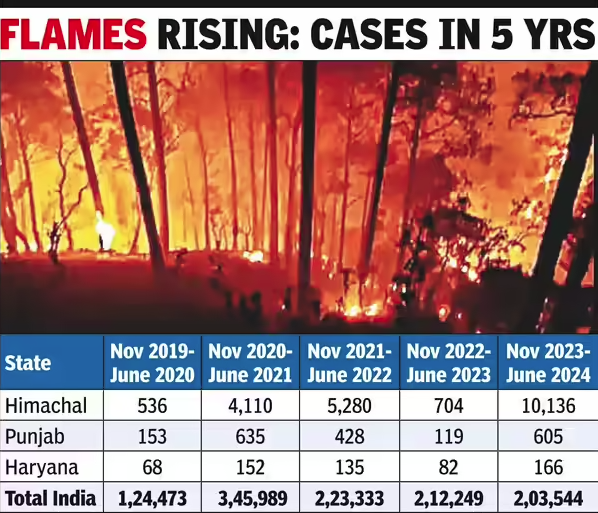
📊 Uttarakhand & Himachal Pradesh Forest Fire Data (2019–2025)
| Year | Uttarakhand | Himachal Pradesh | Total Area Burnt (ha) | Peak Month | Key Triggers |
|---|---|---|---|---|---|
| 2019 | 1,258 fires | 740 | 9,200 | May | Human negligence, debris burning |
| 2020 | 1,040 | 625 | 8,500 | April | Drought & leaf litter |
| 2021 | 1,687 | 1,010 | 11,200 | March | Rising temperature (+2°C) |
| 2022 | 1,432 | 890 | 10,600 | May | Lightning + forest dryness |
| 2023 | 2,102 | 1,180 | 13,400 | April | Tourist litter, burning pine needles |
| 2024 | 1,855 | 1,095 | 12,900 | April | Slash burning, illegal clearing |
| 2025 (till Aug) | 990 | 610 | 7,800 | March–May | Early heatwave conditions |
(Sources: FSI State of Forest Report 2025, NDMA Satellite Fire Monitoring Portal)
📈 5-Year Trend Highlights:
- Fire frequency up 48% since 2019
- Average fire duration: 6–18 hours
- Average temperature anomaly: +1.8°C
- Human-linked causes: 75%
🔥 Environmental Impact Snapshot
1️⃣ Loss of Forest Cover
- ~63,000 hectares (630 sq km) lost in 6 years — roughly equal to the size of Mumbai city.
- Majority affected: Pine forests, mixed temperate zones, and oak regions.
2️⃣ Air Pollution
- Forest fires in Himachal & Uttarakhand contribute PM2.5 spikes up to 400–600 µg/m³.
- Smoke often reaches Delhi-NCR and plains within 48 hours.
- Each major fire emits 5,000–10,000 tons of CO₂.
3️⃣ Soil & Water Degradation
- Topsoil fertility loss up to 40% in burnt areas.
- Runoff leads to siltation of rivers (Ganga, Yamuna tributaries).
- Increased landslide risk post-monsoon by 30–40%.
4️⃣ Wildlife Displacement
- Over 1,200 incidents of wild animal deaths or relocations (2019–2024).
- Forest fires disrupt bird migration and breeding cycles in Himalayan belts.
🧠 Case Study: Uttarakhand Fire Season 2023
- Duration: March–June
- Fires recorded: 2,100+ incidents
- Loss: 13,000 hectares of vegetation
- Impact radius: 9 districts affected (Nainital, Almora, Pauri Garhwal worst hit)
- Air quality: AQI crossed 400 in hill towns for the first time
- Cause: Accumulated pine needles (highly flammable) and human activity
- Lesson: Prevention is cheaper than suppression.
🧭 Preventive Strategies
✅ Create Fire Lines — 10–15 metre cleared belts to break spread.
✅ Collect & compost pine needles — major natural fuel source.
✅ Establish village-level forest watch teams (trained volunteers).
✅ Promote controlled burns in winter to remove debris safely.
✅ Install early warning systems using satellite data + local alerts.
✅ Educate tourists — “No litter, no light, no fire” campaigns.
📢 Systemic Lessons
India must:
- Declare forest fire management a national climate priority.
- Increase funding for forest fire brigades & drones in hilly states.
- Implement community fire insurance for local forest workers.
- Integrate forest fire early warning alerts with NDMA disaster dashboard.
- Encourage research on biofuel extraction from pine needles.
📣 Call to Action
🌱 Forests don’t need sympathy — they need responsibility.
👉 Report fires immediately via Forest Helpline 1926 or NDMA app.
Protect your mountain — protect your future.
📎 References
- Forest Survey of India “State of Forest Report,” 2025
- NDMA “Forest Fire Management Guidelines,” 2024
- CPCB “Air Quality Data During Forest Fire Events,” 2023
- Indian Institute of Remote Sensing (IIRS) “Himalayan Fire Satellite Study,” 2024
🔚 Closing Line
When the Himalayas burn, the nation breathes smoke.
This is why we built HowToSurvive.in — to protect the forests that protect us all.
Common unsafe practices
- Relying on equipment without a hazard assessment
- Blocking or compromising escape routes
- Delaying the alarm or emergency call
- Attempting a response beyond training or safe conditions
- Re-entering before authorised clearance
- Treating a checklist as a substitute for competent inspection