
Quick answers
Why is smoke from an industrial fire dangerous for nearby residents?
Factories often hold plastics, solvents, rubber, chemicals and paints, which release toxic and cancer-causing fumes when burnt. The smoke can travel across a city and enter homes, schools and lungs.
How does pollution from a factory fire reach homes after the flames are out?
Soot can settle on crops, markets and playgrounds, smoke can enter homes through ACs and ventilation, and rain can carry the pollution into soil and rivers, so the effects can linger well after the fire.
What can residents do during the days after a big industrial fire?
Report unmonitored smoke, ask authorities for air-quality data and wear protective masks during post-fire days. After a major fire, monitor the air rather than only counting the losses.
What happened to people near past industrial fires?
In the June 2022 Deepak Nitrite fire at Nandesari, Vadodara, seven workers were hospitalised after inhaling smoke and about 700 nearby residents were moved to safety as a precaution. Follow official evacuation advice and seek medical help for breathing trouble.
In 2024, NCRB recorded 149 fire accidents in factories, out of 5,971 fire accidents across India. Each big one sends smoke and ash over the homes around it. After the blast and fire at a chemical unit in MIDC Dombivli in May 2024, ash and a chemical smell covered an area of about 4 km.
If you live near an industrial estate, this post explains what is in that smoke, how it reaches you, and what to do on the day and in the days after.
Why factory smoke is different
Smoke from a wood fire is bad enough. Factories and godowns hold plastics, solvents, rubber, paints and chemicals, and when these burn they give off gases that can harm the lungs and, with long exposure, raise the risk of cancer.
Smoke does not stop at the factory wall. Wind carries it into colonies, schools and homes, and the ash settles on roofs, water tanks and vegetables.
Recent Indian incidents and what happened to people nearby
| Date | Place | What happened | Effect on people nearby |
|---|---|---|---|
| 7 May 2020 | LG Polymers, Visakhapatnam (Andhra Pradesh) | Styrene vapour leak from a storage tank (not a fire) | 12 dead; hundreds fell ill |
| 13 May 2022 | Commercial building near Mundka Metro, Delhi | Fire began in the office of a CCTV camera and router firm | 27 dead |
| 2 June 2022 | Deepak Nitrite, Nandesari, Vadodara (Gujarat) | Chemical plant fire | 7 workers hospitalised after inhaling smoke; about 700 residents moved |
| 23 May 2024 | Amudan Chemicals, MIDC Dombivli (Maharashtra) | Blast and fire at a chemical unit | 11 dead, 64 injured (as of 24 May); ash and chemical smell over about 4 km |
Sources: The News Minute, 7 July 2020; BOOM, 14 May 2022; The Tribune (PTI), 2 June 2022; IANS, 24 May 2024. We found no published CPCB or State Pollution Control Board air-monitoring data for these incidents, so no AQI figures are shown.
What is in the smoke
| Substance | Comes from | Effect on health |
|---|---|---|
| PM2.5 and PM10 | Soot, dust and burnt material | Irritates the lungs; worsens asthma and heart and lung disease |
| Carbon monoxide (CO) | Incomplete burning | Stops the blood carrying oxygen; deadly in closed spaces |
| Sulphur dioxide (SO₂) | Rubber and fuel oils | Irritates eyes, nose and throat |
| Volatile organic compounds (VOCs) | Solvents and paints | Headaches and dizziness; some raise cancer risk with long exposure |
| Dioxins and furans | Burning PVC and other plastics | Long-lasting toxins that build up in the body |
| Hydrogen cyanide | Burning foam, plastics and some chemicals | Can kill at high exposure, mostly inside or close to the fire |
Some of these gases thin out within hours. Others, like dioxins, settle with the ash and stay in soil and dust for much longer.
How the smoke reaches you after the fire
- Soot and ash settle on crops, vegetable markets, playgrounds and open water tanks.
- Indoors: smoke gets into homes through open windows, air conditioners and ventilation.
- Smog: gases from the fire can react in sunlight and add to ground-level ozone.
- Rain washes the ash and soot into soil, drains and rivers, so air pollution becomes water and soil pollution.
Mundka, Delhi, 2022: when one exit decided everything
- Building: a four-storey commercial building near Mundka Metro. The fire started in the first-floor office of a firm making CCTV cameras and routers.
- Loss: 27 dead and 12 injured on 13 May 2022.
- Escape: the building had only one exit, no fire safety clearance and no sanctioned building plan.
- Air data: we found no published air-quality monitoring for this fire.
The people who died at Mundka were trapped inside the building. The same violations that trapped them, a single exit and no clearance, are found in many small industrial and commercial buildings across Indian cities.
Health effects that last
- Breathing problems: smoke sends people to hospital. Seven workers were admitted after inhaling smoke in the 2022 Nandesari fire.
- Crops and food: soot and ash can settle on fields and vegetables near the fire.
- Soil: settled ash can leave heavy metals and other residues behind.
- Heat: black carbon (soot) absorbs sunlight and adds to warming.
What industries and authorities should do
- Check air quality around the site after every large industrial fire, with the fire service and the State Pollution Control Board working together.
- Install continuous air monitors around large industrial estates.
- Warn residents quickly by SMS and local announcements when smoke is heading their way, with clear advice on whether to stay in or leave.
- Make factory owners pay for clean-up and follow-up monitoring.
- Publish the monitoring data so residents can see it.
What you can do
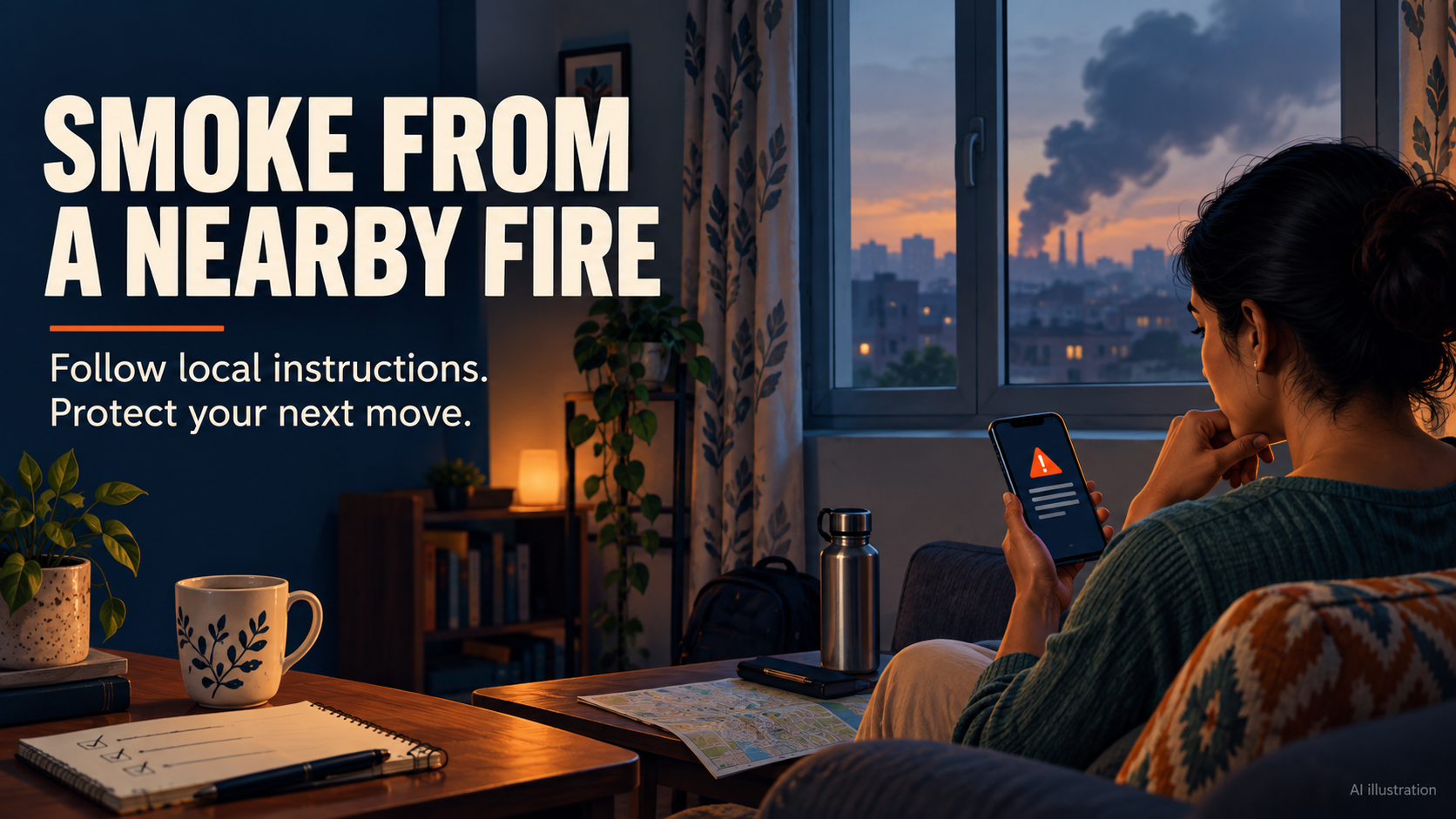
- If smoke from a fire is coming towards your home, go indoors, shut doors and windows, and switch off ACs and fans that pull in outside air.
- If the district administration or fire service tells you to leave, leave.
- Keep children, older people, pregnant women and anyone with asthma or heart disease away from the smoke.
- If you must go out, a well-fitted N95 mask cuts down the fine particles you breathe. It does not stop gases.
- Get medical help for breathlessness, chest pain, dizziness or confusion. Call 112 or 108.
- Wash vegetables and cover water tanks for a few days after ash falls.
- Ask your municipal body or State Pollution Control Board for air-quality data after a big fire. If no one is measuring it, ask why.
References
- Dataful (NCRB data), “Nearly 6,000 fire accident deaths in 2024 despite sharp decline in accidents”, 5 June 2026
- The News Minute, “Vizag gas leak: Govt appointed panel finds LG Polymers guilty of negligence”, 7 July 2020
- BOOM, “27 dead and 12 injured in Delhi Mundka fire, two people arrested”, 14 May 2022
- National Human Rights Commission, “NHRC expresses serious concern over devastating fire incident in Mundka”, 15 May 2022
- The Tribune (PTI), “Gujarat: Massive fire breaks out in chemical plant in Vadodara; 7 workers hospitalised, 700 people in vicinity shifted to safety”, 2 June 2022
- IANS, “Thane blast-cum-blaze toll is 11, chemical stink and ash cover a 4 km area”, 24 May 2024
What needs attention
- Smoke and ash from a big industrial fire can spread over several kilometres, as at Dombivli in 2024
- Burning plastics, solvents and chemicals give off gases that irritate the lungs and some that cause cancer with long exposure
- People living nearby are moved or treated for smoke, as at Nandesari in 2022
- No published air-quality monitoring was found for the major fires listed here
- Rain and settling ash carry the pollution into soil, drains and water tanks
Controls that reduce risk
- Monitor air quality around the site after every large industrial fire
- Have the fire service and State Pollution Control Board work together on monitoring and clean-up
- Install continuous air monitors around large industrial estates
- Warn residents quickly by SMS and announcements when smoke is heading their way
- Publish the monitoring data and recover clean-up costs from the owner
Common unsafe practices
- Standing outside to watch or film the smoke
- Keeping windows open or running ACs that draw in outside air while smoke drifts in
- Relying on a cloth or surgical mask to stop smoke
- Ignoring breathlessness, chest pain or dizziness after smoke exposure
- Leaving water tanks open and eating unwashed vegetables after ash falls
- Assuming the air is clean once the flames are out

Leave a comment